


The Solo Person is Maximum Efficiency, But Efficiency Isn't the Moat
The solo-person company is the most efficient model because it doesn't pay the three coordination losses that every multi-person organization bears: context that can't be transmitted between two heads, misaligned objectives, and vision diluted through each compromise. AI replaces cognitive labor, so one person now handles the volume of work that previously needed a whole team. But this efficiency is not a lasting advantage — everyone has it, so it becomes the floor. Two things remain scarce and will increase in value: judgment inside and trust outside. This piece explains those three losses, why AI erases them, two limits the solo model can't overcome, the concept of complementary goods that explains where value is flowing, and real numbers from opcaios.org itself.
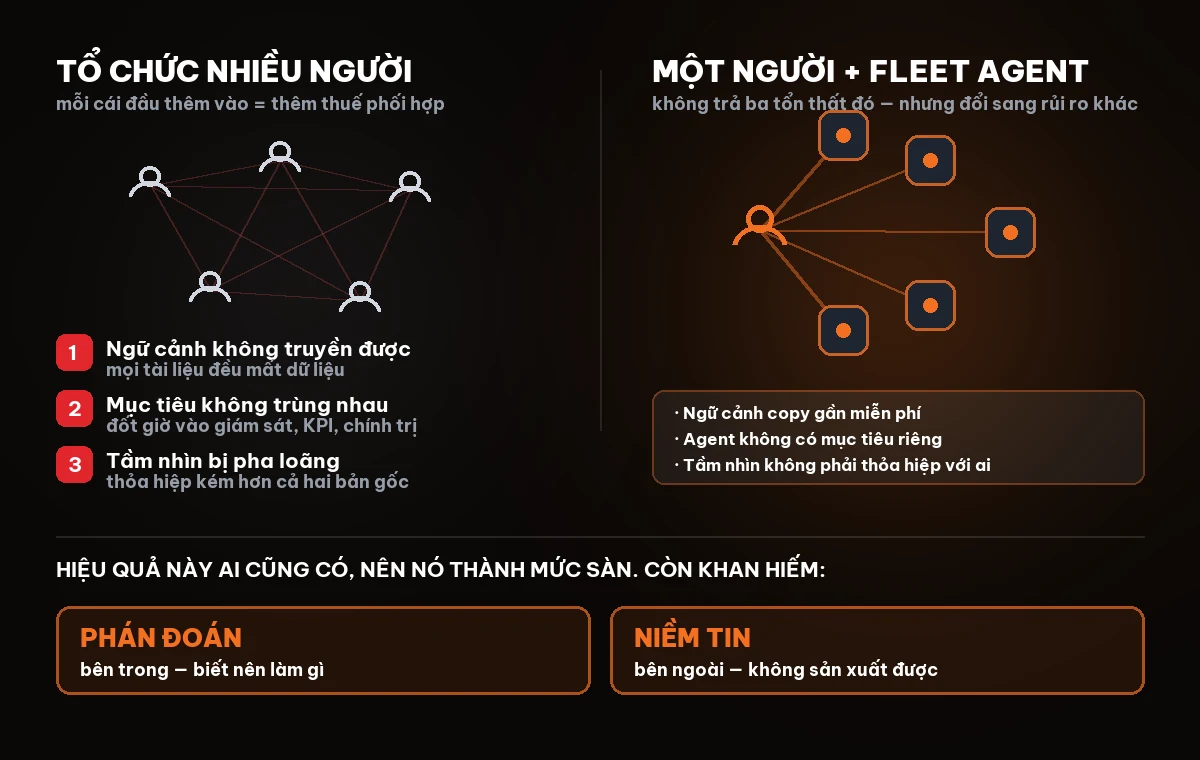
Three losses of the multi-person organization, and two scarce things left. Diagram: OPCAIOS.
All value comes down to one biological limit
You have a body, a brain, and roughly 16 waking hours each day. Each hour spent on this is an hour not spent on that. That is the most fundamental scarcity, and all business value traces back to it.
To overcome that limit, you need leverage. For the past few centuries, leverage has meant using other people's time, in two exchange forms:
Trade money for labor. Work that repeats enough, hire someone full-time to do it — cheaper than hiring piecemeal each time.
Trade equity for labor. A knows code, B knows marketing. Neither has time to learn both, so two people split 50-50.
Naval Ravikant added a third form in Product and Media are New Leverage (04/17/2019): products and media — things with zero cost to replicate. The point he stresses is permissionlessness: with labor leverage, someone has to agree to follow you; with capital leverage, someone has to agree to give money; but code and content require no one's permission. AI is the newest form of permissionless leverage, and it hits directly at the second exchange form.
Three losses when you add another head
Back to A and B. Say A wants the product to go this direction, B wants that direction. Both have solid visions; each one taken to completion could work. But they must compromise. And the compromise — the thing between two good visions — usually is worse than either.
That is one of three inherent losses in working with another mind.
Context can't be transmitted. One head can't upload its contents into another. Every meeting, every document is lossy compression. Bringing someone new into the work takes weeks, and what they receive still isn't as good as what's in your head.
Objectives don't align. Each employee, each shareholder has their own goals. So the company must burn resources on monitoring, reward mechanisms, KPIs and office politics. The entire management layer and organizational chart exist to fight this loss, not to create value.
Vision doesn't survive. Each head an idea passes through interprets it slightly differently. A board takes the average of the visions. The result drifts from the original intent, and no one can point to where it started to slip.
Ronald Coase laid the ground for this back in 1937. In The Nature of the Firm, he asks a seemingly backward question: if prices already coordinate production, why do firms exist at all? His answer is that firms exist to replace the price mechanism — "the distinguishing mark of the firm is the supersession of the price mechanism" — because using the market for each small transaction also costs something. But directing from inside also costs something. The firm's boundary sits exactly where these two costs balance, and he won the 1991 Nobel in Economics partly for this transaction cost idea.
What's worth noting: Coase established that the firm's boundary is decided by coordination costs. If a technology sharply lowers coordination costs inside, that boundary has to move. That's what's happening now.
AI is Synthetic Cognitive Labor
In the past, "one head" meant limited capacity. That's why a one-person company was always a small company.
AI changes the equation. Fundamentally, it's synthetic cognitive labor: it gives you the same leverage as hiring someone, but without three major costs.
| Cost | With humans | With AI agent |
|---|---|---|
| Transmitting context | Weeks of onboarding, still lose data | Copy instruction file, nearly free |
| Separate goals | Need KPIs, supervision, management layers | Agent has no separate goals |
| Diluted vision | Compromise on every decision | No need to compromise with anyone |
| Marginal cost per "staff member" | Salary + insurance + workspace | Token costs, nearly linear |
This table describes the mechanism, not measurement. And it leaves out one column: agents produce a new class of errors that humans don't have — hallucinations, errors that compound across steps, actions that can't be undone. You swap three coordinated costs for a different set of risks, not erase risk entirely.
Macro data shows the direction of shift. According to the U.S. Census Bureau's Nonemployer Statistics, the number of businesses with no paid employees rose from 24 million (2015) to 30 million (2023) — a 25% increase, while total workforce in the same period grew only 9%. From 2023 to 2024 alone it grew another 5.1% (2024 dataset released 09/29/2025).
Read this number carefully: it counts Uber drivers and online sellers, not purely "one-person companies run by AI." It doesn't prove AI caused the trend. But it shows that a one-person economy is no longer an exception.
Two things this model doesn't mean
This is where many people overinterpret.
First, not everyone can build everything. The floor has risen: making something now costs much less. But the ceiling hasn't moved. Making the right thing to make was never an execution problem — it was a choice problem. AI drives execution costs near zero and exposes that the hard part was always elsewhere.
Second, maximum efficiency doesn't mean optimal practice. One person can now run a large operation. But that doesn't follow that it's the best way. Other heads still have great value — only the reason to add people has changed: not to have more hands, but to have different judgment and trust from a different network.
And the third thing, heavier than both: what one person can do, everyone can do. The efficiency of a one-person company will stop being an advantage. It becomes the floor. Two years from now, saying "I work alone and match a whole team" won't be a selling point. It's a job description.
If you want a deeper breakdown of where this model gets oversold, see the illusion of the one-person business getting rich automatically.
Complementary goods: where value flows
If production can no longer distinguish one person from another, value must flow somewhere else. There's an economics concept that explains this neatly: complementary goods.
Joel Spolsky described the mechanism in Strategy Letter V (12/06/2002), often shortened to "turn your complementary goods into commodity goods." Complementary goods are things consumed together. When one gets cheaper, demand and value of the other rise. That's why tech companies deliberately cheapen one layer of the chain to profit on their own layer.
History repeats pretty consistently:
| What got cheap | What complemented it rose |
|---|---|
| Computers | Data — the thing to compute |
| Code | Verification — the thing consumed with code |
| Content distribution | Attention — the thing consumed with content |
| Cognition (AI) | Judgment and trust |
Cognition has two complementary things, matching two business actions.
Action that creates value. Every act of making something comes with an act of choosing that comes with it. The more you make, the better you need to choose. So judgment, taste, and vision go up in value.
Action that distributes. AI makes content production and marketing cheap very fast. The thing consumed with them is attention and trust.
Attention and trust aren't the same. Attention is a fixed resource but can be bought — run ads and you buy attention. Trust is also fixed, but can't be produced: there's no way to spend money to have it in a month. The more AI floods distribution channels, the heavier trust becomes.
What Judgment Really Means
The word "judgment" gets used vaguely. A workable definition: judgment is the ability to know which action to take to reach a goal. You have a goal, you have a forest of things you could do, judgment is knowing which one actually gets you there.
Two consequences few people mention.
One: judgment is tightly bound to real competence in your field. This is why the statement "AI is done now, why learn a trade" is backwards. Professional ability doesn't lose value — it gains value, because with AI you can apply much larger leverage to whatever judgment you actually have. Poor judgment multiplied by large leverage just fails faster and costs more.
Two: a chain of delegation must end with a person. AI can execute, but it cannot absorb loss. It has no stake in the outcome, faces no accountability, has no legal standing to bear responsibility. So a one-person company has exactly one scarce input: the ability to choose of the owner.
Everything else is trust in various forms: audience, position in a network, contact list, community, and the times you delivered on your word.
OPCAIOS Experience
Here I give my real numbers, including the ugly parts.
As of 17/10/2026, opcaios.org has: scheduling page, document landing page, email sequence, webinar with reminders, lead scoring, CRM pipeline, Zalo/Messenger dock, affiliate page, Dream 100 with 134 entities, SEO/GEO toolkit, invoicing system and VietQR. Nearly all built by agent.
Sales results: 0 đồng. The learn_payment_events table has not a single row — the payment webhook has never received a real transaction. Real leads: 0. Five submissions in the system, four are sample data I created myself, one is a test booking by me.
And here is the expensive part:
| Metric | Real number | Source |
|---|---|---|
| Pageviews from 10/10 | 893 | analytics_events |
| Unique visitors | 28 | same table |
| Of which on 14/10 | 750 pageviews from 7 visitors (internal testing) | same table |
| Google Search, 90 days | 0 clicks, 289 impressions, average position 22.7 | Search Console |
Three hundred hours building a factory with no input materials. A note I wrote myself in the strategy document: "Every additional hour spent on a feature right now has near-zero return compared to one hour talking to a customer."
That is precisely the point of this post, proven with my own money. I have near-unlimited execution leverage and used it to produce the wrong things. Judgment is the bottleneck, not capacity.
Limitation of this section: this is one case, not research. I have not yet run long enough on the other side — the side of pouring hours into selling and trust — to give you countervailing numbers. See also 10 lessons from letting an AI agent build and run an entire website and 6 boundaries against burnout when operating alone.
How to Check Yourself in 30 Minutes
Open last week's calendar, split your work hours into three columns:
Production — write, build, code, make content, configure tools. This part is losing value fastest.
Judgment — read to understand your field deeper, look at real numbers, decide what to do and what to drop.
Trust — talk to real people. Customers, peers, audience. Every conversation, every piece with real readers, every time you keep your word.
Then compare:
| Production column ratio | Read how |
|---|---|
| Over 70% | You are pouring hours into something that will be cheaper next year |
| 40–70% | Normal if you are shipping to customers paying you |
| Under 40% but revenue is 0 | You are meeting and reading instead of selling |
This threshold is my convention, not an industry standard. The value is in forcing yourself to count, not in the number itself.
One thing for next week: pick one task in the production column you are doing yourself, push it to the agent, and take that exact number of hours and put it in the trust column — call someone who can pay. If you want to look at these three columns with someone outside, book 30 minutes; if you want to try the tools first then check out the utilities.
Frequently Asked Questions
Is a one-person company really more efficient than a company with employees?
More efficient on coordination costs, yes. But efficient is not the same as optimal. Multi-person companies still win when you need many independent judgments, many networks, or when legal liability capacity and capital scale are mandatory conditions.
Can AI do the "choosing" part for me?
It can suggest, and suggestions get better over time. But the purpose has to come from somewhere, and AI has no stake in the outcome, bears no responsibility. The chain of delegation must end with someone who faces the consequences.
So should I learn more specialized skills or just learn how to use AI?
Both, but specialized skills matter first, not less. Judgment is tied tightly to actual capability in the field. Good AI use with poor judgment just means producing wrong things faster.
How long does it take to build trust, is there a faster way?
There is no way to manufacture trust. There is a way to buy attention (advertising), but attention without trust does not become a transaction. The shortest path we know: work in public, publish the bad numbers too, keep your commitments to a small number of people many times over.
Where do I start if I'm alone and have no revenue yet?
Don't add features. Take real data from yourself (traffic, leads, revenue), look at the smallest number, then pour hours into the trust column until you land your first deal. If you need a roadmap with someone alongside you, see AI Application Training Service.
Source: Ronald H. Coase, "The Nature of the Firm", Economica (1937), excerpt read 26/10/2026 — 1991 Nobel Economics for transaction costs. Joel Spolsky, "Strategy Letter V: The Economics of Open Source" (12/06/2002). Naval Ravikant, "Product and Media are New Leverage", nav.al (17/04/2019). U.S. Census Bureau, Nonemployer Statistics: nonemployer establishments 24 million (2015) → 30 million (2023), +25% versus +9% total workforce (via Gig Economy Data Hub); 2024 dataset released 29/09/2026, +5.1% from 2023. Three-loss coordination framework and judgment–trust pair drawn from YouTube video 0tqty8ltKDA on one-person company. opcaios.org figures are internal data verified 17/10/2026. Two mechanism diagrams and three-column threshold table are OPCAIOS convention, not measurement or industry standard.
Translated from Vietnamese with AI. Read the original.
Want to apply this in your business?
Book a free 30-minute call (Vietnam time, in English or Vietnamese).