



What are SEO and GEO?
SEO (Search Engine Optimization) is optimizing your website so that search engines like Google understand, index, and display your content to the right people. GEO (Generative Engine Optimization) is optimizing your content so that "generative engines" like ChatGPT, Perplexity, Gemini, or Google AI Overviews read it, synthesize it, and cite it in their answers. The term GEO comes from an academic paper published on 16/11/2023 (accepted at KDD 2024), but Google says plainly (according to Google): basic SEO practices are still what helps you show up in their AI features, and you don't need any other special optimization. This article explains both concepts, where they're the same and different, a list of things you should do, what nobody has proven yet, and OPCAIOS's experience building a tool to measure both SEO and GEO for websites.
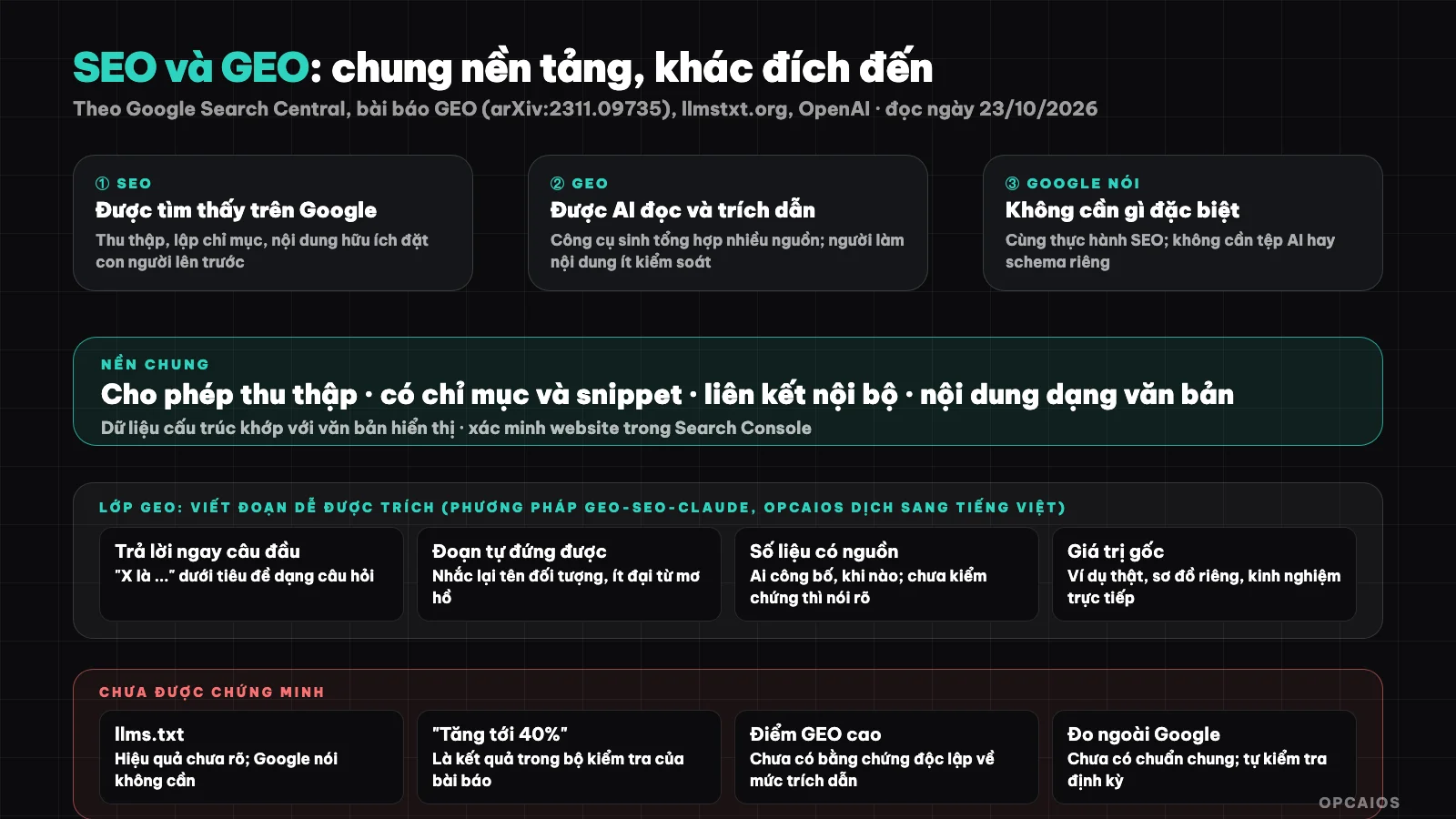
SEO and GEO share one base: correct technique and helpful content; the GEO part adds writing that's easy to extract. Diagram: OPCAIOS.
What is SEO?
SEO is making your website meet the technical requirements of search engines and creating helpful content for users. Google's ranking system is designed, according to Google Search Central (read 23/10/2026), to prioritize information that is helpful, reliable, and created to benefit readers, not content created to manipulate rankings. The SEO foundation has three parts:
- Pages that can be crawled, indexed, and eligible to show up with snippets.
- Your website complies with Google's policies.
- Content that is helpful, trustworthy, and puts people first.
For example, a guide with sourced statistics, real examples, and a clear author fits this better than a page that just repeats keywords. See also the article What is content marketing? on how to create valuable content.
What is GEO and where did it come from?
GEO is optimizing content to increase your presence in answers from generative engines. The paper "GEO: Generative Engine Optimization" by Pranjal Aggarwal and colleagues (arXiv:2311.09735, submitted 16/11/2023, version 3 on 28/6/2024, accepted at KDD 2024) describes generative engines as search systems that use generative models to gather and summarize information from multiple sources. For content creators, this is a black box, because you have almost no control over when your content shows up. The authors propose three things:
- A black-box optimization framework called GEO.
- A test set called GEO-bench.
- Results showing that GEO can increase presence by up to 40% in generative engine answers, and that the effectiveness of different strategies varies across fields.
Read this right: these are results in the paper's test set, not a promise for your website. For example, a strategy that works well in one field may not work in another, according to the paper itself (Aggarwal 2024).
Where are SEO and GEO the same and different?
Same foundation, different goal. Google confirms in documentation about AI features: SEO best practices still apply to AI Overviews and AI Mode, there are no additional requirements to show up, and you don't need to create a new reader file, AI text file, or any special schema.org markup.
| Criterion | SEO | GEO |
|---|---|---|
| Goal | Rankings and clicks from search results | Being read, synthesized, and cited in AI answers |
| Foundation | Correct technique, helpful content | Same foundation |
| Unit to optimize | Page and keyword | Self-contained paragraph that can be excerpted separately |
| Tools | Google, Bing | ChatGPT, Perplexity, Gemini, Copilot, Google AI Overviews |
| Measurement | Search Console | No common standard yet; Google reports AI impressions in Performance report (Web type) |
What Technical Preparation Do You Need for Both SEO and GEO?
According to Google, to become a supporting link in AI Overviews or AI Mode, a page must be indexed and eligible to appear with a snippet in Google Search, with no additional technical requirements. The checklist of best practices that Google lists:
- Allow crawling in robots.txt and on all CDNs or hosting infrastructure.
- Make content easy to find through internal links.
- Provide a good page experience.
- Ensure important content is in text form.
- Add high-quality images and videos where appropriate.
- Structured data must match the displayed text.
- Update Merchant Center and Business Profile information if you have them.
- Verify your website in Search Console to detect and diagnose issues.
Google also notes: meeting all requirements does not guarantee crawling, indexing, or display.
Do AI Bots Need Permission to Access?
AI bots need to be distinguished into search bots and training bots. OpenAI uses two separate robots.txt tags, according to OpenAI (read on 23/10/2026) and documentation on crawlers (according to OpenAI):
- OAI-SearchBot: used to display your website in ChatGPT search results. Websites that block this bot will not appear in ChatGPT search answers, though they may still appear as referral links.
- GPTBot: related to using content to train foundation models.
Website owners can allow OAI-SearchBot to appear in search results while still blocking GPTBot to indicate they do not want their content used for training. Updating robots.txt can take about 24 hours for OpenAI's systems to adjust. Also, with Google, robots.txt for Googlebot is how you control crawling for Search; you can limit displayed information using nosnippet, data-nosnippet, max-snippet, or noindex, and Google-Extended for their other systems. The decision to allow or block each bot is up to the content owner; there is no universal answer.
Is the llms.txt File Necessary?
The llms.txt file is not required, and its effectiveness has not been proven. llms.txt is a proposal by Jeremy Howard (published 3/9/2024, version 2 updated August 2026) for a Markdown file in the root directory that summarizes a website and links to detailed Markdown pages so that AI agents can read more cleanly compared to HTML full of ads and JavaScript. Thousands of websites have posted an llms.txt file and some AI labs post one for their programming documentation, according to the llmstxt.org proposal page (read on 23/10/2026). First is the summary file, then detailed Markdown pages. However, Google makes clear you do not need an AI-specific text file to appear in Google's AI features. So think of llms.txt as a low-cost option, particularly useful for technical documentation, not a requirement to be cited. For example, the opcaios.org website has /llms.txt, /llms-full.txt, and Markdown versions for each page (add .md to the end of the address); we have not yet measured their impact on being cited by AI.
How Do You Write Content to Be Easily Cited by AI?
Writing content that is easily cited by AI means writing self-contained paragraphs: someone or a machine reading only that paragraph still understands it. These are the OPCAIOS principles applied to the blog posts in this series, combining Google's helpful content standards and the citation ability scoring method from the open-source project geo-seo-claude, which we have translated into Vietnamese:
- Headings as questions and answer on the first line: "What is X?" then answer "X is ..." in the first sentence.
- Paragraphs contain sufficient context: limit vague pronouns, repeat the name of the subject.
- Moderate length: around 134 to 167 English words, equivalent to roughly 175 to 215 Vietnamese words.
- Data with sources: state who published it and when; unverified numbers should be clearly marked.
- Original content: real examples, custom diagrams, direct experience.
- Easy to read: short sentences, numbered lists, tables for comparisons.
Does the GEO Score Prove Its Effectiveness?
Not yet. This score is an internal tool to keep article quality consistent, and there is no independent evidence that achieving a high score will result in more AI citations. Google also asks the right questions about original content when evaluating helpful content, according to Google Search Central (according to Google).
OPCAIOS's Experience: Building Our Own SEO and GEO Measurement Tools
OPCAIOS has built two measurement tools in the website's admin panel. The SEO tool scores each post according to criteria like title, description, main keywords, structure and links. The GEO tool checks an address for readiness with AI search, calculating scores using fixed rules (not using a model for scoring, to enable comparison across months), across six categories: citation potential 25%, brand reputation 20%, content and E-E-A-T 20%, technical platform 15%, structured data 10%, platform readiness 10%; checking AI bot access permissions in robots.txt, the presence of llms.txt and llms-full.txt, JSON-LD data, and whether content is available in HTML without needing to run JavaScript. It can crawl the entire website weekly. Every post in this series is scored by both tools before publishing, typically achieving SEO of 95 or above; GEO scores vary by post, mostly ranging from around 70 to 85 according to the measurement on 25/10/2026. One more principle: the tool only recommends, it does not automatically change robots.txt, because the decision to allow or block bots belongs to the website owner.
Measuring SEO and GEO Effectiveness With What?
For Google, use Search Console: according to Google, impressions in the AI feature appear in the Performance report under the search type "Web", along with total search traffic; combine Google Analytics to track conversions and time on page. For other AI tools, there is no common measurement standard yet; check it yourself by asking the questions your customers usually ask and recording whether your website gets cited or not, on a regular basis. Don't compare using numbers from unclear sources.
Read more: Measuring whether AI cites your website; The "Programmatic SEO for the lazy" strategy; Auditing AI content before publishing.
Frequently Asked Questions
What are SEO and GEO?
SEO is optimizing your website so search engines understand and display your content; GEO is optimizing content so AI tools read and cite your answers. Both use the same technical foundation and helpful content.
Does GEO replace SEO?
No. Google says basic SEO practices are still what helps you appear in AI Overviews and AI Mode, and there are no special additional requirements. GEO adds a way to write passages that are easy to cite, it doesn't replace the foundation.
Do you need an llms.txt file to be cited by AI?
Not required. Google says you don't need a text file for AI to appear in their AI features; the effectiveness of llms.txt with other tools has not been proven. This is a low-cost option.
Should you allow or block AI bot traffic?
It depends on your goal. OpenAI separates OAI-SearchBot (currently in ChatGPT search) from GPTBot (training); you can allow search bots and block training bots. This is the decision of the content owner.
How do you know if your content is being cited by AI?
For Google, check the Performance report in Search Console. For other tools, check manually on a regular basis using questions your customers usually ask. Want to learn how to do SEO and content with controlled AI, see OPCAIOS's AI application training course.
Sources: Google Search Central: "AI features and your website" and "Creating helpful, reliable, people-first content"; paper "GEO: Generative Engine Optimization" (arXiv:2311.09735, KDD 2024); llms.txt proposal by Jeremy Howard (llmstxt.org); "Overview of OpenAI Crawlers" documentation; read directly on 23/10/2026. Citation scoring method based on the open-source project geo-seo-claude, which OPCAIOS translated into Vietnamese; no independent evidence yet of impact on being cited. The 40% result is within the test set of the paper. Not a ranking guarantee.
Translated from Vietnamese with AI. Read the original.
Want to apply this in your business?
Book a free 30-minute call (Vietnam time, in English or Vietnamese).