



When should a solopreneur open a company, and when is a business household enough? With business registration, the short answer: a business household is simpler and lighter when you sell small, direct, low risk; a company (usually a single-member limited liability company) is more suitable when you need to separate personal assets from business liability, sign contracts with large enterprises, raise capital, or revenue and risk increase. This is a reference, not legal or tax advice: regulations on business household taxes have changed significantly from 2026 and the sources we read (as of 25/10/2026) are not consistent on some thresholds, so you need to check the original documents or ask an accountant or lawyer before deciding. Hypothetical example: a freelancer earns 40 million dong each month from 5 business clients, that is 480 million dong per year, close to the 500 million dong threshold that some sources mention.
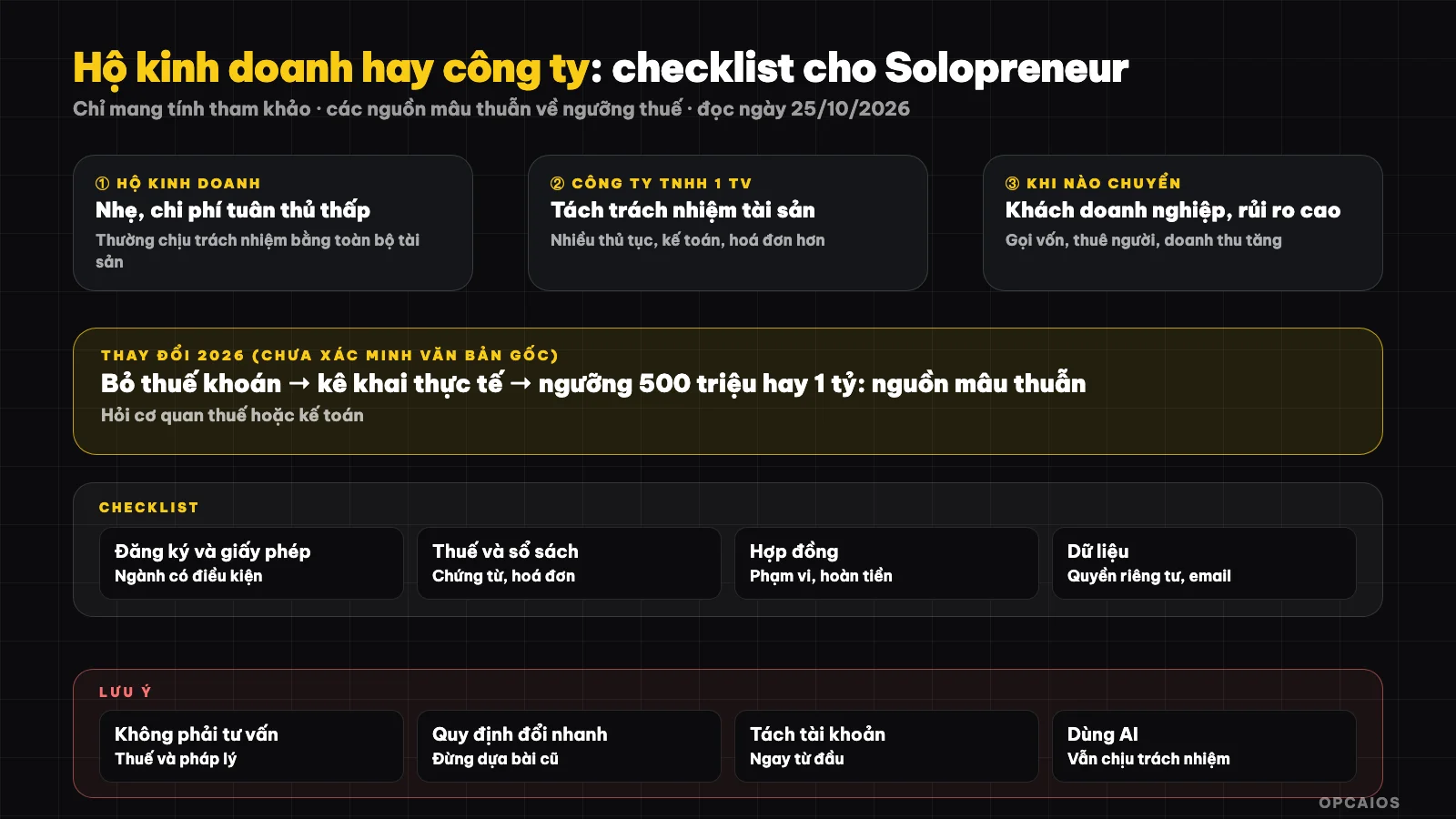
Quick comparison of business household and company, with checklist. For reference only. Diagram: OPCAIOS.
What has changed in business household taxes and what is still uncertain?
Business household tax is the amount a household must pay on sales activity, and regulations have changed significantly from 2026. According to domestic summaries (read 25/10/2026, not yet verified against original documents), there are four points:
- Abolishing fixed tax: according to Resolution 198/2025/QH15, from 01/01/2026 business households no longer apply fixed tax and switch to declaring based on actual revenue and expenses incurred.
- Business license fee: many sources say it has been abolished; check for yourself.
- Revenue threshold for not paying tax: sources contradict each other; some mention 500 million dong per year, others mention 1 billion dong after new guiding decrees. OPCAIOS cannot determine the correct figure; this is a point you must ask the tax authority or an accountant about.
- How to calculate tax for households with revenue exceeding the threshold (by percentage of revenue or by income) is also interpreted differently by various sources.
Therefore this post does not provide specific tax figures. Hypothetical example: annual revenue of 700 million dong exceeds the 500 million dong threshold but is below 1 billion dong, so the conclusion depends on which source is correct.
Comparison of business household and company (general level)
| Criterion | Business household | Single-member limited liability company (owned by an individual) |
|---|---|---|
| Legal status | No legal entity status; tied to an individual or household | Has legal entity status, independent from owner |
| Asset liability | Household owner usually bears liability with all assets | Owner usually bears liability within the charter capital |
| Establishment procedure | Simpler | More steps |
| Records, accounting | Lighter but transitioning to declaring based on actual figures | Stricter: accounting, tax reporting, invoices |
| Contracts with large enterprises | May be more difficult | Usually more convenient |
| Capital raising, partners | Limited | More suitable |
| Compliance cost | Lower | Higher |
| Details (number of people, fields, location, conditions) depend on current regulations; check the Enterprise Law and latest guiding documents. |
When is a business household enough, when should you open a company?
A business household is suitable when you are just starting out, and a company is suitable when risk and scale increase; both are just suggestions, not advice. A business household is usually enough when:
- Revenue is small, customers are mainly individuals.
- Risk of liability is low (products or services unlikely to cause major damage).
- You don't yet need to issue invoices to large enterprises or sign complex contracts, and want to test the market with low compliance costs.
Consider opening a company when:
- Business customers require contracts and invoices from a legal entity.
- Risk of liability is high (consulting could cause damage, products have risks, sensitive data).
- Revenue and profit increase to the point where you need to optimize tax structure legally (need an accountant), or want to raise capital, invite partners, hire people.
Opening a company entails accounting obligations, tax reporting, invoices; calculate that cost first. Hypothetical example: a freelancer signs a 50 million dong contract with an enterprise requiring invoices from a legal entity should ask an accountant.
What does the registration, tax, and bookkeeping checklist include?
This checklist is a list of things to do before selling regularly. The first item is registration, followed by taxes, and finally bookkeeping:
Registration and licenses
- Choose a business form (individual business or company) and register accordingly.
- Check whether your industry requires conditions or licenses.
- Register your name, address, and contact information consistently.
Taxes and bookkeeping
- Learn about current tax obligations with an accountant or tax authority; don't rely on old articles.
- Declare actual revenue and expenses according to regulations; keep receipts.
- Electronic invoices when mandatory.
- Separate business bank account from personal account.
- Record revenue and expenses monthly, for example using Google Sheets.
Example: recording 20 transactions monthly takes about 30 minutes, while hiring an accountant costs 750,000 đồng monthly (roughly 10% of 7.5 million đồng revenue if you sell small) is a cost to consider.
What does the contract, data, and personal protection checklist include?
The second checklist is about protecting customers and yourself, including contracts, data, advertising, and documents. Complete it before taking on your first business customer:
Contracts and customers
- Contract or terms of service: scope, price, payment, changes, product ownership, liability.
- Clear refund policy with digital products.
- State clearly when using AI if it could affect customers.
Data and advertising
- Privacy policy; consent when collecting personal data and sending email (Data security when using AI, What is email marketing?).
- Honest advertising without unfounded outcome claims.
- Copyright for content, images, music, software you use.
Personal protection
- Consider professional liability insurance if risks are high.
- Keep copies of contracts, invoices, registration documents.
Example: a one-page contract with 2 rounds of edits and a 7-day refund helps avoid disputes for a 5 million đồng order; professional liability insurance might cost several million đồng yearly, ask 2 providers.
Special note for AI users
- Content created by AI is still content you are responsible for.
- Check the commercial terms of use for AI tools, music, images, fonts.
- Customer data entered into AI needs justification and protection measures.
- Selling services abroad may involve tax and regulations elsewhere.
OPCAIOS experience
OPCAIOS has no legal or tax expertise to advise; we use accountants and official sources for such decisions. What we learn from operating is: separating accounts and keeping receipts from the start saves much work later, and business tax regulations change fast so don't rely on old articles. This article does not replace professional advice.
Frequently asked questions
Should I open a company or individual business?
Depends on scale, risk, customers, and plans; individual business is lighter, company liability is clearer.
Does individual business still have fixed tax?
According to sources we read, fixed tax was abolished from 01/01/2026; confirm with tax authority.
What revenue level requires tax filing?
Sources conflict (500 million or 1 billion đồng); we couldn't determine, ask tax authority or accountant.
Do I need to register to sell courses, digital products?
Usually needs consideration as business activity; ask an expert about the right form and tax.
Where do I start?
Ask an accountant before choosing a form. See OPCAIOS's AI application training course for the operations part.
Source: domestic summaries of Resolution 198/2025/QH15 and individual business tax changes (read 25/10/2026; conflicting thresholds; did not cross-check original text). For reference only, not legal or tax advice. Experience is OPCAIOS's.
Translated from Vietnamese with AI. Read the original.
Want to apply this in your business?
Book a free 30-minute call (Vietnam time, in English or Vietnamese).