


What is a Mini-Course?
A mini-course is a short course focused on solving one narrow problem for a group of learners, usually consisting of a few short lessons, accompanying materials, and a specific result the learner achieves. Making one in 7 days is feasible if you already have real experience and just need to restructure it, but 7 days only gives you a first version you can test-sell, not a finished product; quality depends on the experience you have and the time you spend. AI helps you draft an outline, write lessons, create quiz questions, and write video scripts, but it cannot replace what you know from practice: real examples, mistakes you've encountered, methods you've tried. Hypothetical example: 6 short lessons, 60 minutes of video, trial price $19 for 50 people, meaning maximum $950. This post lays out a 7-day schedule, how to use AI safely, how to test-sell, and what we don't promise.
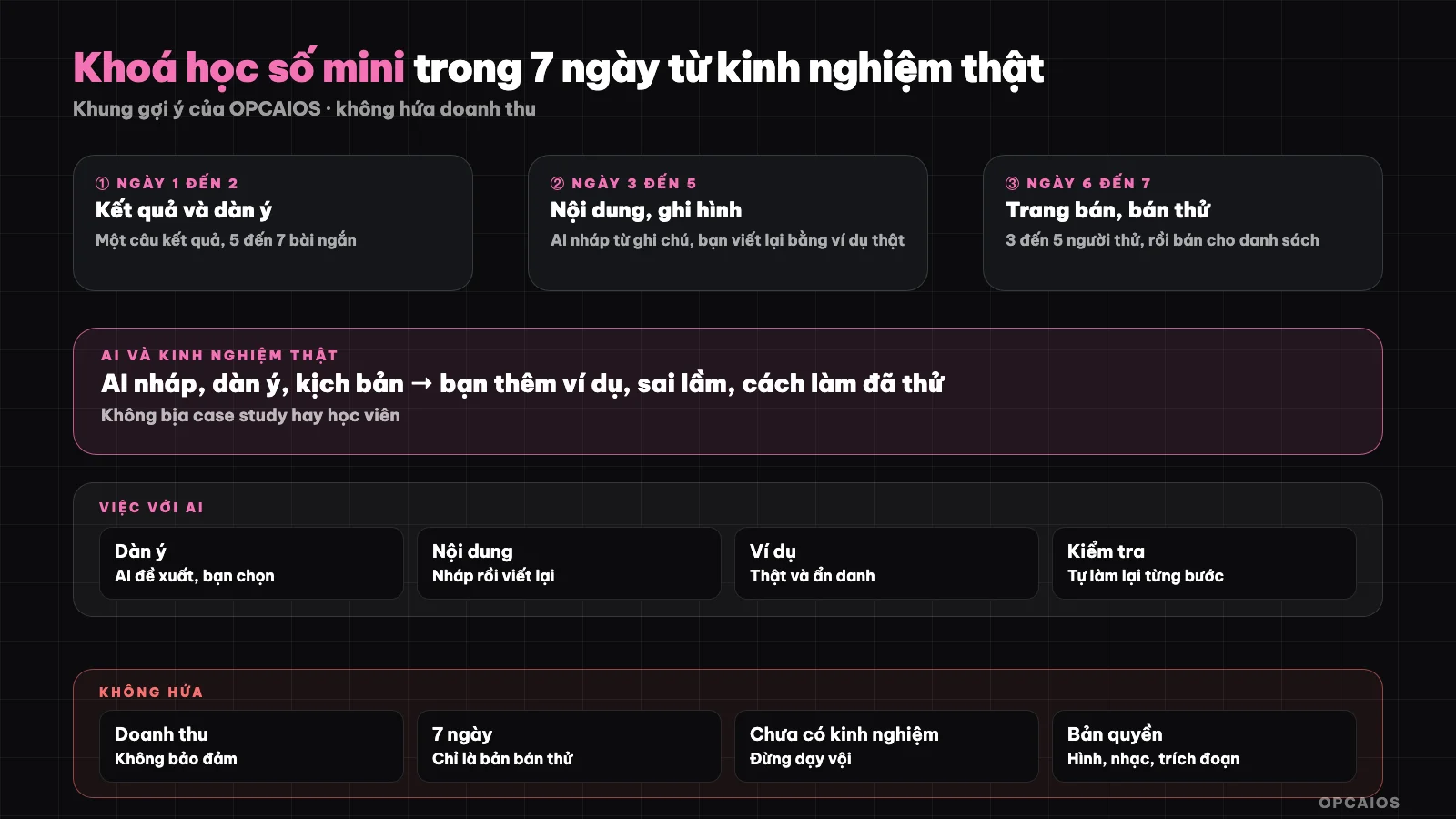
Seven days from experience to a test-sell version. AI drafts, you add what's real. Diagram: OPCAIOS.
Before You Start, Do You Have Something to Teach?
Checking your experience base is the first step: a good mini-course comes from a result you've already achieved and can explain, because AI doesn't create expertise. Ask yourself three questions:
- Have I helped anyone achieve a real result (true, not made up)?
- What do other people usually ask me about?
- Can I work through one example from start to finish?
If you don't have real experience yet, don't teach; do more first. Hypothetical example, not a real client: an accountant who has prepared tax reports for 30 clients can teach "prepare quarterly tax reports using Google Sheets in 2 hours". Someone who has never done it shouldn't teach that topic yet, even if ChatGPT can draft an outline in 5 minutes.
Days 1 and 2: How to Choose the Outcome, Your Audience, and Create an Outline?
Days 1 and 2 are when you determine who you're teaching and what you're teaching, ending with an outline of 5 to 7 lessons. First, write one sentence: "After this course, [who] can [do what] in [how much time]." Keep it narrow. Three things to do:
- Day 1: ask 5 people from your target group if they want that outcome and what they've tried. Use ChatGPT or Claude to summarize their answers, not to replace them.
- Day 2: break the outcome into 5 to 7 short lessons in order. Each lesson has one goal and one action the learner completes. Ask AI to suggest an outline then you cut, rearrange it based on real experience.
- Finally, check if there's any step a beginner will stumble on.
Hypothetical example: 6 lessons, each 10 minutes, total 60 minutes of video; if you ask 5 people and 4 say (80%) they haven't tried any approach, this group needs a foundation lesson first.
Days 3 to 5: How to Write Content, Film and Make Materials?
Days 3 to 5 is when you turn the outline into complete lessons. Each lesson needs main content, your real examples, common mistakes, and an exercise. The steps:
- Days 3 and 4: use AI to draft from notes and examples you provide; then rewrite in your own voice, check every fact, remove real client information (see Data Security When Using AI).
- Day 5: film short videos, screen record or talk to camera, or make a written lesson; include checklists, templates, downloadable files. You can use AI to write scripts, add captions, write summaries. Keep audio clear enough to hear.
- After that, reuse the content for your blog and emails (turn video into written posts).
Hypothetical example: writing 6 lessons takes 8 hours, filming takes 3 hours, so about 11 hours over 3 days, and AI helps cut draft time by about 30%.
Days 6 and 7: How to Make a Sales Page, Test and Test-Sell?
Test-selling is when you put the course on the small market to learn from feedback, not to make a lot of money. Two days include these tasks:
- Day 6: make a page that clearly states who it's for, what the outcome is, content, length, price, and refund policy.
- Invite 3 to 5 people to try free or at a discount, note what's unclear then fix it.
- Set up payment and how you'll deliver the course.
- Day 7: tell your email list, community, past clients; answer questions and gather feedback.
The goal of your first version is to learn: who buys, why, who doesn't, why. Hypothetical example, not a measured result: trial price $19, send to 200 people on your email list, if 2% (4 people) buy that's $76 revenue. A small number but enough to see what your sales page is missing.
How to use AI safely in your course
| Task | Do | Don't |
|---|---|---|
| Outline | Let AI suggest, then you choose | Use a generic outline as-is |
| Content | Draft from your own notes | Paste AI text directly, make up data |
| Examples | Use real, anonymized examples | Invent case studies and students |
| Scripts, subtitles | Ask AI to standardize | Impersonate someone else's voice |
| Quiz questions | AI suggests, you review | Skip checking the answers |
Pricing and selling
- Mini courses usually cost less than longer ones; we don't set prices since it depends on your market. Test pricing with your first group.
- Show buyers a free sample (one lesson).
- Sell to your own list first; a new course with no audience is hard to sell (automated sales funnel for solopreneurs).
- Automate payment and course delivery with your tools.
What we don't promise
- We don't promise your course will sell or guarantee specific revenue.
- We don't promise 7 days is enough for a high-quality course if you're inexperienced.
- We have no data on completion rates or satisfaction for AI-assisted courses.
Risks
- Wrong content: AI can make things up; verify by doing it yourself again.
- Copyright: images, music, excerpts from others.
- Overpromising: don't say "guaranteed to make money".
- Privacy: don't put customer data in examples.
- Tax and law: see Legal checklist.
OPCAIOS experience
We make guides and tutorials. We found the most value comes from real examples and mistakes we've actually faced; AI helps us move fast on outlines and drafts. We don't publish revenue or student numbers for any course and don't claim a 7-day timeline works for everyone; this is a suggested framework.
Frequently asked questions
Is 7 days enough to make a course?
Enough for a first version to test-sell if you have real experience; not a finished product.
Can AI write my whole course?
It can draft, but a course without real experience will be generic and error-prone.
What topic should I teach?
One specific outcome you've already done for a group you understand.
Where do I sell?
Your own website or a course platform; check current fees and terms.
Where do I start?
Write your outcome statement and ask 5 people in that group. See OPCAIOS's AI application training course.
Source: OPCAIOS's experience making guides and common practice; no revenue or learning outcome data. Experience is OPCAIOS's own.
Translated from Vietnamese with AI. Read the original.
Want to apply this in your business?
Book a free 30-minute call (Vietnam time, in English or Vietnamese).