

What is a 24/7 automated sales funnel?
A 24/7 automated sales funnel is a series of automated steps to take a stranger from not knowing you to making a purchase. It has five layers: attraction (content, ads), information collection (forms, gifts), nurturing (email, messages), offer (sales pages, quotes), and payment. With simple, low-price products like documents, small courses, or consultation sessions, the entire funnel can run while the business owner sleeps. With high-price services, the funnel only automates the early part (attraction, information collection, scheduling), while closing still requires human conversation. This post describes the five layers, what should be automated, legal points, a 7-step process, and OPCAIOS experience, including unverified parts.
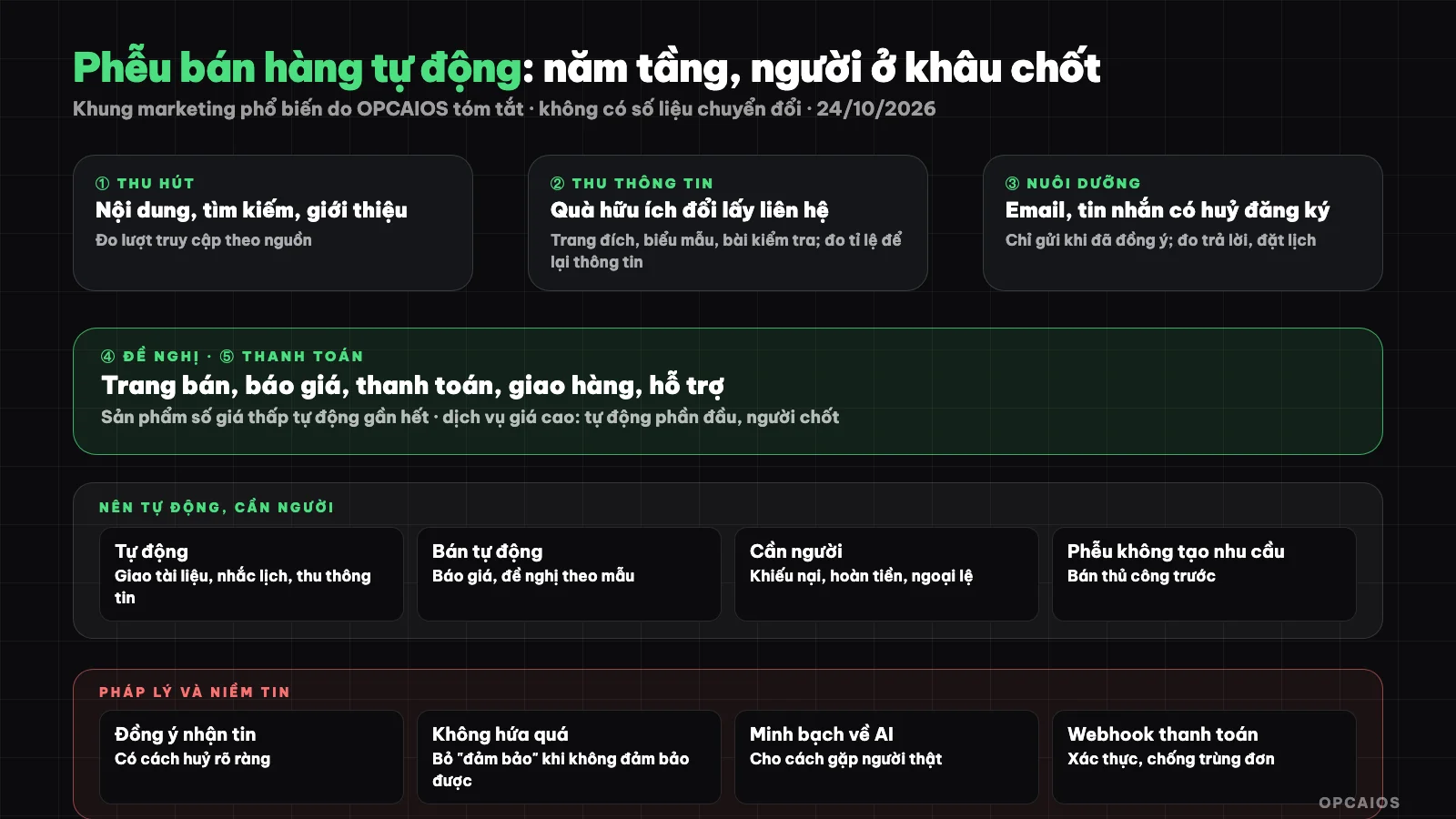
Automate the top of the funnel, keep people at the closing stage for high-value services. Diagram: OPCAIOS.
What layers does a sales funnel have?
An automated sales funnel has 5 consecutive layers, and each layer has its own goal, tools, and metrics. First is attraction, then information collection, then nurturing and offer, finally payment and delivery (details in the table below). A hypothetical example: if 100 people view the landing page and 20 leave their email, the information collection rate is 20%; this number only illustrates how to measure, not OPCAIOS' actual results.
| Layer | Goal | Common tools | Metric |
|---|---|---|---|
| 1. Attraction | Right people know about you | Content, search, social media, referral | Traffic by source |
| 2. Information collection | Exchange useful gift for contact | Landing page, form, quiz | Information collection rate |
| 3. Nurturing | Build trust, answer questions | Email sequences, messages | Open rate, reply rate, booking rate |
| 4. Offer | Present offer clearly | Sales page, quote, call | View-to-purchase rate |
| 5. Payment and delivery | Collect money, deliver, support | Payment gateway, automated delivery | Payment completion rate, refund rate |
What parts of the funnel should be automated, and what needs people?
Which parts to automate depends on order value: the lower the price, the more you can automate. Complaints, refunds, and exceptions always go to people, even if the funnel runs on n8n or Dify. A hypothetical example: a 300,000-dong course can sell almost entirely automated, but a 20-million-dong consulting package needs at least one call before closing.
| Situation | Suggestion |
|---|---|
| Low-price digital product | Can automate most: sales page, payment, file delivery |
| Mid-price service | Automate booking consultation, reminders, sending prep materials; people handle conversation and quoting |
| High-price or custom service | Automate the early part; close with a call |
| Complaints, refunds, exceptions | Always people |
One thing rarely said: an automated funnel does not create demand. A funnel only multiplies what already works when you sell manually; if you have no buyers when selling by hand, sell manually first.
What technology do you need to build a funnel?
Minimum technology to build a funnel has 5 groups: landing page and forms, chatbot, email and messages, automation, and payment.
- Landing page and forms: one clear page, one call to action.
- Chatbot or assistant: answer common questions and collect information; see What is Dify? on building an assistant on your website.
- Email and messages: nurture sequences by behavior (see What is email marketing? and What is Zalo OA?).
- Automation: connect forms, CRM, email, payment (see What is n8n?, What is a webhook?, What is an API?).
- Payment: payment gateway supporting bank transfer and automatic transaction recognition; validate webhooks and prevent duplicate orders.
A hypothetical example: when 50 people fill out a form in 1 week, n8n can record contacts in CRM, send an opening email within 5 minutes, and remind each person of their consultation appointment, at an estimated tool cost of $30 per month.
Legal Points and Trust
- Consent to receive: only send marketing emails and messages to those who have agreed; always provide a clear unsubscribe option.
- Rules on marketing messages and personal data: comply with current Vietnamese regulations; ask a legal expert.
- Don't promise beyond your ability: remove statements like "guaranteed" or "assured" when you can't guarantee them.
- Be transparent about AI: if customers chat with an AI assistant, say so clearly and provide a way to reach a real person.
- Protect customer data: minimum permissions, key encryption, don't store data in unnecessary tools.
Seven-Step Funnel Building Process
Building a funnel is a seven-step sequence from manual selling to automation, and the order of steps matters more than the tools. First sell manually to a few customers to understand the real questions, then automate. Finally, measure each stage weekly to fix the biggest leaks.
- Pick one product and one specific customer group.
- Sell manually to the first few customers and write down the questions they ask.
- Write a landing page from those very questions.
- Build a form, a useful gift, and a short email sequence.
- Connect payment and test with a small-value trial transaction.
- Add automation for scheduling reminders and delivering materials.
- Measure each stage weekly, fix the biggest leak first.
Example assumption: a trial transaction might be just $1 or 10,000 đồng, enough to confirm the payment gateway recognizes the order automatically before opening sales to real customers.
OPCAIOS's Experience
We have built the funnel components into our website: a landing page with a diagnostic quiz, a form collecting contact info into a CRM, an email sequence with unsubscribe, appointment booking with reminders, a website assistant, and bank transfer payment with automatic order recognition. We are also frank about what's not yet enough: some channels (like Zalo OA messages) are only at integration level and haven't been tested in real customer use, and automatic payment needs to be verified with real transactions before trusting. We don't publish conversion rates or revenue from the funnel and don't use them as evidence for this post; what we are sure of is that you must measure each stage yourself rather than trust someone else's numbers.
Read more: Automating a funnel to attract leads; AI app analyzing customer psychology.
Frequently Asked Questions
What is an automated sales funnel?
An automated sales funnel is an automated sequence running on tools like n8n, moving strangers from not knowing you to buying, with 5 stages: attract, collect info, nurture, propose, and pay. Example assumption: with a $5 resource, all 5 stages can run 24 hours a day without anyone on duty.
Can you close deals completely automatically while you sleep?
With low-price digital products, yes; with high-price services, automate the early part and have someone close it through conversation.
How many tools do you need to build a funnel?
Minimum: a landing page, a form, email, one payment gateway, and one tool to connect them; see AI tool suite for the OPC model.
Does an automated funnel violate marketing message rules?
It can, if you send without consent or don't provide an unsubscribe option. Three safe principles: only send to those who agreed, always have a clear unsubscribe option, and don't promise beyond your ability with words like guaranteed or assured. OPCAIOS is not legal advice, so ask a legal expert about current Vietnamese rules. To get help building this system, see OPCAIOS's AI application training course and SOLO Content Engine.
Source: the five-stage framework is common marketing practice summarized by OPCAIOS, not research results; no conversion numbers in this post; tool information taken from OPCAIOS's related posts (read 24/10/2026). Legal information is for reference only. Experience is OPCAIOS's.
Translated from Vietnamese with AI. Read the original.
Want to apply this in your business?
Book a free 30-minute call (Vietnam time, in English or Vietnamese).