


What is Bolt?
Bolt (Bolt.new) is a StackBlitz tool that lets me describe an application in plain language and have an AI agent build, run, and deploy a full-stack web application right in my browser, without setting up an environment. According to the open source repository (MIT license), the agent controls the file system, Node.js server, package manager, terminal, and browser console in a WebContainers environment; the models run inside that environment. According to the official pricing page (read on 24/10/2026), the Free plan includes 1 million tokens per month (maximum 300 thousand per day), the Pro plan is $18 per month when paid annually with 10 million tokens. For example, someone building a small prototype can use the Free plan before paying. This post explains what Bolt is, how it works, the plans and limits, when to use it, risks from AI-generated code, and OPCAIOS's experience.
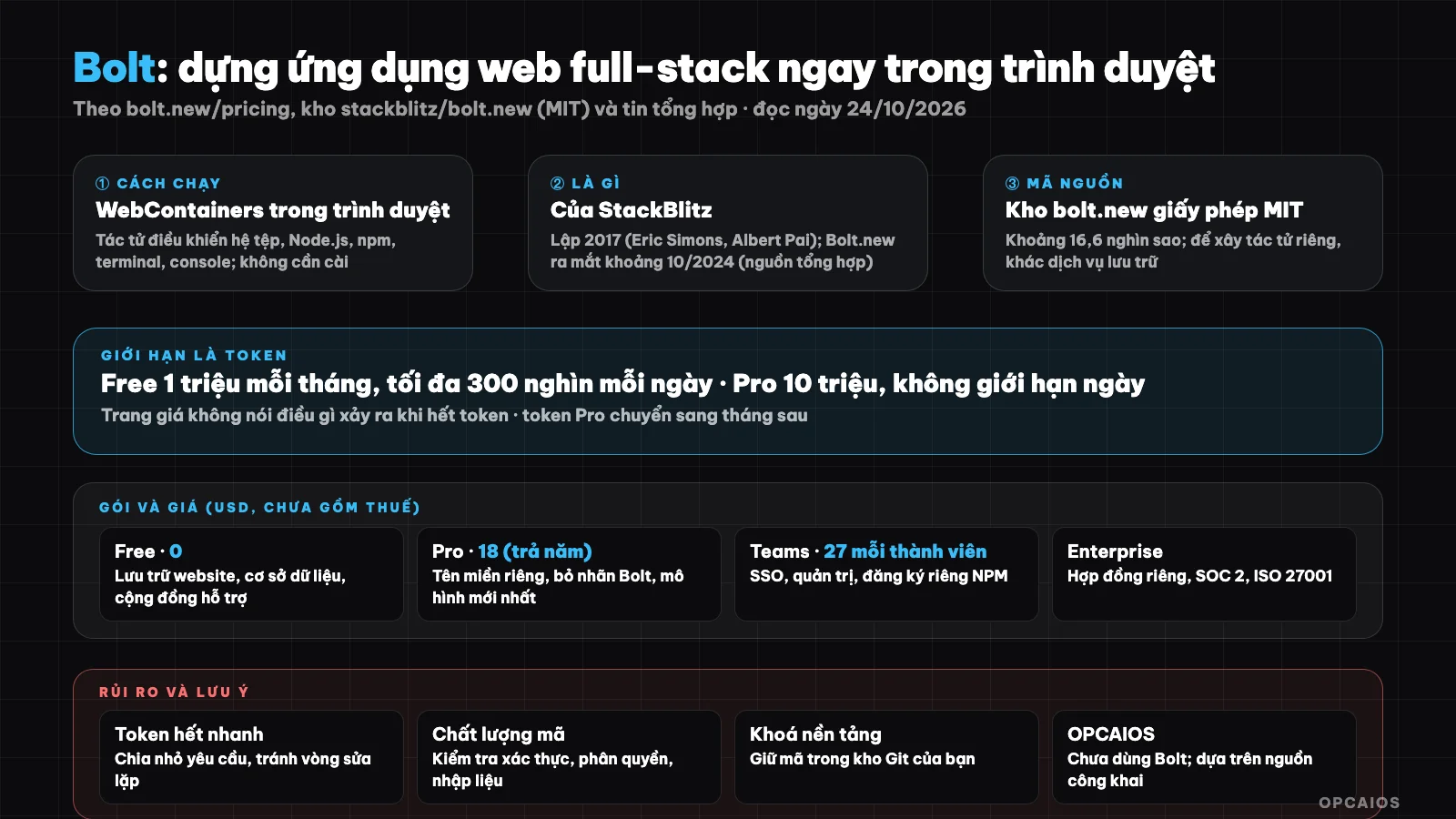
Bolt runs the entire development environment in the browser; the limit is in the number of tokens. Diagram: OPCAIOS.
What is Bolt and how does it work?
StackBlitz was founded in 2017 by Eric Simons (CEO) and Albert Pai (CTO) according to various sources; WebContainers technology (from 2021) is a WebAssembly-based environment that runs Node.js, npm, and a development server inside the browser's sandbox. Bolt.new launched around October 2024 (according to one Chinese source, we have not verified further) and according to reports grew rapidly: reaching $4 million ARR in the first four weeks; Series B round in January 2025 around $105 million, valued around $700 million. Other revenue figures (such as $40 million ARR) are estimates or company announcements, we have not verified them. Thanks to WebContainers, the agent can install npm packages, run a Node.js server, and deploy applications without needing a local server. To understand this way of working, see What is Vibe code?.
Bolt's pricing plans
According to the official pricing page (USD, read on 24/10/2026, not including tax):
| Free | Pro | Teams | Enterprise | |
|---|---|---|---|---|
| Price | $0 | $18 per month (paid annually, $216 per year) | $27 per member per month (paid annually) | Custom contract, billed by usage |
| Tokens per month | 1 million | 10 million | 10 million per member minimum | Unlimited, billed by usage |
| Daily limit | 300 thousand tokens | None | None | None |
| Carry over tokens to next month | No | Yes | Yes | Yes |
| Latest AI model | No | Yes | Yes | Yes |
| Storage, domains | Public and private projects, unlimited website storage and database | Add custom domain, remove Bolt branding, private sharing | Like Pro | Like Teams |
| Connections and MCP | No | Yes | Yes | Yes |
| Support | Community | Priority | 24/7 |
Example scenario: a team of two people using the Teams plan would pay $54 per month when paid annually (2 members times $27). The pricing page doesn't say what happens when tokens run out (the corresponding FAQ is blank) and doesn't name the database provider, only says "choose a database provider" from the Pro plan; we don't speculate. Prices and tokens may change.
When should I use Bolt?
| Scenario | Recommendation |
|---|---|
| Build a prototype or small tool quickly to test an idea | Bolt is a good fit |
| Need both interface and processing (full-stack) without setting up | Good fit |
| Long-term project requiring code control, testing, tight security | Export code to a Git repository and continue with another tool (see What is GitHub?) |
| Project heavily dependent on custom business integrations | Consider building from scratch or Cursor |
Compare options in Top 5 Vibe Coding tools.
Risks and considerations with AI-generated code
- Tokens run out fast: large prompts or repeated debugging cycles consume many tokens; break requests into smaller pieces.
- Quality and security: AI-generated code needs review (validation, permissions, input handling); don't put secrets in prompts.
- Vendor lock-in: an application built on one platform can be hard to move; always keep your code in your Git repository.
- Customer data: don't use real data in prototypes.
- Licensing and storage: read the terms if using commercially; according to the pricing page, custom domains and removing branding are paid features.
OPCAIOS Experience
We haven't used Bolt for any project; our website and tools are built using our own process with programming agents on source code in a Git repository, so this post is based on official sources, not our own experience. We also haven't compared code quality or token costs of Bolt with other tools. What we've learned from our own approach: regardless of the tool, put code in a Git repository early, write tests, and have someone review it before deploying.
Frequently Asked Questions
What is Bolt?
Bolt (Bolt.new) is a StackBlitz tool for creating full-stack web applications through prompts, running directly in your browser thanks to WebContainers. According to the open-source repository stackblitz/bolt.new (MIT license), the AI agent controls the file system, Node.js server, package manager, terminal, and browser console inside the WebContainers environment, so you don't need to set up a development environment on your machine. According to the official pricing page read on 24/10/2026, the Free plan gives 1 million tokens per month and the Pro plan is $18 per month when paid annually. For example, a small business owner could describe a booking page through a prompt, preview it right in the browser, and then deploy it. The main limitation is the token count, and code generated by AI still needs security review from a person before being used in production.
Is Bolt free?
Yes, Bolt has a Free plan. According to the official pricing page read on 24/10/2026, the Free plan provides 1 million tokens per month, with a maximum of 300 thousand tokens per day, community support, and tokens don't roll over to the next month. The Pro plan costs $18 per month when paid annually ($216 per year) with 10 million tokens, plus a custom domain, removes the Bolt badge, and includes MCP connections. The Teams plan is $27 per team member per month when paid annually. For example, with a limit of 300 thousand tokens per day, a large prompt or iterative debugging could use up your daily limit, so you should break requests into smaller pieces. The pricing page doesn't say what happens when you run out of tokens, so OPCAIOS won't speculate.
Is Bolt open source?
The stackblitz/bolt.new repository is under the MIT license (around 16.6 thousand stars when read); this is source code for building your own agent, different from the bolt.new hosting service.
Can you export code outside?
We haven't read the code export section in the documentation so we can't confirm; check it out yourself and always keep your code in your own Git repository.
How is Bolt different from Cursor and Lovable?
Bolt runs entirely in the browser and counts limits by tokens, while Cursor is a code editor environment for people who know some programming, and Lovable counts by credits, not by number of users. According to the pricing page read on 24/10/2026, Bolt Pro is $18 per month (paid annually), Lovable Pro is $25 per month with 100 credits, and Cursor Plus is $8 and Premium is $30 per month. OPCAIOS hasn't compared the output quality of the three tools, so the pricing table only helps with comparing costs and limit calculations, not ranking them. Choose Bolt when you need to build a full-stack prototype quickly without wanting to install anything; choose Cursor when you need to control code in your Git repository. See the comparison table. Want to learn how to use it safely, check out OPCAIOS's AI application training course.
Source: bolt.new/pricing (read 24/10/2026), GitHub repository stackblitz/bolt.new (MIT), search results about StackBlitz and Bolt.new; Wikipedia article on Bolt.new doesn't exist (404). ARR figures and funding from sources, not verified. Prices exclude tax and may change. Experience is from OPCAIOS.
Translated from Vietnamese with AI. Read the original.
Want to apply this in your business?
Book a free 30-minute call (Vietnam time, in English or Vietnamese).