


What is book-to-skill?
book-to-skill is an open-source agent skill that transforms technical books in PDF, EPUB, DOCX formats or entire document directories into a structured skill, so AI agents like Claude Code, Codex or GitHub Copilot CLI read the exact chapter you need when you ask. According to GitHub API (read 04/11/2026), the virgiliojr94/book-to-skill repository was created on 01/05/2026, has around 36,885 stars, is written in Python and uses the MIT license; the repository's most recent update was on 03/11/2026. The tool is free, but the book conversion step uses the agent's AI model so it still costs tokens. This post explains what book-to-skill creates, how to install it per the README, actual costs, how it differs from RAG or NotebookLM, and especially the copyright boundary when you feed someone else's books to AI.
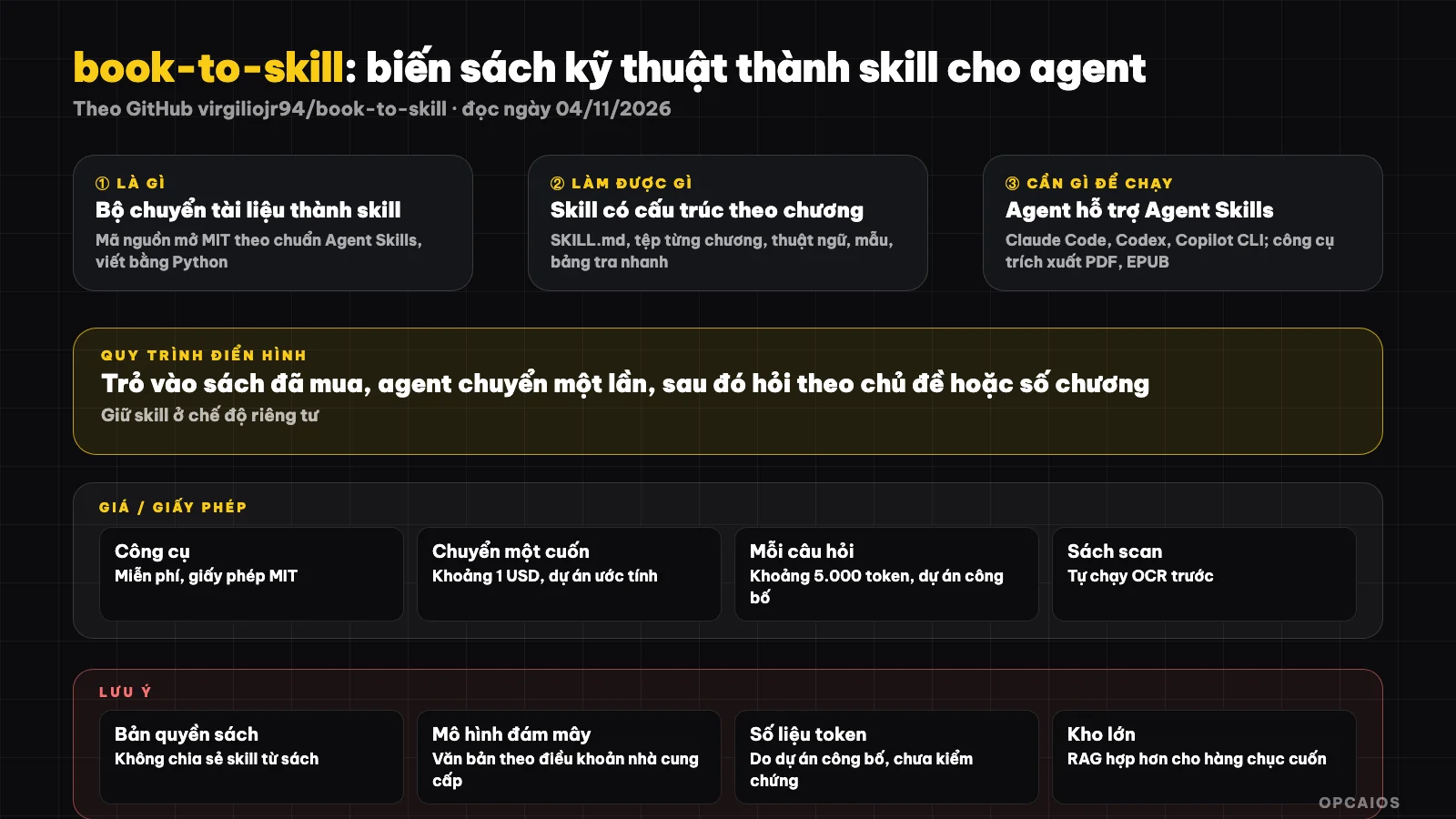
book-to-skill converts a book once into a skill, then the agent only loads the part needed for your question. Diagram: OPCAIOS.
What is book-to-skill and who made it?
book-to-skill is a document-to-skill converter following the open Agent Skills standard, developed and maintained by a programmer with the GitHub account virgiliojr94 in their personal time. A skill is a package of instructions that an agent loads when needed; if you're new to this, read What is a skill?.
The problem the README raises is very familiar: you buy a good technical book, read it once, and a few months later you forget what chapter 7 said. You ask an agent about the book and it either makes something up or says it has no content. book-to-skill solves this by distilling the book into a thinking framework, decision rules, common errors and separate files for each chapter. Per the README, this is structure, not a summary. After installing, you type a command with the skill name and topic, the agent opens the right chapter and answers based on actual content. The README lists agents that can read the same SKILL.md format: GitHub Copilot CLI, Amp, Claude Code, Codex, Hermes Agent, OpenCode and OpenClaw.
What does book-to-skill create?
book-to-skill creates a skill directory with one core file and auxiliary files that load only when needed. The table below summarizes per the README read on 04/11/2026; token counts are estimates published by the project.
| File | Role |
|---|---|
SKILL.md |
Core thinking model and chapter index, around 4,000 tokens |
chapters/ch01-*.md |
One file per chapter, around 1,000 tokens each, loads only when asked about it |
glossary.md |
Key terms arranged alphabetically, with chapter numbers |
patterns.md |
Techniques, algorithms, design patterns in the book |
cheatsheet.md |
Decision tables and quick reference rules |
Input is not just books. The README suggests using it for internal documentation (operations procedures, architecture decision records), brand guidelines, sets of research papers with notes, or technical specs and standards. Supported formats include PDF, EPUB, DOCX, TXT, Markdown, reStructuredText, AsciiDoc, HTML, RTF, MOBI, and AZW. There's a mode to merge multiple files into one skill and a mode to add new documents to an existing skill.
Example scenario: an operations team combines 40 internal procedure files into one skill, then during on-call incidents they just ask the agent "database recovery procedure" instead of digging through directories.
Is book-to-skill free? What's the real cost?
book-to-skill is free under the MIT license. According to the README, this license applies to the converter tool, not to the books or documents you process. The real cost lies in the tokens that the AI agent's model consumes when converting books. The table below summarizes information from the README and docs/performance.md, read on 04/11/2026, before tax and subject to change.
| Item | Cost and conditions |
|---|---|
| book-to-skill | 0 đồng, MIT license |
| Converting one book | The project estimates around 1 USD per book with Claude Sonnet 4.5, paid once |
| Each question after that | Around 5,000 tokens (core plus one chapter), according to the project |
| PDF extraction tools | pdftotext, pypdf free; docling slower but preserves tables and code |
| Scanned books | You must run OCR first yourself, for example ocrmypdf; the tool does not OCR automatically |
The project reports that answering a question using a skill consumes 24 to 51 times fewer tokens than putting the entire book into context, measured with tiktoken across three real books. This is the project's published number, not yet verified; we have not measured it ourselves. The figure around 1 USD per book is the project's estimate based on Anthropic's token price at the time they wrote it, so it will differ if you use a different model. For the concepts of tokens and context window, see What are tokens and context window?.
How do I install book-to-skill and get started?
Installing book-to-skill takes one command through the multi-agent skills tool, or cloning the repository into the agent's skills folder. According to the README and docs/usage.md (read on 04/11/2026), the process is as follows:
- First, install the skill using one of the two commands below.
- Next, check that the extraction tools are on your machine using the project's check command; this command tells you which formats are missing and how to install them.
- In the agent, call the skill with the path to a file, folder, or glob pattern, plus an optional skill name. The skill will ask whether the book is technical or mainly prose to choose the extraction tool.
- Finally, use the new skill like any other skill: call the skill name with a topic or chapter number.
npx skills add virgiliojr94/book-to-skill
git clone https://github.com/virgiliojr94/book-to-skill.git ~/.claude/skills/book-to-skill
python3 scripts/extract.py --check
The calling syntax in the agent according to the README is /book-to-skill <path> [skill-name]. With GitHub Copilot CLI you may need to reload the skills list; Claude Code and Amp pick up skills in the next session. If you use Claude Code, also read the anatomy of a skill in Claude Code.
Book copyright: the most important thing before you use it
book-to-skill comes with no book content; it is just a converter you point at files you already have. The copyright section in the README sets out four principles, which we restate as follows.
First, extraction runs on your machine and the tool does not upload files anywhere. But if your agent's model runs in the cloud, the text you give it goes under that model provider's data terms, like any other prompt. Second, use a book version you have bought, your company's documents you own, or articles you have the right to read. Third, the skill that the tool produces is treated by the project as personal study notes: summaries of concepts, definitions, main ideas, and rules are not word-for-word copies. Finally and most importantly: do not redistribute. Publishing publicly or sharing a skill made from a copyrighted book may infringe the author's and publisher's rights. The tool's feature to push skills to GitHub therefore makes repositories private by default. Internal documents, your own articles, and open-license materials can be shared within the scope of their license.
For readers in Vietnam, whether "personal use only" counts as a legal exception depends on intellectual property law and the terms of each e-book; many e-book sellers ban content extraction. This is a general note, not legal advice; we have not cross-checked the original legal text.
book-to-skill versus RAG, NotebookLM, and stuffing books into context
book-to-skill works at compile time, while RAG works at query time. The table below is a general description, not a measurement.
| Approach | Strong at | Weak at |
|---|---|---|
| book-to-skill | Going deep into one or a cluster of documents, ready to use directly in a programming agent | Takes effort to convert upfront; not suitable for libraries of dozens of books |
| RAG | Finding relevant passages in a large repository | Returns semantically similar passages, no pre-built thinking framework |
| NotebookLM | Asking questions across multiple sources in the browser | Sits outside the agent workflow |
| Stuffing the whole book into context | No preparation needed | Wastes tokens repeating with each query |
The project's own FAQ mentions two complementary directions: RAG suits wide and shallow repositories, book-to-skill suits one narrow and deep topic. See also What is RAG? and What is NotebookLM?.
When should you use book-to-skill?
book-to-skill is suitable when you keep returning to the same source material many times while working with an agent. The table below suggests based on situation.
| Situation | Suggestion |
|---|---|
| A technical book you bought, refer to often when programming | book-to-skill, keep the skill private |
| Internal documentation set, operational procedures | book-to-skill, combine the whole directory into one skill |
| Library of dozens of books, only need to find passages mentioning X | RAG or NotebookLM |
| Book scanned as images | Run OCR first then convert |
| Book read once then done | Not needed, read directly or ask once and that's enough |
OPCAIOS's experience
We added book-to-skill to the Repo list in the Utilities section on opcaios.org after reading the README and checking that the repository is still being maintained; we haven't run it ourselves yet, so this section states the criteria we use to consider it, not an evaluation after using it. OPCAIOS operates via AI agents and uses Obsidian as a knowledge repository, so the idea of turning documents into skills aligns with how we work. Four criteria we look at: whether the repository is still maintained (latest update 03/11/2026); license (MIT for the tool, books follow their own copyright); hidden costs (tokens when converting and PDF extraction tools); and copyright risk, which determines we should only try it with documents we write ourselves or open-licensed material first.
Read more: What is Claude Code?, What is Obsidian?, What is context engineering?, 7 best Claude Code skill sets 2026.
Frequently Asked Questions
Is book-to-skill free?
Yes. book-to-skill is open source under the MIT license, you can install and use it without paying. The real cost comes from the AI model that your agent uses when converting the book: the project estimates around 1 USD per book with Claude Sonnet 4.5, a one-time payment, according to docs/performance.md read on 04/11/2026. After that each question costs around 5,000 tokens according to the project. Extraction tools like pdftotext or pypdf are all free. These numbers are published by the project and will change based on the model, token prices, and the length of your book.
Does using book-to-skill with purchased books violate copyright?
The project README views skills created from books you have purchased as personal study notes, and requires that you do not redistribute them. Publishing skills publicly or sharing skills created from copyrighted books could infringe on the author and publisher's rights, so the feature to push to GitHub is private by default. However, whether extraction is legal depends on intellectual property law where you live and the terms of the ebook seller, many places prohibit extraction of content. This is not legal advice; if you use it for commercial purposes, consult a lawyer.
Which agents can use book-to-skill?
According to the README (read on 04/11/2026), book-to-skill uses the open standard Agent Skills, so any agent that can read SKILL.md files can use it. The README lists GitHub Copilot CLI, Amp, Claude Code, Codex, Hermes Agent, OpenCode and OpenClaw. Skills are installed by default in a shared skill folder for multiple agents; when running in Claude Code, the tool tries to create a link so Claude Code can see the skill. Hermes Agent organizes skills by group so it uses a separate folder. With GitHub Copilot CLI you may need to reload the skill list after creating; Claude Code and Amp pick up skills in the next session.
How is book-to-skill different from RAG?
RAG works at query time: it splits documents into chunks, creates vectors, finds chunks similar in meaning to the question and then inserts them into the prompt. book-to-skill works at compile time: it analyzes the book once to extract a mental framework, rules, common mistakes, then saves them as a structured file by chapter. The project's FAQ summarizes that RAG returns chunks close to the question, while skills provide pre-built mental frameworks for reasoning. The project also says the two complement each other: for a store of dozens of books RAG is better, for a narrow topic explored in depth book-to-skill is better. This is the project's description; we have not done a practical comparison.
Can someone with no coding experience use book-to-skill?
Yes, but you need to get comfortable with a command-line agent. You must have an agent like Claude Code or Codex, run one install command, then call the skill with a path to your book file. Some formats require installing additional extraction tools via pip or a package manager, and the project's check command will tell you which commands to run. Scanned books must run OCR first. The docs/usage.md documentation mentions that someone who doesn't write software reported an issue and helped the project fix scanned book handling. If you want to systematically learn to use agents and skills for your daily work, check out OPCAIOS's AI application training course.
Source: GitHub virgiliojr94/book-to-skill (README, docs/faq.md, docs/usage.md, docs/performance.md, API, read on 04/11/2026); the project has no separate website; not read/not verified: the project's published data on 24 to 51 times token savings and around 1 USD cost per book, Vietnam's intellectual property law and terms of ebook sellers; star count and prices may change. Experience is OPCAIOS's.
Translated from Vietnamese with AI. Read the original.
Want to apply this in your business?
Book a free 30-minute call (Vietnam time, in English or Vietnamese).