


One-person enterprise (OPC, One Person Company) is an enterprise where an individual is both the owner and the main operator, using digital tools and AI for work that previously required a whole team. This term carries three different meanings: a policy initiative in Vietnam, an entrepreneurship wave frequently mentioned in China, and a way of operating. This post separates these three meanings, only presenting information from named sources with dates, and clarifying where comparisons could not be made. The post does not promise revenue, does not promise that one person can do the work of a team, and is not legal advice. You will have a table distinguishing the three meanings, the content of Resolution 86/NQ-CP which we read ourselves in the original PDF, the China section based on news reports, and what to do next Monday.
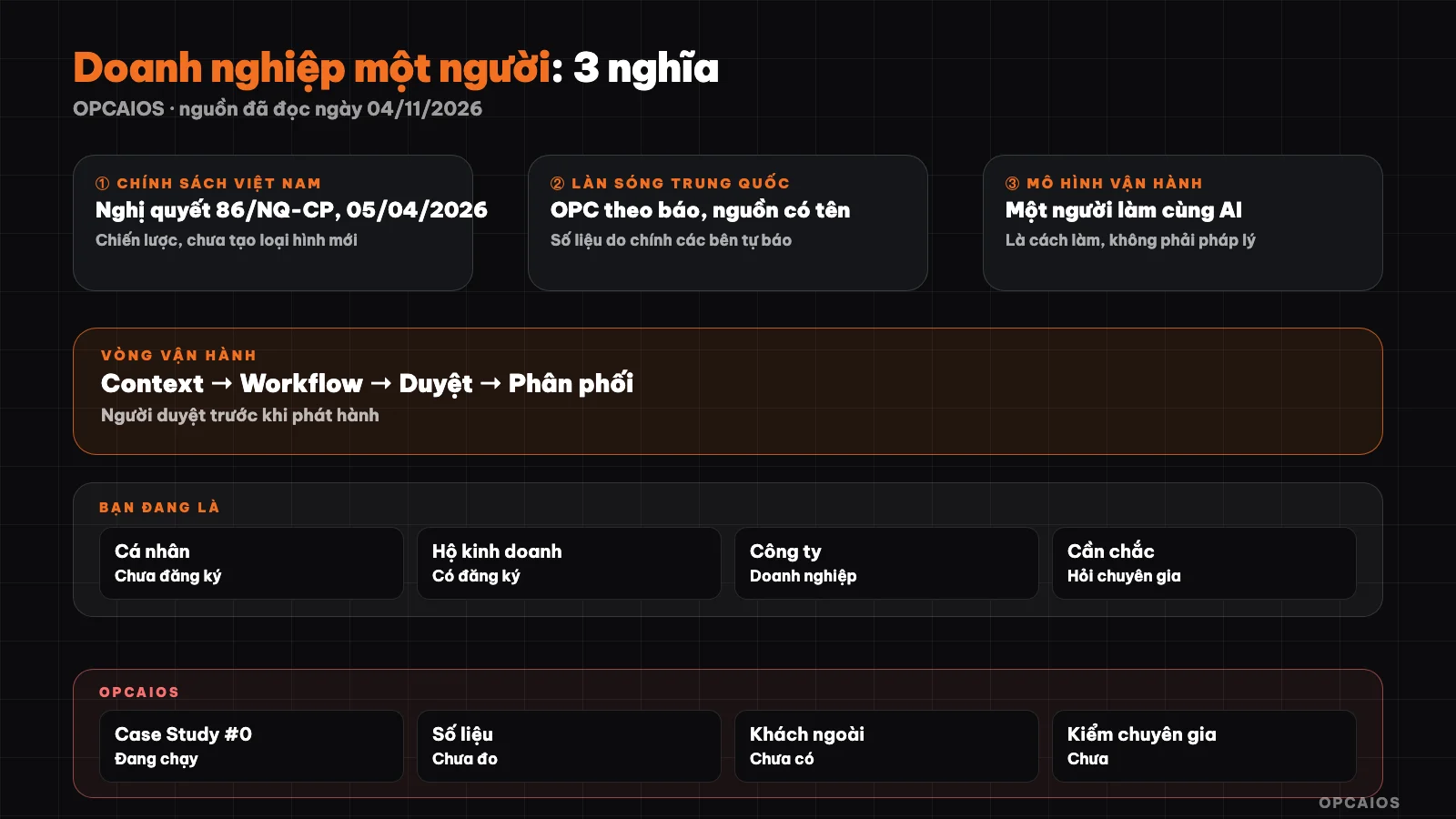
Three meanings of "one-person enterprise" and the one-person operating cycle. Diagram: OPCAIOS.
What is a one-person enterprise (OPC)?
A one-person enterprise is an enterprise owned and directly operated by an individual, using digital tools, AI, or outsourcing for remaining work instead of hiring a fixed team. This is a term based on how it operates, not yet the name of a distinct legal form in the documents we have read. What already exists in law is the limited liability company with one member: according to Article 74 of the Enterprise Law No. 59/2020/QH14 (original text on vanban.chinhphu.vn, read on 04/11/2026), it is an enterprise owned by one organization or one individual, the owner bears responsibility within the scope of chartered capital, and the company has legal status from the date it receives the business registration certificate. The law has been amended after 2020; we have not yet compared the latest consolidated version.
How do the three meanings of "one-person enterprise" differ?
The three meanings differ in who is speaking and their legal value, so reading news without separating them is easy to misunderstand. You can operate according to the third meaning without enjoying any policies from the first meaning.
| Meaning | Who says it | Legal value in Vietnam |
|---|---|---|
| 1. Vietnam policy | Government, National Assembly, ministries | Currently only guidelines and proposals |
| 2. China's wave | Local authorities, media | Not applicable in Vietnam |
| 3. Operating model | Person working alone | Not a legal form |
Vietnam: What does Resolution 86/NQ-CP say about one-person enterprises?
Resolution 86/NQ-CP issues the national strategy on startup innovation and mentions one-person enterprises as something needing proposals and pilot programs, not creating a new legal form. We downloaded and read the PDF signed on vanban.chinhphu.vn (read on 04/11/2026): number 86/NQ-CP, dated 05/04/2026, issued by the Government, signed by Deputy Prime Minister Nguyễn Chí Dũng on behalf; Article 2 states it takes effect from the signing date. Three places mentioning one-person enterprises are all task assignments to agencies, not regulations with effect on individuals:
- Strategy, section III.3.a: "propose pilot policies" for the model, including simple end-to-end registration in digital environment, no requirement for physical address in business registration, exemption from audits for the first 03 years and other policies.
- Section V.2.b: Ministry of Finance researches and proposes pilot policies; section V.4.b: ministries, agencies, localities allocate resources for support programs.
- Appendix, section III.4: "Plan to develop one-person enterprise model," led by Ministry of Finance, submitted to competent authority, deadline 2027.
The figure "one million one-person enterprises by 2030" does not appear in the official text we read. According to Tuổi Trẻ (Ngọc Anh, 20/05/2026), it was a statement by Mr. Phạm Đức Nghiệm, Ministry of Science and Technology, at a press conference in late April/2026; the targets in the Strategy are 5 million business entities and a minimum of 10,000 innovative startups. More recent and only at draft stage: according to Sức khoẻ & Đời sống (17/10/2026) and Nhân Dân (around 07/10/2026), the draft Law on Development of Small and Medium Enterprises of the Ministry of Finance contains provisions allowing households to convert into one-member companies with one individual as owner, with minimal governance. The draft has not been passed and we have not compared the original text.
China: what the press says about the OPC wave, and what remains uncertain?
In China, "OPC" is used by the press to refer to solo founders, mainly building AI products, and many localities have announced support for this group. We only cite what we read from two named sources with dates (read on 04/11/2026), with no original documents. According to Beijing Review (Yuan Yuan, 09/03/2026): Shenzhen is cited as the first city with a city-level action plan for OPC, offering training vouchers of up to 10 million yuan per person per application per year to offset compute costs and AI model calls. According to Rest of World (Viola Zhou, 18/03/2026): Suzhou commits to building 30 OPC communities and developing 1,000 one-person businesses by 2028.
Limits stated in the articles themselves: most support levels are maximum caps, not amounts actually spent; no national OPC count, survival rate, or profitability figures; revenue figures are self-reported by businesses; cited investors (unnamed) believe most OPCs will not become sustainable businesses; definitions remain inconsistent. Beijing Review is state media so the article tone is positive. This is only a signal that other places are experimenting; results remain unclear.
Are you a household business, a company, or an individual?
To know which policies might apply, first identify your current form, since each has different accounting, tax, and liability rules. The table only helps with positioning; this article does not list tax rates or thresholds because we have not yet cross-checked them.
| Your current form | Do this first | Read next |
|---|---|---|
| Individual selling services, not yet registered | Ask an accountant about tax obligations and separate income and expense records | Personal income tax |
| Household business | Separate personal and business funds, keep records | Household business records |
| Considering upgrading to a company | Ask a lawyer about single-member companies | Moving household business up to company |
| Already have a single-member company | Keep records, contracts, and taxes on time | Legal checklist |
Consult a specialist before signing large contracts, taking capital, hiring long-term, or if unsure about last year's tax obligations. If unclear on direction, see What is a solopreneur?.
How does one person operate: Context, Workflow, Review, Distribution?
One person operates through AI mainly via four layers of repeating work: Context (write down background), Workflow (break work into steps), Review (someone checks), Distribution (ship to market). Context is a short document about who you are, what you sell to whom, your voice, what is forbidden; see Context pack for solo workers. Workflow is a repeatable chain of steps, described in system for AI operating solo. Review is the step where a real person reads and decides before anything goes out, especially things touching customers, money, and law. Distribution is where results meet users: posts, email, messages, storefronts; see AI helps one person run a business.
The real weakness of the model is the sole person: illness, overload, or wrong calls mean no one else can cover, and AI mistakes still need a human to catch them. Do not skip the Review step, and measure actual hours (a week delegating to AI with real hours). See also why maximum efficiency becomes the floor, not an advantage.
What to do next Monday if you want to try?
Do three small things in one morning. One, write a half-page context: what you sell, to whom, what you never say. Two, pick exactly one repeating weekly task and write the current steps on paper. Three, give that task to AI, review the result yourself, and log real minutes before and after. Without numbers, do not draw conclusions. Handle law and taxes separately with an accountant or lawyer.
OPCAIOS experience
OPCAIOS is an AI operating system built by Le Quoc Nghia for solo workers; the website opcaios.org is built by one person with AI agents, has a blog, document and template shop, courses, internal CRM, and SEO articles drafted by AI then reviewed by hand, not auto-posted. Nghia is running Case Study #0 on himself. We have no published figures on revenue, traffic, or time saved so we share no numbers, and no outside customers yet verified to cite. One real limit: filming and speaking on camera remains the slowest part; AI cannot yet replace that.
Frequently Asked Questions
Is a one-person business a new business type in Vietnam?
Not yet. According to the PDF of Resolution 86/NQ-CP (05/04/2026) that we read, the document only proposes a pilot policy for this model and assigns the Ministry of Finance to develop a plan, with a deadline of 2027. A single-member limited liability company has existed since the 2020 Enterprise Law, Article 74. A draft law is under discussion about household businesses converting to single-member companies, but it has not been passed. Ask a lawyer or accountant before choosing a business form.
Have the three-year audit exemption and no physical address requirement been applied yet?
Not yet in effect. These two items are in the "propose pilot policies" section under section III.3.a of the Strategy attached to Resolution 86/NQ-CP. We have not seen any legal documents issued to apply these, so do not register, establish an address, or abandon record-keeping based on them. When official documents are available, read the conditions, effective date, and consult an expert.
Has Vietnam set a target of one million one-person businesses by 2030?
According to Tuoi Tre (20/05/2026), this figure was mentioned by Pham Duc Nghiem, Ministry of Science and Technology, at a press conference in late April 2026. In the Strategy document itself that we read, the specific target by 2030 is 5 million business entities and a minimum of 10,000 innovative startup enterprises; we did not see the figure of one million there. So treat one million as a statement by an official, cite the source clearly, not as a target in the resolution.
Has China's OPC model proven that one person can do the work of a whole team?
No. The articles we read (Beijing Review 09/03/2026, Rest of World 18/03/2026) mainly discuss support policies and a few examples, and they themselves mention limitations: no national OPC figure, revenue self-reported by businesses, investor skepticism, definition not yet unified. Do not treat this wave as proof that a model has succeeded; it only shows many places are trying it.
Where should a person start trying this model?
Start with a repetitive task, not with registering a company. Write a one-page background, record the current steps of one task each week, pass it to AI and review yourself, then record actual minutes. Handle legal, tax, and record-keeping in parallel with an accountant or lawyer; before registering, see the legal checklist for solopreneurs.
Next Steps
We are running Case Study #0 on Le Quoc Nghia himself and will publish measurements when available, including parts we haven't completed. To follow along, see the about OPCAIOS page.
Source: Resolution 86/NQ-CP dated 05/04/2026 and attached National Strategy on Innovative Entrepreneurship (signed PDF, vanban.chinhphu.vn); Enterprise Law No. 59/2020/QH14, Article 74 original version (vanban.chinhphu.vn); Tuoi Tre (Ngoc Anh, 20/05/2026); Health and Life (17/10/2026); Nhan Dan (around 07/10/2026); Beijing Review (Yuan Yuan, 09/03/2026); Rest of World (Viola Zhou, 18/03/2026); all accessed 04/11/2026. Not verified: consolidated Enterprise Law version, original draft law, original Chinese government documents, and documents on one-person businesses issued after the reading date. This post is for reference only, not legal or tax advice; consult an accountant or lawyer before deciding. Experience is from OPCAIOS.
Translated from Vietnamese with AI. Read the original.
Want to apply this in your business?
Book a free 30-minute call (Vietnam time, in English or Vietnamese).