


Packaging and Selling AI Prompts or n8n Templates: What Is It?
It's turning the AI prompts and automation workflows you've used effectively into digital products with documentation, setup guides and support, then selling them to people who don't want to start from scratch. "No capital needed" is true in that the cost to produce is roughly your time; but it doesn't mean you need nothing: you need a product that actually solves a problem, an audience to sell to, you need to scrub all sensitive information, and you need to understand the risks of support and refunds. This is also a crowded market: many people sell prompts and templates for free or cheap, so value lies in completeness and measurable results. A hypothetical example: a bundle of 5 prompts at $15 sold to 40 people brings in $600 before fees, not counting a few hours of support. A step-by-step guide, based on Gumroad's pricing page read on 25/10/2026, and noting things not yet verified.
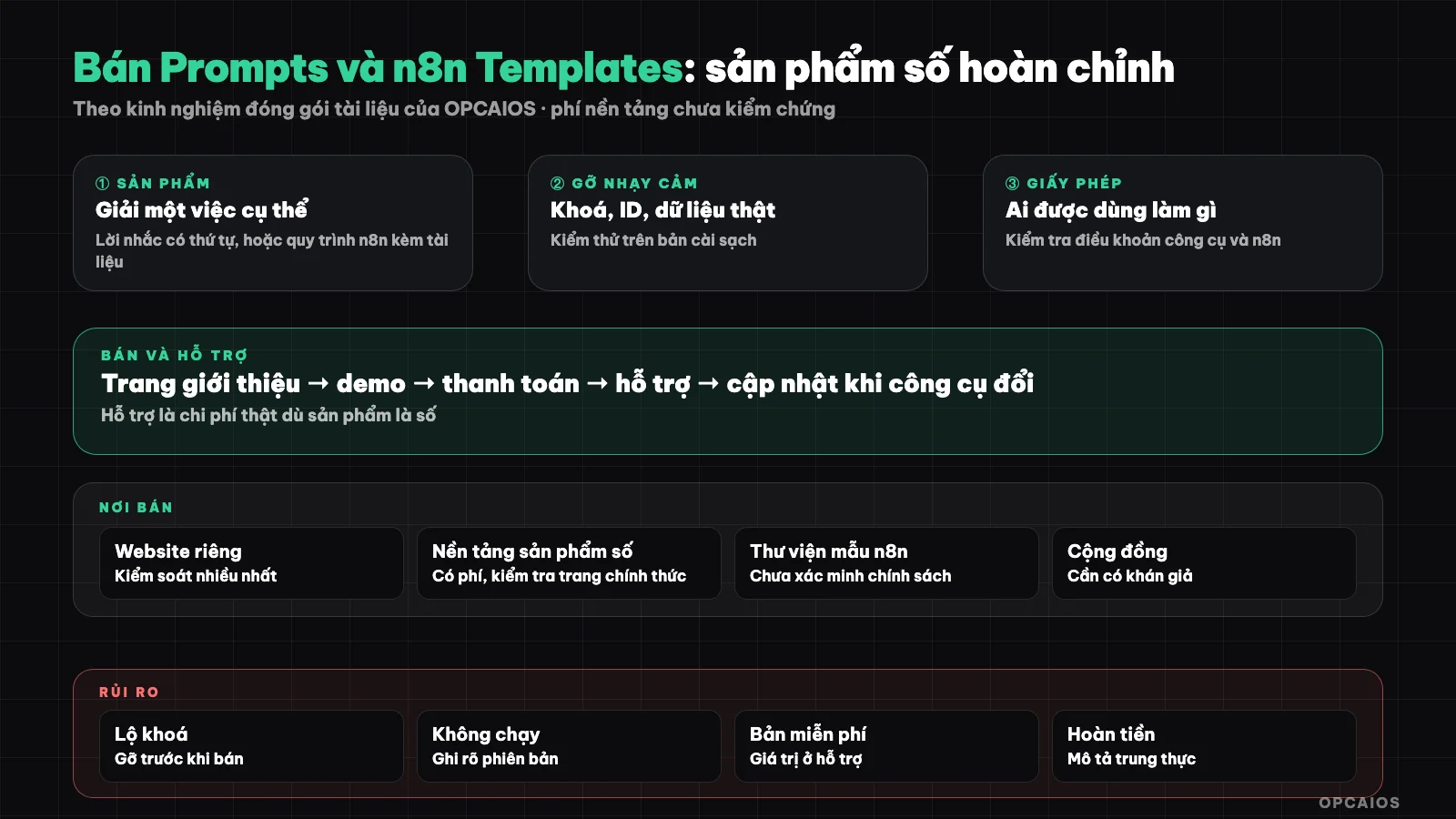
From a workflow you've used to a product with documentation and support. Diagram: OPCAIOS.
Steps 1 and 2: How do I choose a problem and then make a complete product?
A sellable product solves a specific job for a specific group, such as "chain of prompts to write product descriptions for fashion shops" or "n8n workflow that takes orders from a form and sends confirmation". A bundle of "100 best prompts" in general is hard to sell because there are many free versions. Start with something you've actually used. After choosing a problem, make a complete product:
- With AI Prompts: an ordered chain of prompts, variables to fill in, example inputs and outputs. Test on multiple models like ChatGPT and Claude, clearly note which models you tested and when, since results change when models update. Add instructions for checking results since AI can be wrong.
- With n8n Templates: a workflow file exported from n8n, with documentation about purpose, requirements (n8n version, service accounts), each setup step, how to test and handle errors (n8n on VPS).
- Finally, add screenshots or a setup video. A hypothetical example: a bundle of 5 prompts with a 10-minute video, sold for $15 to 40 people.
Steps 3 and 4: How do I scrub sensitive information and handle licensing?
Scrubbing sensitive information is a mandatory step: delete or replace all API keys, tokens, passwords, internal addresses and account IDs before selling or sharing a workflow (see Data Security When Using AI). A hypothetical example: an n8n file with 3 API keys and 2 account IDs left behind is enough to expose data to 100 buyers. Step 3 has four tasks: replace real customer data with fake data; separate credentials from the file; guide buyers to create their own credentials; open and test the file on a clean setup to make sure no traces remain. Step 4 is licensing and rights:
- Product license: clearly state what buyers can use it for (personal, commercial, can they resell).
- Rights to third-party content: make sure you have rights to images, fonts, text in the bundle.
- n8n license: n8n uses Sustainable Use license; if you sell workflows for customers, read the current terms yourself, OPCAIOS does not give legal advice.
- Terms from AI providers like OpenAI or Anthropic: check rules about using prompts and outputs for commercial purposes.
Steps 5 and 7: What goes into documentation, how to sell, and long-term support?
A good sales page answers five questions: what problem does it solve, who should buy, who shouldn't, what's in the bundle, and what are the real results (from you, not made up). You also need a short demo video about 3 minutes long shot with Loom, frequently asked questions and a refund policy. You can give away a small free version to collect emails and build trust (automated sales funnel). After you sell, support is a real cost: a template breaks when a button or API changes, a prompt gets worse when a model changes. Decide these three things ahead of time:
- How long you support and through which channels.
- How often you update.
- Are updates free.
A hypothetical example: if 40 people buy and 10% (4 people) ask questions in 30 days, each one takes 20 minutes, total support is about 80 minutes, not counting updates.
Step 6: Which sales platform is suitable and what are the fees?
A sales platform is where customers pay and receive files; each choice trades control for convenience. On fees, according to Gumroad's official pricing page (read October 25, 2026), selling directly via profile or private link charges 10% plus $0.50 per transaction, while selling through Discover charges 30% per transaction. Example calculation: a $20 template sold directly costs $2.50 in fees, sold through Discover costs $6.
| Option | Notes |
|---|---|
| Own website + payment gateway | Most control, you handle file delivery and taxes |
| Digital product platform (like Gumroad) | Convenient, but has fees: 10% + $0.50 direct sales, 30% via Discover (official page, read October 25, 2026) |
| n8n template library | Has community template library; we have not verified paid template sales policy, check the official page |
| Your community, your newsletter | Low cost, need an audience |
Fees and terms change; check the official page again before selling.
Risks
| Risk | How to reduce |
|---|---|
| Exposing keys or customer data | Scrubbing process above |
| Product doesn't run on buyer's machine | Test on clean install, specify versions |
| Competition from free versions | Value in documentation, results proof, support |
| Refunds and disputes | Honest descriptions, clear policy |
| License or copyright violation | Check terms, ask an expert |
| High support costs | Limit support scope |
| Taxes | See Legal checklist |
OPCAIOS experience
We have not sold n8n templates or prompt sets and have no revenue figures from this model. OPCAIOS runs a free library of documents and templates, and what we learned when packaging digital documents is the most labor-intensive part is testing on a clean install and writing guides, not building the product. The platform fees and template library policies in this article have not been verified by us directly.
Frequently asked questions
Can you make money selling prompts and n8n templates?
We have no figures; the market is crowded and many are free, so value must come from completeness and support.
Do you need capital?
Cash costs are low, but you need time, audience, and support.
How do you avoid leaking information when sharing workflows?
Remove keys, IDs, real data; test on a clean install.
Where to sell?
Own website, digital product platform, or community; check current fees and terms.
Where to start?
From a workflow you have actually used and a specific customer group. See OPCAIOS's AI application training course.
Source: Gumroad's official pricing page (read October 25, 2026) for 10% + $0.50 and 30% fees; OPCAIOS's experience packaging documents; n8n template sales policy not verified and terms from each platform. No revenue figures. Experience is OPCAIOS's.
Translated from Vietnamese with AI. Read the original.
Want to apply this in your business?
Book a free 30-minute call (Vietnam time, in English or Vietnamese).