



What is E-E-A-T?
E-E-A-T is short for Experience, Expertise, Authoritativeness, and Trustworthiness. According to Google's helpful content guidelines (as of October 25, 2026), E-E-A-T is not a direct ranking factor, but Google's systems use a combination of signals to recognize content that demonstrates these qualities, and among the four components, trustworthiness is the most important. This post explains what E-E-A-T is, the Who, How, Why framework, self-assessment questions, how to demonstrate it on your website, and OPCAIOS's experience.
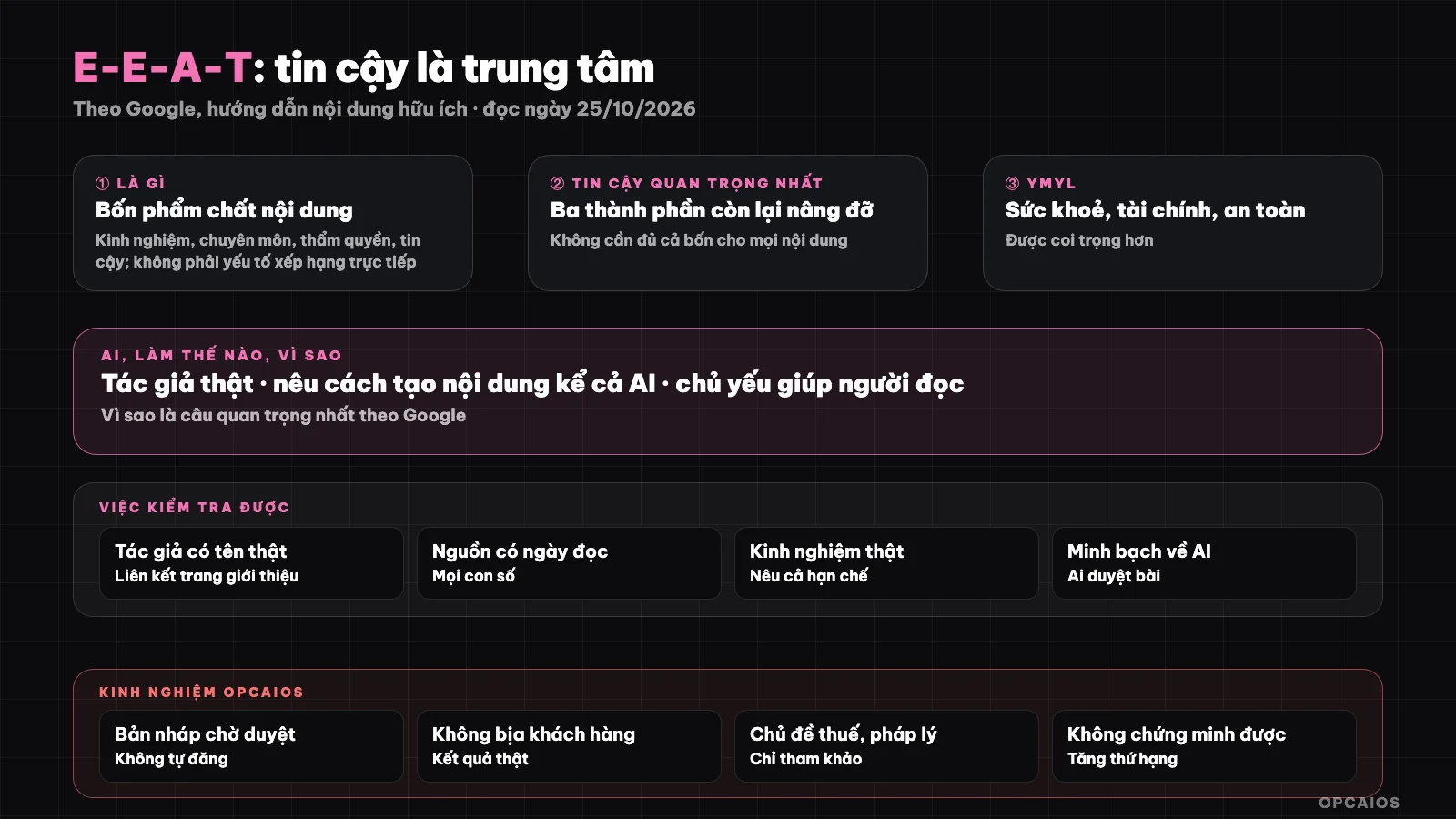
Trustworthiness is at the center; experience, expertise, authoritativeness support it. Diagram: OPCAIOS.
What is E-E-A-T and is it a ranking factor?
E-E-A-T is a framework for evaluating content quality. Google is clear it is not a direct ranking factor; instead their automated systems use many signals to identify content that demonstrates experience, expertise, authoritativeness, and trustworthiness.
Google also notes you don't need to show all four equally: some helpful content relies on real-world experience, others on expertise. For "Your Money or Your Life" topics—those affecting health, finances, safety, and life—E-E-A-T is weighted more heavily.
What do the four components mean?
| Component | Plain meaning | How to show it |
|---|---|---|
| Experience | The writer has directly done, used, or gone through it | Real examples, real screenshots, mention limitations too |
| Expertise | Deep understanding of the topic | Accurate, detailed explanations with basis |
| Authoritativeness | Recognized in the field | Cited and referenced by trustworthy sources |
| Trustworthiness | Accurate, honest, transparent | Clear sources, fix errors, no fabrication, clear contact info |
The table is OPCAIOS's interpretation based on the names; what Google makes clear is that trustworthiness matters most.
The "Who, How, Why" framework
Google suggests three questions. Who: make clear who created the content, provide author information, don't fabricate identity or credentials. How: explain how the content was made, including the role of automation or AI. Why: the most important question—the content must primarily help readers, not primarily drive search traffic.
This is especially relevant when you use AI to write content: be transparent about the process and have someone accountable for verification. See auditing AI content before publishing and AI hallucination.
Google's self-assessment questions
Google provides a list of questions to evaluate your content yourself. Some key ones: does the content offer research, analysis, or original insight beyond the obvious; is it accurate, complete, thorough; would readers want to save or recommend it to friends; would someone learning about your site view it as trustworthy; do readers achieve their goal after reading; was the content written for real readers or to chase rankings and trends.
Showing E-E-A-T on a solo website
Concrete and verifiable actions: have a real author bio page, credit the author and update date, source all figures with access dates, share real experience including limitations, note what you haven't verified, and fix errors publicly. Don't create fake experts or reviews.
- Author has a real name and role, linked to their bio page.
- Sources for every figure, with access date.
- Real experience section, mentioning what you haven't done.
- Transparent about AI: say how the post was made and who reviewed it.
- Clear contact and policy information.
- Regular updates to posts with prices or changing rules.
The optimal way to be found and cited by AI, see SEO and GEO explained and structured data.
OPCAIOS's Experience
Our content rules follow the points above: posts have authors with real titles, the "OPCAIOS's Experience" section states both limitations, the final sources paragraph records the date read and what was not read, we don't make up customers or results, and AI-written drafts always wait for review.
Limitations: E-E-A-T is not a measurable score; we have no way to prove that doing these things raises rankings, and Google states clearly it is not a direct ranking factor. We treat it as a self-check standard for quality, not an SEO trick. On taxes, legal matters, or health, we only provide reference information and recommend consulting an expert.
Frequently Asked Questions
Is E-E-A-T a score I can optimize?
No. Google says it is not a direct ranking factor; this is a framework for evaluating and improving content quality.
When was the first E (Experience) added?
The page I read does not state when the first E was added; I only confirm the current framework contains experience, expertise, authoritativeness, and trustworthiness.
Does using AI to write posts violate anything?
Google says you should be transparent about automation's role and content should mainly help readers. Verification and responsibility still belong to the person.
Do I need a degree to have E-E-A-T?
Not always. Google says some helpful content comes from direct experience; but don't make up a degree.
Where should I start?
Add real authors, sources, and read dates to your 5 most important posts. Need help, see AI application training services.
Source: Google Search Central, "Creating helpful, reliable, people-first content" (developers.google.com), read October 25, 2026; the page does not state when the first E was added. The table explaining the four components and the to-do list are OPCAIOS's. Experience is OPCAIOS's.
Translated from Vietnamese with AI. Read the original.
Want to apply this in your business?
Book a free 30-minute call (Vietnam time, in English or Vietnamese).