



AI Content Auditing is a systematic review of a draft written or co-written by AI, to catch factual errors, copyright issues, wrong tone, and legal risks before it reaches readers. This post does not promise that a checklist will eliminate every risk, and the legal section is for reference only, not legal advice. You will get checklists by layer: facts, copyright, tone, legal and personal data, AI labels. The post also covers how to fact-check in 10 minutes, supporting tools, how to record evidence, how to correct when wrong, and which parts of the review can be automated. Points about AI-generated content are based on Google Search Central guidelines, read on 25/10/2026. If ChatGPT or Claude draft content, it still goes through the same process.
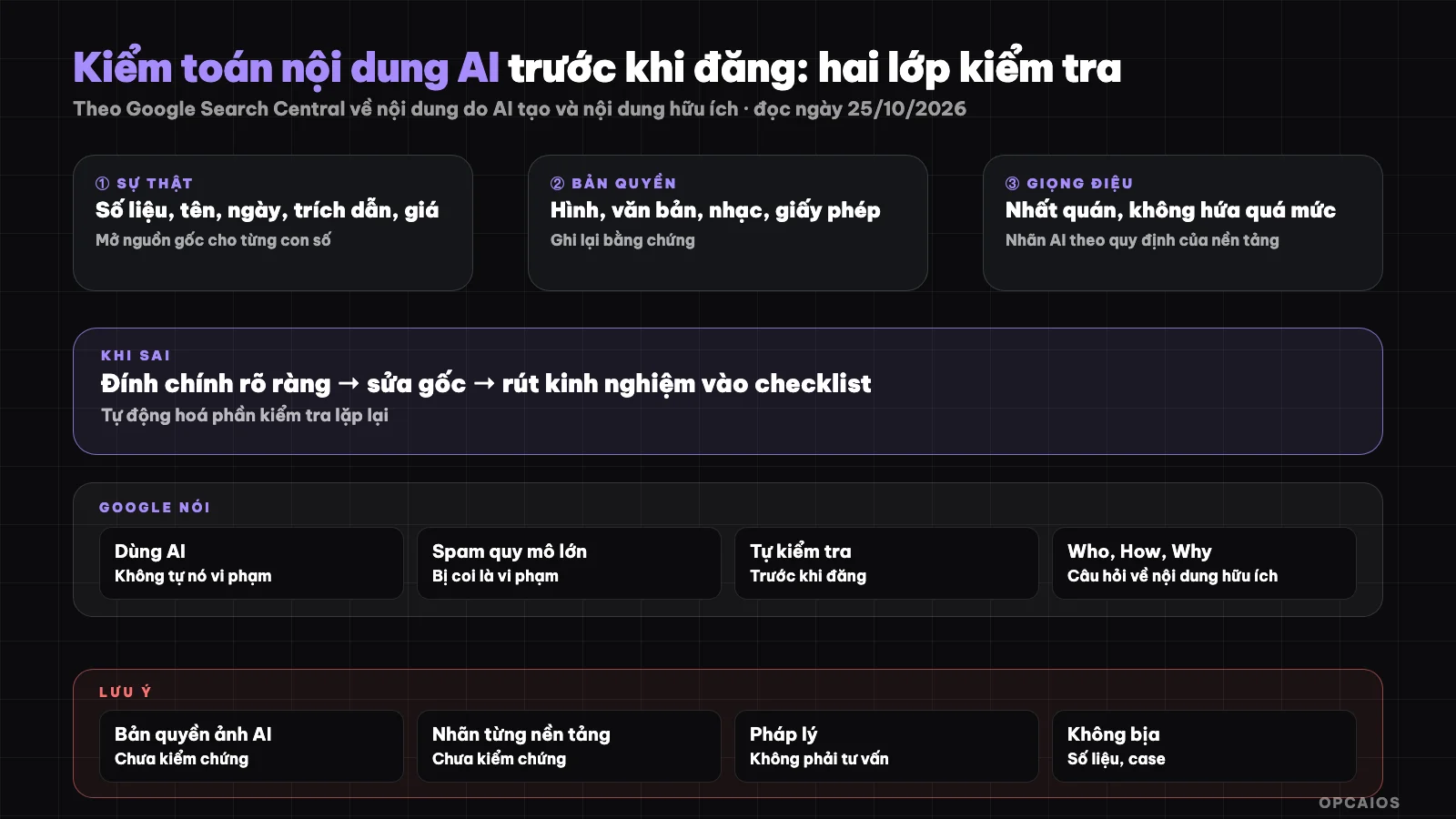
Review layers from draft to manual review. Diagram: OPCAIOS.
Why audit AI content before publishing?
You must audit because language models generate text with high confidence but do not retrieve verified facts, so they can write incorrectly very confidently. Google Search Central's guidance on AI-generated content (read 25/10/2026) is clear: using AI to research or organize original content is fine, but you should fact-check and review before publishing, including title, meta description, structured data, and image alt text. Google also treats bulk AI-generated pages that don't provide user value as violating large-scale content spam policy. The guidance on helpful content asks three questions:
- Who wrote it: is the author clear, don't make up authors or credentials.
- How: you should say how content was created, including AI use, when readers might wonder.
- Why: write to help readers, not just to pull search traffic.
Two-layer Checklist: Facts First, Then Form
Layer 1: What does fact-checking include?
Fact-checking is the first layer, consisting of 6 items that need to be verified against official sources. The data item: numbers, percentages, statistics need sources, and if I can't find the origin, I drop the number. The name item: people, companies, products, titles must be written correctly, cross-checked against official pages. The date item: event dates, versions, legal milestones, I check the source page and update date. The quotation item: quoted sentences must be real and from the correct speaker, I find the sentence in the original source and delete it if I don't see it. The price item: prices, packages, tool limits, I open the official price page and note the viewing date. The link item: URLs still work and have correct content, I click each link to test. Hypothetical example: a draft written by ChatGPT contains a CEO's quote, but I can't find it in the original source; the quote must be deleted. Language models often fabricate quotes, numbers, and links that sound plausible. Safety rule: anything I can't find a source for, I don't post as a fact.
Layer 2: What does copyright check include?
Copyright checking means determining whether images, text, music, and people's images in the post are permitted to use. For images, I ask where the image came from and what license permits commercial use, then do a reverse image search to see if the image is a copy of someone else's. For text, I check which passages are too similar to an existing source, using plagiarism detection tools or searching a distinctive sentence in quotation marks. For music and video, I read the library license and platform terms. For images or real people's voices, I confirm that consent has been obtained. Example: an illustration created by an AI tool still needs me to read the tool's commercial use terms before posting it to a sales page. Reverse image searching on Google or similar tools takes a few minutes and is usually enough to detect copied images.
Tone, Legal, and Personal Data
Tone
- Consistent with the brand; don't use oversized promises ("guaranteed", "sure to make money").
- Don't impersonate real people or create fake testimonials.
Legal Advertising and Personal Information
- Comparative claims, effectiveness, income need evidence; if it's paid advertising, read the platform's policy. Specific regulations vary by location, we haven't verified details, please ask an expert when content is sensitive (health, finance).
- Don't include customer names, phone numbers, images without permission. See securing business data when using AI.
What is AI labeling by platform?
AI labeling is a mark to tell readers that content was created or assisted by AI. Many platforms have rules about labeling AI-generated content, and rules change. OPCAIOS hasn't verified the current terms of each platform, so before posting, open the policy page of where you're posting. Specifically with Google, the documentation mentions considering informing readers how content was created and adding image metadata. For e-commerce pages using Merchant Center, there's a requirement to label images and descriptions created by AI. Example: a store posting a product to Merchant Center needs to read this labeling requirement before using AI-generated images.
What are the steps in the 10-minute fact-check method?
The 10-minute fact-check method has 5 steps, applicable to any draft, including those from ChatGPT or Claude.
- Mark everything that needs verification: numbers, names, dates, quotes, prices, links.
- For each item, find the official source (supplier's website, documents, legal text); secondary sources are only for reference.
- Items with no source: delete, or write clearly "not yet verified".
- Note the date I read the source at the end of the post, because prices and policies change.
- Read through once with human eyes: are there passages that sound right but I don't trust?
Example: a 800-word post has about 10 numbers and names to check; spending 1 minute per item is just right within 10 minutes.
Which tools support AI content auditing?
Tools that support AI content auditing come in 5 groups, and most are free or available in your browser. The first group is reverse image lookup using image search tools like Google to detect copied images. The second group is searching quoted sentences to trace their origin. The third group is broken link checkers that can run across an entire article. The fourth group is searching web archives to see what a page said at an earlier time, useful when sources have changed prices or policies. The final group is a fixed checklist in your note-taking tool, so each article goes through the same steps. For example, you can save the 5 fact-checking steps above in Notion or a note file, then copy it for each new article. Tools are just filters; the final call still rests with the reviewer.
Record evidence
For each article, keep a brief record: sources reviewed, date reviewed, what was corrected, what remains unverified, who reviewed it. When someone asks "where did this number come from", you answer in a minute; when you need to issue a correction, you know where the error was.
When you find an error, how do you correct it?
Correction means fixing wrong content and letting readers know what changed. The process has 4 steps:
- Fix the wrong content right away; don't silently fix it if the error affects a reader's decision.
- Add an update note with a date: what was wrong, what is right.
- If you already sent it by email or social media and the error is serious, post a correction in the same place.
- Find the root cause (weak source, easy-to-mistake instruction) and add it to the checklist.
Example scenario: an article states the wrong price for a tool package, and 3 people read the email version; you fix the article, add a note "updated on ..., correct price is ..." and send a correction email. Step 4 keeps the same type of error from repeating in the next article.
Which part of auditing can be automated?
The automatable part is repetitive work machines do well: checking links, detecting numbers and dates in articles to create a list of "needs a source", matching forbidden phrases (money-making promises, absolute statements), detecting personal information like email or phone number, and scoring duplication. The part that needs people is judging whether a claim is true, whether an image can be used, whether the tone fits. For example, a script could scan an article and list 10 unsourced numbers for the reviewer to handle, instead of having the reviewer read line by line. Don't have one AI model audit another AI model and then fully trust it; treat that step as a rough filter. For why you shouldn't push everything to AI, see lazy AI users get filtered out.
OPCAIOS experience
With my blog, OPCAIOS applies 5 rules. Articles drafted by AI are reviewed by hand before posting, not auto-published. The end of each article lists sources read with the date read. Articles clearly state what remains unverified. Articles don't fabricate data, revenue, or customer cases. If there's no real case, I use a hypothetical model and clearly mark it as hypothetical. OPCAIOS hasn't measured the error rate caught by the review step, and the checklist above isn't a full description of the internal process. You can see how an AI-operated system works at AI system operating by itself.
Frequently Asked Questions
Does Google penalize content written by AI?
According to Google Search Central guidelines (read October 25, 2026), using AI by itself is not a violation; the issue is producing masses of low-value content, which falls under large-scale content spam policy. Quality and usefulness are what matter.
Do I need to label content as "written by AI"?
Google suggests considering whether to disclose how content was created when readers might wonder, but it's not required for every piece. Other platforms have their own rules that I haven't verified—read the policy where you're posting.
What if I can't find a source for a statistic?
Drop the number, or clearly note it as unverified. Don't keep it just because it sounds reasonable.
Is it safe to use AI-generated images for copyright?
There's no blanket guarantee: it depends on the terms of the image generation tool and laws in each country, which I haven't verified. Read the commercial use terms of your tool, and avoid images that resemble existing works or real people.
Where should I start?
From the layer of facts: make a list of numbers, names, dates, quotes, prices and check each one. If you want to learn how to build a review process into your daily work, see OPCAIOS's AI application training course.
Source: Google Search Central guidelines on AI-generated content and helpful, trustworthy, people-first content (read October 25, 2026); unverified: AI labeling and advertising rules by platform, copyright issues with AI images, specific legal rules (not legal advice); experience is OPCAIOS's.
Translated from Vietnamese with AI. Read the original.
Want to apply this in your business?
Book a free 30-minute call (Vietnam time, in English or Vietnamese).