


What is Fine-tuning?
Fine-tuning (fine-tuning) is training a foundational model further on your input and output example pairs so it performs better at a specific task. According to OpenAI's model optimization documentation (read on 25/10/2026), compared to using prompts alone, fine-tuning allows you to use more examples than fit within a context window, shorten prompts to reduce cost and latency, and train smaller, cheaper models for narrow use cases. This post explains what fine-tuning is, how it compares to prompting and RAG, when to use it, risks, and OPCAIOS's experience.
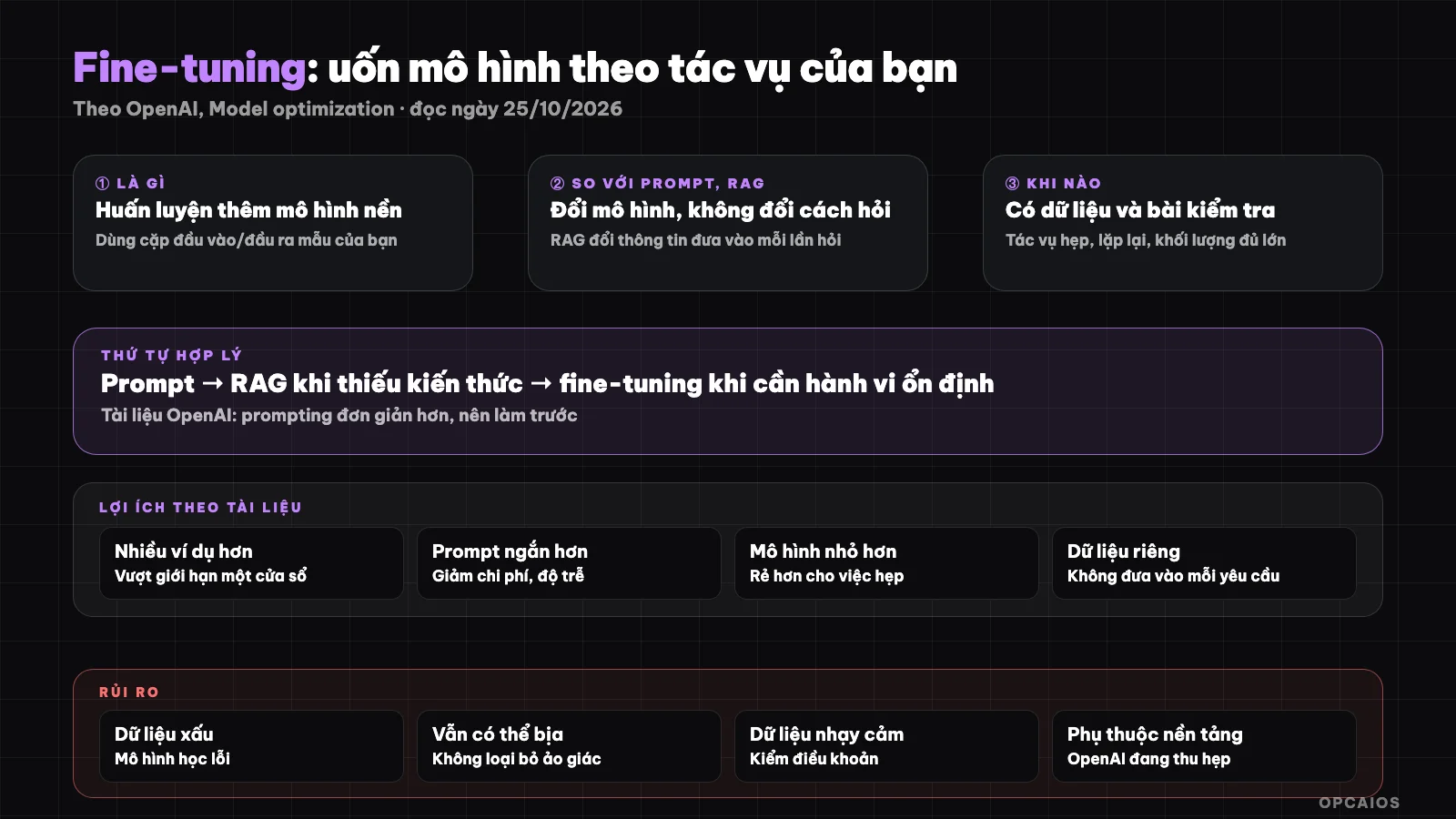
Selection scale: prompt first, RAG when knowledge is lacking, fine-tuning when stable behavior is needed. Diagram: OPCAIOS.
What is fine-tuning and how does it work?
Fine-tuning continues training a foundational model on a set of your examples (desired inputs and outputs), then produces a new variant tuned to that task. You don't teach the model from scratch; you adjust the behavior of an existing model using sample data.
The foundation is an LLM: a model that has already learned language from very large amounts of data, fine-tuning simply "bends" it toward your own style, format, or task. It's usually used to make behavior more stable, not the main way to load new knowledge that changes daily.
How does fine-tuning differ from prompting and RAG?
Prompting changes how you ask, RAG changes the information fed in each time you ask, while fine-tuning changes the model itself. OpenAI documentation says prompting is simpler and should usually be tried first; the page I read didn't discuss RAG, so the comparison below is a general description by OPCAIOS.
| Criteria | Prompt | RAG | Fine-tuning |
|---|---|---|---|
| Changes what | Instructions each query | Documents fed each query | Model weights |
| Data needed | A few examples | Document repository | Many high-quality input/output pairs |
| Update knowledge | Easy | Easy (swap documents) | Must retrain |
| Startup cost | Low | Medium | Higher, time-consuming |
| Strong at | New tasks, quick changes | Q&A from custom documents | Style, format, narrow repeated tasks |
The table is a general description, not a measurement. See what is a prompt and what is RAG.
When should you consider fine-tuning?
Consider it when you've tried prompting and RAG, have criteria to measure results, have many good examples, and the task is narrow and repeated with volume large enough to offset cost. OpenAI documentation emphasizes fine-tuning is time-consuming and most effective when paired with testing to see if it helps.
Reasonable signs, according to the documentation: prompts are too long because they carry many examples, you want to cut cost and latency, you don't want to send custom data in each request, or you want to use a smaller model for a narrow job. If the problem is missing knowledge or information that changes, RAG is usually a better fit.
Risks, costs and limits
Fine-tuning needs clean, correct data with enough variety; bad data produces a bad model that's hard to spot. Also you depend on your model provider and their support timeline.
- Data quality: errors in example pairs will be learned.
- Doesn't eliminate hallucination: a fine-tuned model can still make things up.
- Sensitive data: feeding customer data into training is sharing data; check terms and privacy.
- Platform dependence: the OpenAI documentation I read on 25/10/2026 says they are narrowing their fine-tuning platform: new users can't access it, old users can still create jobs for a while, fine-tuned models work until the base model is discontinued. The situation may have changed, check the official page.
OPCAIOS's experience
We haven't fine-tuned any models. Our system relies on prompting, Skills that package workflows (what are Skills and how to use them) and document lookup; when custom knowledge is needed, we prefer lookup because it's easy to update.
Because we haven't done it ourselves, this post doesn't provide our measurement results or cost figures, only a summary from provider documentation. For small business, we think the reasonable order is prompting, then RAG, then consider fine-tuning only when you have enough data and tests; this is practical thinking, not a measurement result. See which AI model to choose.
Frequently Asked Questions
Does fine-tuning teach the model new knowledge?
It can have an effect, but I shouldn't treat it as a method for loading in new knowledge that changes how the model works. For proprietary knowledge and frequently updated information, document retrieval is easier to control.
How much data do I need for fine-tuning?
It depends on the task and the provider; the source I read didn't give specific numbers. Check your provider's documentation.
Is fine-tuning cheaper than prompting?
It might reduce cost per call through shorter prompts or smaller models, but there are training costs and the effort to prepare data. I need to calculate the total.
Does fine-tuning stop AI from making things up?
No. It helps behavior become more stable, but it doesn't guarantee accuracy.
Where should I start?
Write test criteria, try prompts, then add retrieval. If I need advice on a roadmap, see AI application training service.
Source: OpenAI, "Model optimization" documentation (developers.openai.com), read on 25/10/2026; the page does not discuss RAG and does not specify the amount of data needed. Information about narrowing down the platform is from the page at the time of reading. The comparison table is a general description from OPCAIOS. The experience is OPCAIOS's own.
Translated from Vietnamese with AI. Read the original.
Want to apply this in your business?
Book a free 30-minute call (Vietnam time, in English or Vietnamese).