


What is an LLM?
LLM (Large Language Model) is a machine learning model, typically a neural network, trained on vast amounts of text to perform language tasks such as writing, summarization, translation, and text analysis. Most LLMs, according to Wikipedia (accessed 24/10/2026), use the Transformer architecture, learning to predict the next token and then fine-tuned to follow instructions; chatbots like ChatGPT, Claude, Gemini, Grok, Qwen, and DeepSeek all run on LLMs. LLMs are strong at language processing but have clear limitations: they can "hallucinate," are constrained by context windows, and reflect biases in training data.
This post covers: 1) how it works (tokens, Transformer, training); 2) context windows; 3) limitations; 4) extending capability with RAG and tools; 5) safe usage; 6) OPCAIOS's experience. For example, ChatGPT is a chatbot product, while an LLM is the model running underneath.
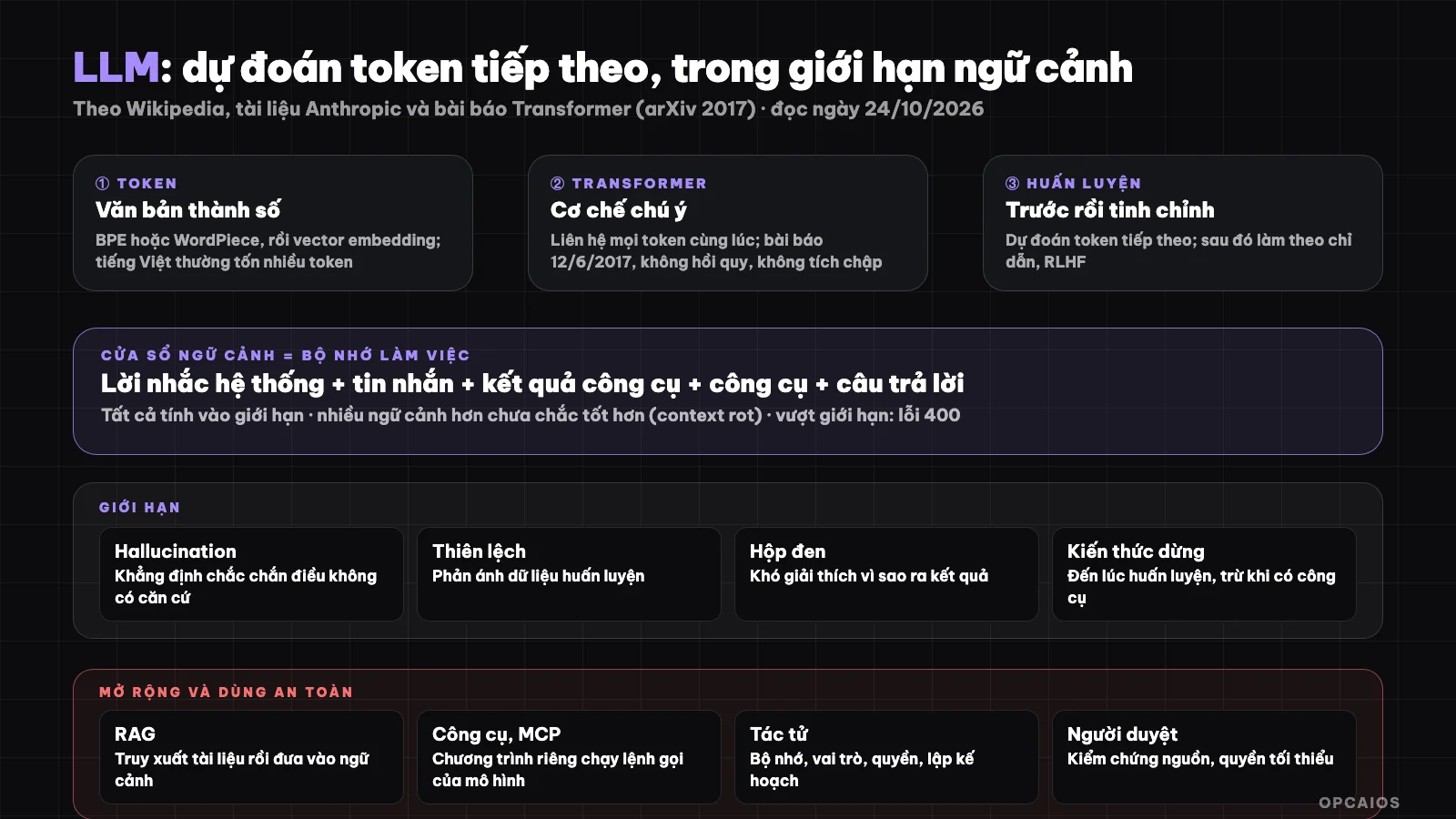
LLM predicts the next token within the context window limit; RAG and tools help it use external data. Diagram: OPCAIOS.
What is an LLM and how does it differ from regular software?
An LLM differs from regular software in that it doesn't run on rules written by a programmer in advance, but instead learns language patterns from data. Regular software, like a calculator or spreadsheet, always produces the same output for the same input. An LLM generates answers by selecting tokens one by one based on their likelihood given the context, according to Wikipedia (accessed 24/10/2026). For this reason, the same question can produce slightly different answers, and fluent answers are not guaranteed to be correct. For example, when you ask ChatGPT or Claude about a specific number not in the context, the model might give you a number that sounds plausible but is wrong. First, treat the output as a draft. Next, cross-check the numbers with their sources. Finally, keep a human reviewer for important content. The general rule is that all important LLM results need verification before use.
How LLMs Work
Tokens and embeddings
According to Wikipedia, text is converted into integers called token IDs (using methods like byte-pair encoding or WordPiece) and then into embedding vectors for neural networks to process. A token can be a word, part of a word, or a character; so Vietnamese text typically costs more tokens than the number of words you see.
What is a Transformer and how does the attention mechanism work?
A Transformer is a neural network architecture that relies solely on the attention mechanism, without using recurrent networks or convolutions, introduced in the paper "Attention Is All You Need" (Vaswani et al., posted to arXiv on June 12, 2017). The paper makes three main points: 1) the attention mechanism allows all tokens in a sequence to relate to each other simultaneously, regardless of distance; 2) according to the paper's summary, Transformers are easy to parallelize and train faster, achieving 28.4 BLEU on English-German WMT 2014 translation and 41.8 BLEU on English-French after 3.5 days with eight GPUs; 3) from that foundation came GPT, BERT, and most models today.
Additionally, some models use a mixture of experts architecture, where each input only passes through a subset of subnetworks to reduce inference costs. For example, when translating a long sentence, the attention mechanism helps a word at the end of the sentence relate directly to a word at the beginning instead of going through intermediate steps.
What stages does training a language model involve?
Training a language model is a process with two main stages, according to Wikipedia (read October 24, 2026).
- Step 1, pretraining: the model learns to predict the next token on a very large cleaned dataset (removing poor-quality data, duplicates, and harmful content).
- Step 2, fine-tuning: teaching the model to follow instructions and behave helpfully, including supervised instruction fine-tuning, learning from human feedback (RLHF, using a reward model trained on evaluator preferences), or methods like constitutional AI.
Training costs are very high. Wikipedia cites estimates of around $50,000 for GPT-2 (2019) and around $8 million for PaLM 540B (2022), and these numbers are just estimates. "Scaling laws" show that performance increases with compute, number of parameters, and data. For example, with the same architecture, a model with more parameters and data usually achieves higher performance, but costs increase accordingly.
Reasoning models
Wikipedia notes that chain-of-thought prompting (2022) helps models reason through multiple steps better, and reasoning models like OpenAI o1 (September 2024) or DeepSeek-R1 (January 2025) are trained to produce step-by-step analysis before answering. In exchange, the "thinking" portion consumes additional tokens and time.
What is a context window?
A context window is all the text the model can reference when generating a response, including the response itself, according to Anthropic documentation (read October 24, 2026); different from the training dataset, the context window is more like a "working memory." There are four things to know, in order: 1) everything in the request counts toward it; 2) window size varies by model; 3) exceeding the window causes an error; 4) more isn't always better. On the first point, the system prompt, messages, tool results, images, documents, tool definitions, and the part the model generates (including the thinking portion) all count. According to current documentation, many new Claude models have a 1 million token window and a request can generate up to 128 thousand tokens of output; other models may be smaller, so check your provider's current model comparison table. If input already exceeds the window, the API returns error 400. For example, a long conversation with attached documents may hit the limit because every previous message is recalculated on each turn.
Limitations of LLMs
- Hallucination: according to Wikipedia, models can confidently state things the training data doesn't support; ways to reduce this include information retrieval, automatic reasoning, and fine-tuning.
- Bias: output reflects the training data.
- Black box: hard to explain why the model produces a result; research in "mechanistic interpretability" is working to clarify this.
- Doesn't learn in real time: knowledge stops at the training time, unless given search tools or data.
- Cost and energy: Wikipedia also raises concerns about copyright and electricity.
- Debate: the research community still disagrees about whether models truly "understand" language or are just good at mimicking patterns.
Expanding LLMs: RAG, tools and agents
According to Wikipedia, RAG (retrieval-augmented generation) embeds questions and documents into vectors, finds the nearest passages in a vector database then feeds them into context so the model can answer based on that; see details in What is RAG?. Using tools means a separate program receives tool calls from the model, runs them then returns the results; the MCP protocol standardizes this connection. When an LLM is given memory, roles, environment access and planning ability, it becomes an agent; see practical use in What is Vibe code?.
Safe LLM use at work
Safe LLM use means sourcing, verifying and keeping a reviewer in the loop, in six steps.
- Step 1, provide sources: put real documents in context (RAG) instead of letting the model remember.
- Step 2, verify: numbers, quotes, links, commands need to be checked against sources.
- Step 3, keep a reviewer: public content, sending to customers or irreversible actions must go through a reviewer.
- Step 4, least privilege: give the agent only the tools and permissions it needs.
- Step 5, don't put secrets in prompts: API keys, passwords, sensitive customer data.
- Step 6, pick the model for the job: simple work uses a small, cheap model; hard work uses a strong model, measure token cost.
For example, an article to send to customers should be read by a reviewer before posting, whether written by Claude or ChatGPT. The process applies to current models in 2026, including models from Google, OpenAI or Anthropic.
OPCAIOS experience
OPCAIOS uses LLMs in two different ways, and the actual process has two parts.
- First, text generation models to draft: articles, summaries and English translations all go through a review queue, and OPCAIOS doesn't let the model publish on its own.
- Second, small embedding models (e5-small) for semantic search in the vector database: this model turns text into vectors but doesn't generate answer sentences.
Lesson learned: LLMs speed up the writing phase, but verifying sources and deciding to publish still belongs to people; each OPCAIOS post clearly notes what hasn't been read or verified. We haven't trained or fine-tuned LLMs ourselves yet, and we don't have formal measurements of error rates for each model.
Common questions
What is an LLM?
A machine learning model trained on large amounts of text to understand and generate language, usually using Transformer architecture and learning by predicting the next token.
How is LLM different from ChatGPT?
ChatGPT is a chatbot product; LLM is the model running underneath. Claude, Gemini, Grok, Qwen, DeepSeek are also chatbots or model families based on LLMs.
What is a token?
A small unit the model processes, can be a word, a part of a word or a character. Context limits and costs are usually measured in tokens.
Why does an LLM give wrong answers even though it sounds very confident?
Because the model generates text based on the highest probability from its training data rather than looking up facts. This phenomenon is called hallucination; reduce it by sourcing (RAG), verifying and having a reviewer.
Is a larger context window always better?
Not really, because more context doesn't automatically mean better. Anthropic's documentation (read 24/10/2026) notes that as token count increases, accuracy and recall degrade, a phenomenon called "context rot", so choosing what to put in context matters as much as remaining capacity. Many new Claude models have 1 million token windows, but large capacity doesn't guarantee the model pays equal attention everywhere. For long conversations, the documentation introduces server-side context compression mechanisms (compaction, beta form). First, only include directly relevant documents. Next, summarize old turns when the conversation is long. Finally, double-check important details in the middle of long text. For example, instead of pasting all 200 pages of a contract, paste the clauses you need to ask about. To learn how to use LLMs and automate safely for your business, see OPCAIOS AI application training course.
Sources: Wikipedia "Large language model" (read first 100,000 characters of the article, remaining part not read); Anthropic documentation "Context windows"; arXiv 1706.03762 "Attention Is All You Need", read 24/10/2026. Training cost figures from Wikipedia, are estimates. Context window size varies by model and time. Experience is from OPCAIOS.
Translated from Vietnamese with AI. Read the original.
Want to apply this in your business?
Book a free 30-minute call (Vietnam time, in English or Vietnamese).