



Who is "the lazy AI user," and why do they, not traditional companies, face the most risk?
This is a perspective, not a research finding: AI doesn't automatically make an existing company's customers, brand, processes, and relationships disappear; but it sharply increases the cost of doing sloppy work. "Lazy" here doesn't mean working less, but passing the work to AI and posting the raw output without checking, without perspective, without taking responsibility. When anyone can create content and products in minutes, what's no longer scarce is average output; what's scarce is judgment, reliability, and real experience. We don't have data on the rate companies get eliminated and we don't predict the future; this post lays out reasoning and ways to self-check. For example, an 800-word post posted raw with 3 factual errors might lose 1 repeat customer.
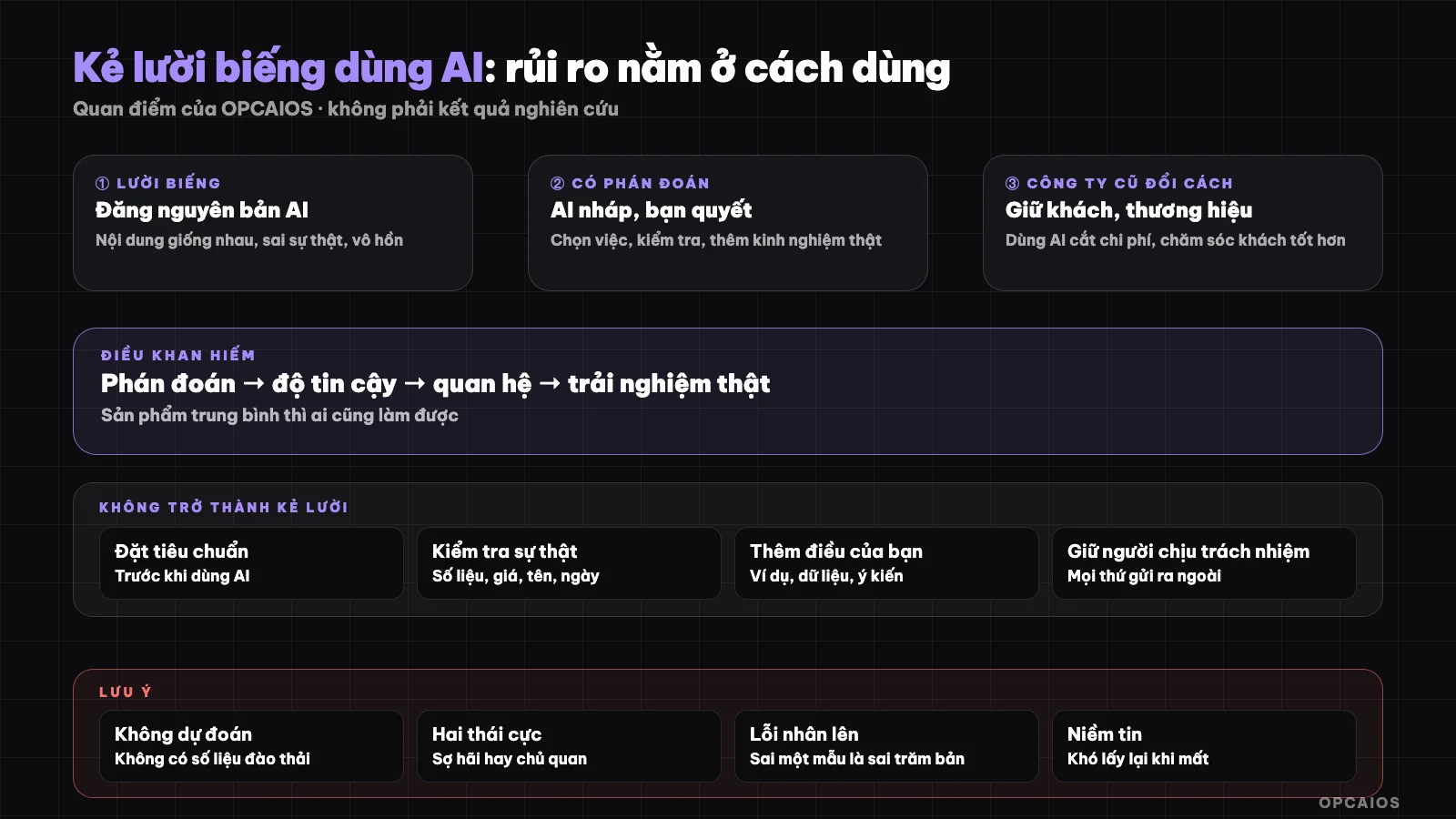
Using AI to multiply errors or to raise quality. This is the view of OPCAIOS, not a research finding. Diagram: OPCAIOS.
Where this view is right and where it's wrong
| Claim | Our assessment |
|---|---|
| "AI kills traditional companies" | Too strong; many companies have customer, brand, data, license, and distribution channel advantages that AI doesn't create on its own |
| "Traditional companies are safe" | No; companies that don't improve their processes are easily beaten on cost and speed |
| "Sloppy AI users will lose" | Reasonable; but we don't have quantified data |
| "AI doesn't matter" | Wrong; AI changes the cost and speed of many tasks |
What to avoid are two extremes: fear (AI will take everything) and overconfidence (just use it and you're ahead). Most outcomes depend on how you use it.
What are the three types of AI users and how do they differ?
The lazy AI user is someone who pastes a question into ChatGPT or Claude and posts the raw result; the other two types are users with judgment and traditional companies that change their approach. The difference lies in the review step and unique value. An illustrative scenario with no real numbers: a shop posts 30 pieces a week using ChatGPT but 20% have wrong information, while a competitor posts 5 checked pieces, and 60% of customers choose the competitor by 2026. Each lost order is worth $25, or $750 a month if 30 orders are lost.
- The lazy user: paste the question, post the raw result. The consequence is content that's identical, factually wrong, violates copyright, and gives poor customer care. Low marginal cost pushes this person to do more, but doing more average work creates no advantage.
- The user with judgment: AI makes the draft and handles repetition; the person picks the work, sets standards, checks facts, adds real experience.
- The traditional company that changes how it works: keeps existing advantages (customers, brand, process) and uses AI to cut costs and save time. This group has the biggest advantage if they're willing to experiment.
Why does "lazy" become more costly now?
"Lazy" becomes more costly when the supply of content explodes, since posts, images, videos are nearly free to make and people filter more strictly. There are five main reasons, according to OPCAIOS reasoning rather than measurable data:
- First, search engines like Google and platforms prioritize useful, trustworthy content and have policies on repetitive, low-value content.
- Errors multiply: one mistake in a template means a hundred mistakes in the output. Example scenario: one template with a wrong price, sent to 500 customers in 1 hour, leads to 40 follow-up questions.
- Trust is hard to rebuild: being caught once making up data or copying content can damage credibility for months.
- Legal risk: wrong ads, data privacy breach, copyright violation.
- Finally, the cost of fixing mistakes usually exceeds what the tool saved. Example scenario: save $50 a month but lose 8 customers over wrong content, each worth $100.
How Not to Become an "AI Lazybones"
To avoid becoming an AI lazybones, I treat AI as a draft writer while humans keep final review power. The seven steps below work for both companies and solo workers, and they work with ChatGPT, Claude, or Gemini:
- Set standards first: what quality counts as passing, what to check.
- Verify facts against sources, especially numbers, prices, names, dates.
- Add what only you have: experience, private data, real examples, opinions.
- Keep someone accountable for everything sent out.
- Label AI-assisted content clearly when needed.
- Measure real results (customers, feedback, refunds) instead of output volume. Example: track 10 complaints per month instead of counting 100 posts, and a 5-step review template helps cut 30% of errors, saving $40 monthly.
- Keep learning but don't chase every tool (Break the AI tool buying habit).
See also How AI Helps One Person Run an Entire Business.
What Should Traditional Business Owners and Solo Workers Do?
Traditional business owners should start from specific pain points like reports, customer care, contract drafting—not from technology. Solo workers have the speed advantage but easily fall into laziness because no one checks. Example: a 20-person company tries Claude drafting reports for 14 days, measuring time drop from 5 hours to 3 hours per report (40% cut) at $20 per person monthly, then scaling up. Work to do:
- Try small, measure, scale; one process at a time.
- Protect customer data (5 security rules).
- Train staff to use AI by standard, neither banning it nor letting it run free.
- Keep what makes you different: relationships, expertise, experience.
- Solo workers build their own checklists and review processes before handing over (5 mistakes building OPC).
OPCAIOS Experience
We use AI agents a lot for code, content, and operations, and our internal rule is everything must have someone review and verify sources before going public; our blog posts mark what is not yet checked. We once had AI write code for the wrong version or make up details, and errors showed up only in the check step. We found that the check step is the part you cannot skip when using Claude or other models for coding. We have no data comparing AI uses or company dropout rates; this post is a perspective.
Frequently Asked Questions
Does AI make traditional companies disappear?
We have no proof of that; companies that don't change have competitive risk, but customer and trust advantages still hold value.
What does "AI lazybones" mean?
Hand off to AI and post the raw output without checking, without adding your own value.
Do I have to label AI use?
It depends on platform and rules; be clear when content might mislead.
How do I know I'm using AI well?
Real results with customers: feedback, retention, complaints.
Where do I start?
From one repeated process and a quality checklist. See OPCAIOS's AI application training.
Source: OPCAIOS perspective; not based on statistics on company dropout rates. The experience is OPCAIOS's.
Translated from Vietnamese with AI. Read the original.
Want to apply this in your business?
Book a free 30-minute call (Vietnam time, in English or Vietnamese).