


What is the 30-day OPC roadmap?
It's a four-week plan for one person to move from idea to a solo business that can take its first client. Week 1 picks the problem and customer, week 2 builds the minimum product or service, week 3 builds the operating foundation and AI tools, week 4 sells to the first customers and measures results. Important note: 30 days is enough to build the foundation and test the market, not enough to guarantee revenue, and this post makes no income promises. Example scenario: an accountant picks a group of small shops on day 3, interviews 5 people on day 5, builds a service package on day 10, builds a process using n8n on day 18 and sends a proposal to 3 customers on day 25. Below is a day-by-day plan, a gate checkpoint each week, and how Claude, ChatGPT help.
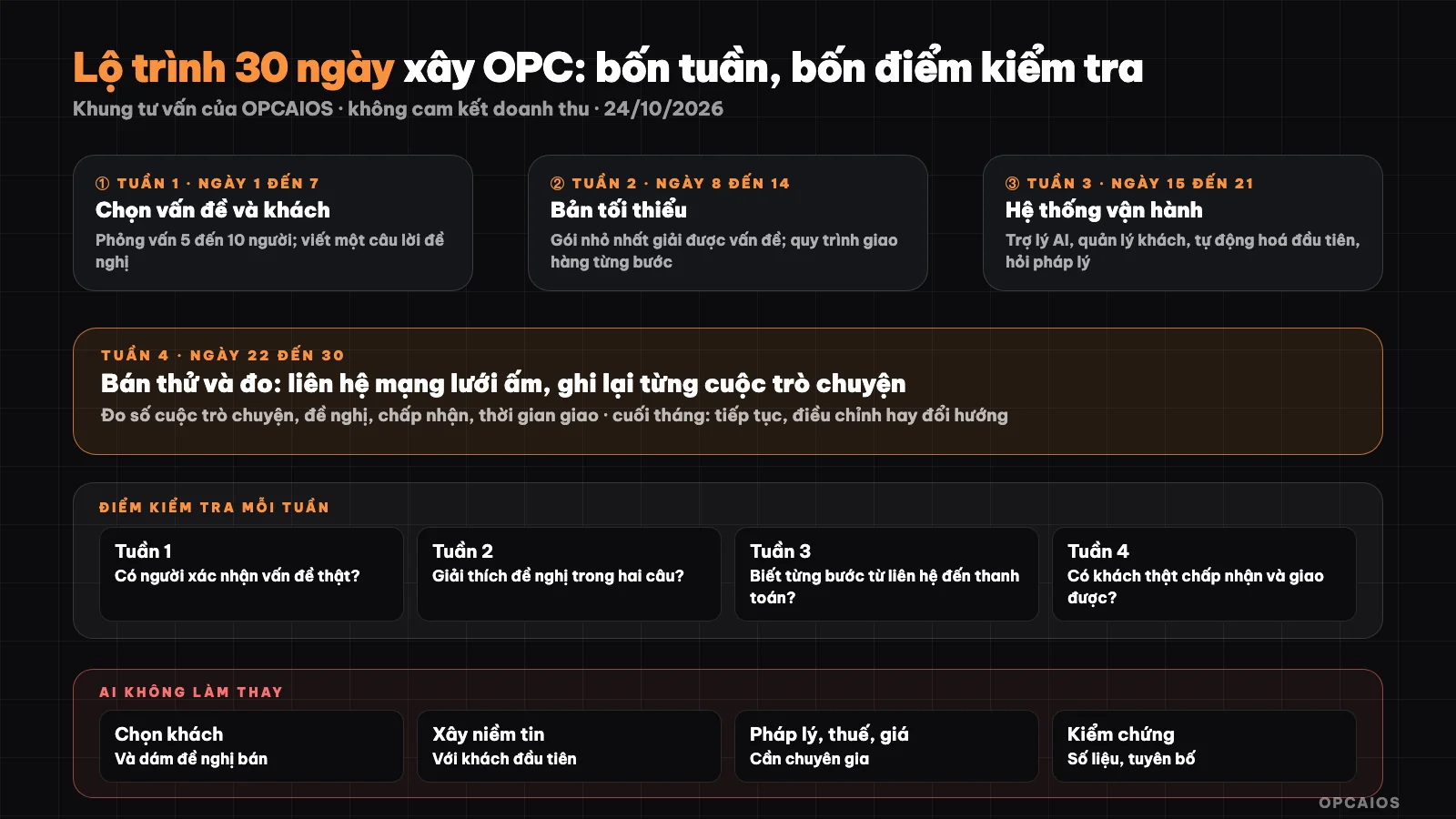
Four weeks: pick customers, build minimum version, build operations, test sell and measure. Diagram: OPCAIOS.
What principles do I need to remember before starting the 30-day roadmap?
The principles are five rules to keep the 30-day roadmap grounded in real customers instead of tools. Read the five rules first, then pick week 1 work.
- Start from your real expertise, not from tools.
- One customer group, one problem, one offer.
- Sell before you build too much: test with a few real customers early.
- Each week has a verifiable output and a decision point.
- Make no revenue promises to yourself or others before you have numbers.
For example, week 1 only needs 1 offer statement and 5 conversations with customers, no need for a pretty website or logo; later weeks build tools like n8n or Claude from Anthropic.
Week 1 (days 1 to 7): pick the problem and customer
| Day | Task | AI support |
|---|---|---|
| 1 to 2 | List your expertise, experience, customer groups you have helped before | Ask AI to interview you and summarize |
| 3 to 4 | Pick one customer group and three problems they pay to solve | AI synthesizes public research, compares competitors (verify sources) |
| 5 to 6 | Talk to 5 to 10 people in that customer group | AI writes interview script, summarizes notes |
| 7 | Write one offer statement: who, what problem, what result | AI suggests many ways to phrase it, you pick |
Week 1 checkpoint: do at least a few people confirm the problem is real and willing to hear the offer? If not, switch customer groups or problems before moving to week 2. Example scenario: in 7 days, you interview 8 people, 5 confirm the problem is real and 3 are willing to hear the offer; this result is enough to move to week 2.
Week 2 (days 8 to 14): what is the minimum product or service?
The minimum product or service is the smallest version that still solves the customer's problem. In the 7 days of week 2, four tasks need to be done in order:
- Define the smallest version that solves the problem (one service package, one template, one training session).
- Write the delivery process step by step; this is the foundation for automation later.
- Prepare a one-page intro, how to contact and how to pay.
- Ask AI to draft the landing page, process, frequently asked questions; you review every line and remove any claim you cannot verify.
Example scenario: the accountant above picks a "review books 1 month" package for small shops, writes a 6-step process and builds a one-page website using Claude in about 3 days. Price and package content are decided by the business owner, AI does not decide for you.
Week 2 checkpoint: can you explain the offer in two sentences and deliver a test to someone you know?
Week 3 (Days 15 to 21): How do I set up an operating system?
| Task | Suggested tool | Notes |
|---|---|---|
| Main AI assistant + context | See AI Toolkit for the OPC Model | One file describing you, your clients, tone, rules |
| Client management | Spreadsheet or simple CRM | One source of truth |
| First automation | n8n or equivalent | Pick the most repetitive process |
| Content | Weekly content calendar | See One-person marketing room |
| Legal and tax | Ask accountant, lawyer | Business type, invoices, sample contracts |
The Week 3 operating system is a minimum set of tools for one person to receive, deliver and collect payment from clients without chaos. Legally, an individual can choose a single-member limited company or a private business under the 2020 Enterprise Law (they differ in legal status and asset liability); ask an expert before deciding. Assumed example: an OPC owner sets up n8n to send a confirmation email within 5 minutes after a client fills out a form, then logs each client into a Google Sheets spreadsheet.
Week 3 checkpoint: can you trace an assumed client from contact to payment, knowing each step clearly?
Week 4 (Days 22 to 30): How do I test-sell and measure?
Test-selling is offering your proposal to real clients and recording feedback during the final 9 days of the roadmap. Follow five steps:
- Reach out to the list of people you interviewed in week 1 and your warm network.
- Make your offer to at least some specific potential clients.
- Log each conversation: who, feedback, reason for acceptance or rejection.
- Measure: number of conversations, number of offers, number of acceptances, time to deliver once.
- End of month, sit down: continue, adjust the offer or change your client group.
Assumed example: 10 conversations, 4 offers, 1 client accepts and 6 hours to deliver the first time is enough of a result to evaluate, even if not enough to forecast revenue.
End-of-month checkpoint: do you have at least one real client who accepted and did you deliver? If not, that is information, not failure: adjust your offer based on feedback.
What AI does not do for you in 30 days
- Choose your client group and dare to make the offer.
- Talk and build trust with your first client.
- Decide on legal matters, tax, pricing.
- Verify facts and claims in your content.
OPCAIOS experience
We use a gate-checkpoint approach similar to this when planning business internally: each stage has a decision point based on measured numbers, and every target number is treated as a target, not truth. We have not run any cohort exactly to this 30-day roadmap so this is a suggested framework, not a process verified on many people, and carries no result guarantee. Our own lesson: building systems is much faster with AI, but finding clients and building trust is always slower than expected.
Read more: "Productized Service" – what is it? Why is this the only way out for a freelancer who does not want to sell labor; Legal & Business Registration Checklist for Solopreneurs.
Frequently Asked Questions
Is 30 days enough to generate revenue?
30 days is enough to build a foundation and test selling, and you might get your first customer if you already have expertise and a network. Nothing guarantees revenue. An example scenario: after 30 days you have 1 real customer, 10 recorded conversations, and 1 delivery process running on n8n. OPCAIOS hasn't run any cohorts along this roadmap yet, so this is a suggested framework, not a process verified across many people.
What should I do in the first week?
The first week is about choosing customers, not building systems. First, list your expertise and the groups of customers you've already helped. Next, choose one customer group and one problem they pay to solve. Then, talk with 5 to 10 real people in that group, spending about 30 minutes with each. Finally, write a one-sentence value proposition.
How much capital do I need to start?
Starting capital depends on the industry and is mostly time, so there's no reliable single number. An example scenario: Claude Pro at about $20 a month plus basic automation tools is the main tooling cost by week 3. Legal costs, taxes, and company setup need to be discussed with an accountant and lawyer. See the tool cost breakdown in the post about AI tool costs replacing 3 staff and ideas in 7 OPC business ideas on a low budget.
Do I need to register a company right away?
Not required in the first 30 days, since the goal of this phase is to verify whether customers will accept what you're offering. Ask an accountant about the timing and business type that fits according to the 2020 Enterprise Law. For example, if by week 4 you have 1 customer who agrees and needs invoices, that's when to ask an expert in more detail. To get guidance on building an AI system for your work, see OPCAIOS's AI application training course.
Source: the roadmap is OPCAIOS's consulting framework, not research results; legal information is from analyses of the 2020 Enterprise Law and is for reference only (read on 24/10/2026). The experience is OPCAIOS's.
Translated from Vietnamese with AI. Read the original.
Want to apply this in your business?
Book a free 30-minute call (Vietnam time, in English or Vietnamese).