


What is Productized Service?
A productized service is a service standardized into a package with fixed scope, delivery time, and price, sold like a product: the customer chooses the package, pays, and receives results following a repeating process instead of negotiating each project and billing by the hour. The article title says "the only way out" in a familiar way; in reality this is a common and practical way out, not the only one, because freelancers can also make digital products, charge high for consulting, or go full-time employment. Packaging helps you depend less on billable hours, but you are still selling your labor; it just makes that labor easier to repeat and easier to price. Example assumption: instead of charging $50 per hour for 10 hours of work, a freelancer sells a fixed package for $500, delivered in 7 days. The article explains the concept, step by step packaging, how to price, risks and the role of AI.
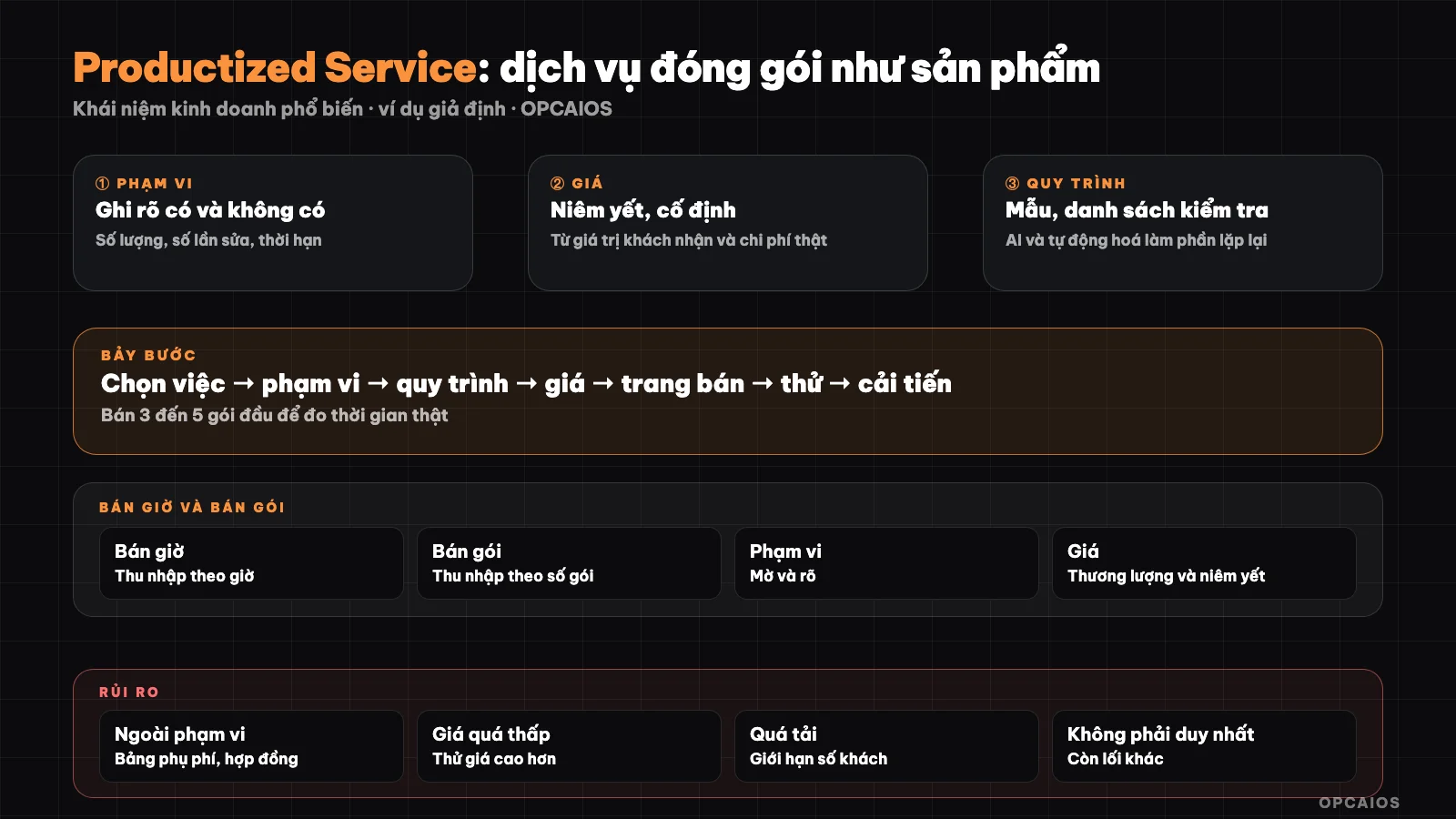
From custom work to fixed packages with process. Diagram: OPCAIOS.
Comparing selling hours versus selling packages
| Criteria | Selling hours / by project | Productized Service |
|---|---|---|
| Scope | Changes per customer | Fixed, clearly states what's included and not included |
| Price | Negotiated or hourly | Listed, fixed |
| Delivery time | Uneven | Committed within a range |
| Process | Done fresh each time | Repeating, templated |
| Income | Grows with hours | Grows with number of packages and productivity |
| Sales | Long, lots of negotiation | Shorter, easier to pitch to customers |
| Risk | Customer asks for extra work | Customer wants customization outside the package |
Packaging a service in a few steps, where to start?
Packaging a service is the process of turning custom work into a package with results, scope and a repeating process, consisting of seven steps. The first three steps define what is being sold:
- Step 1, pick one task you do well and customers pay for. Review past projects: which tasks repeat often, which customers are most satisfied, which results are measurable. Pick one narrow task, easy to explain in one sentence.
- Step 2, define the results and scope. Write clearly what the customer gets, quantity, number of revisions, format, deadline, and also what is not included. Vague scope is the source of delays and disputes.
- Step 3, standardize the process into an input form, checklist, delivery template, revision rounds. This is where AI and automation shine (n8n on VPS, AI system that runs itself).
Example assumption: a freelancer wrote 12 old projects into Google Sheets, saw 8 projects (67%) were all blog writing, 9 customers (75%) were happy with that work, then picked exactly that task. Each past project took 6 hours, at $50 per hour.
How to price, sell and improve the package?
Pricing a package comes from the value the customer receives and your actual cost: average hours, tools, taxes, time to find customers. Four more steps:
- Step 4, price. Many people set three packages (basic, standard, premium) so customers can choose easily, then test the price with a few early customers and adjust. OPCAIOS does not give specific price levels because it depends on industry and market; the numbers in the example are just to show the method, like $120, $240 and $480 for three packages.
- Step 5, make a sales page and ordering process. A page that clearly states what package, price, time, frequently asked questions, order button and payment via Stripe or bank transfer.
- Step 6, test with the first customer. Sell 3 to 5 early packages, measure actual time, note requests outside scope, improve the template.
- Step 7, improve and upgrade: cut time with templates and AI, add more packages, raise prices when the process is stable and there is demand.
Example assumption (not a real customer)
An example assumption is packages that show how to set scope, not data about real results or revenue. Three common cases:
- Content writing freelancer: package "4 search-optimized blog posts each month", fixed price, 2 revision rounds, delivered in 10 business days, does not include posting and custom images.
- Video person: package "10 short videos from one long video", has subtitle template and cover image.
- Automation expert: package "set up one n8n workflow for one business process", has handover documentation.
If you sell the first package at the example price of $300 per month and get 5 customers, revenue is $1,500 per month before tax and tool costs like ChatGPT. This number is an example calculation, not a measured result.
What is the role of AI in packaging services?
The role of AI is to cut time on repetitive parts: drafting, research, reporting, summarizing, checking. AI doesn't replace defining the package, pricing, and taking responsibility for quality. Example assumption: a package takes 6 hours per client, using Claude or ChatGPT for drafting brings it down to 4 hours, meaning about 33% time savings and $100 in effort saved if you count $50 per hour. Three sensible ways to use AI:
- First, have AI draft from the client's information form, and you review it.
- Next, use AI to check the checklist before delivery, to keep quality consistent through 2026.
- Finally, decide whether to pass the savings on to clients (better price, faster delivery) or keep the profit, and be transparent when needed.
Risks and how to handle them
| Risk | How to handle |
|---|---|
| Client demands outside scope | Add-on fee table or separate package, contract spells it out |
| Price too low from fear of losing client | Try higher price, measure close rate |
| Overload when many clients | Cap number of clients per month, waiting list |
| Uneven quality | Checklist, templates, reviewer |
| Dependent on a few clients | Expand client sources |
| Tax and legal risk | See Legal Checklist |
From service package to digital product
Once the process is solid, you can sell the standardized part to self-doers: templates, toolkits, mini courses (sell Prompts and n8n Templates, 7-day mini course). This is a step to make income less dependent on your hours.
OPCAIOS experience
OPCAIOS organizes services into categories with clear scope and uses automation for intake and tracking; we find clear scope reduces disputes the most. We don't have numbers on income increase from packaging and don't claim this is the only path.
Frequently asked questions
How is Productized Service different from regular service?
Scope, price, and process are standardized and sold like a product.
Is it the only way out for freelancers?
No; it's one practical choice, alongside digital products, consulting, or full-time work.
How much should I price?
From the value clients get and your real costs; try with a few early clients.
How many clients do I need to try?
A few early clients to measure time and emerging requests.
Can AI help?
Yes, for repetitive parts. To learn how to package services with AI, see OPCAIOS's AI application training course.
Source: common business concept; example assumptions, not real data. Experience is OPCAIOS's.
Translated from Vietnamese with AI. Read the original.
Want to apply this in your business?
Book a free 30-minute call (Vietnam time, in English or Vietnamese).