


Creating Content with AI
Creating content with AI means using a language model to handle the heavy lifting of content production (finding angles, drafting, refining sentences) while you keep the decisions: which facts are correct, which post gets published, what voice is yours. This post describes the process we use for opcaios.org, written for brands and small businesses; it is not about running MMO channels or posting in bulk. We do not promise this process will increase traffic or customers: we have not measured impact on visits or leads, have no external clients, have not measured hours saved. What this post delivers is something reproducible right away: six steps, a table of what to hand to AI and what to keep, one complete brief template, and an 8-item checklist before approval.
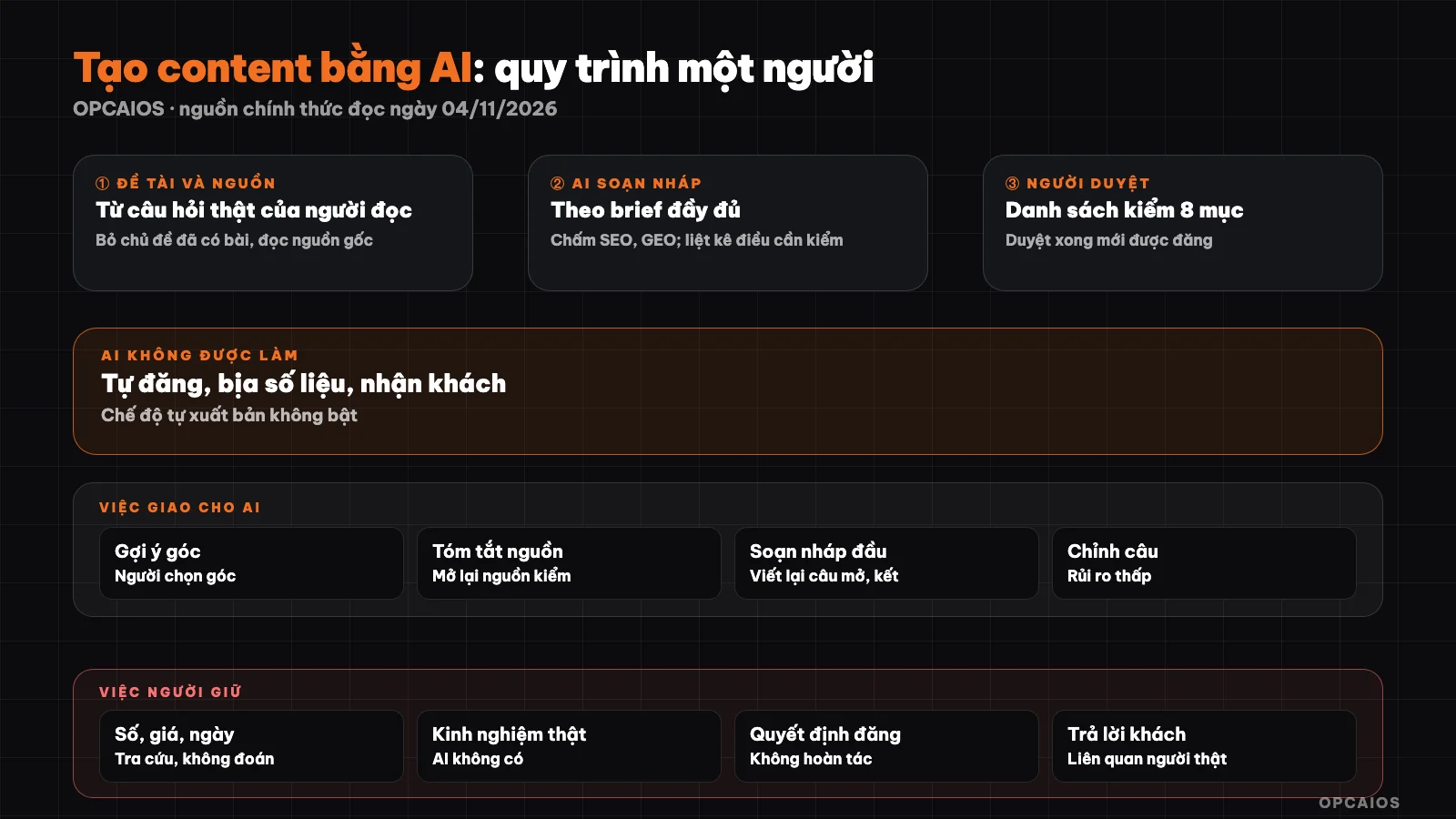
Six steps from idea to approved post; AI joins in steps 1 through 4, the person decides in steps 5 and 6. Diagram: OPCAIOS.
What steps does the AI content creation process have?
Our process has six sequential steps, and no step lets a post go straight from AI to the public. Step one is an idea from a real question: a keyword phrase someone typed, a search query that showed up in your own website search tool, or a question a customer asked; the system skips topics already covered by existing posts. Step two is source research: open official documents, pricing pages, policy pages, note the read date. Step three is a draft written by AI following a brief, using your brand voice and the rule not to make up numbers. Step four is a gate: SEO and GEO score, overlap with old posts, banned words, and a list of up to eight specific claims (price, number, date, feature) for the reviewer to go back and check. Step five is the reviewer: read, edit, reject. Step six is scheduling to publish, which only happens after someone hits approve. The process stops at the draft waiting for approval if step five is missing.
What work do you hand to AI, what do you keep?
The rule for choosing: hand to AI work that you can check in a few minutes; keep work where a mistake will hurt your reputation. The table below is OPCAIOS's assignment, a suggestion not yet tested with other teams.
| Work | Hand to AI | Person keeps | Reason |
|---|---|---|---|
| Suggest angles and list reader questions | Yes | Choose angle | AI has many ideas, person knows the goal |
| Summarize source materials | Yes, with links | Open source to check | Model can rephrase incorrectly |
| Write first draft | Yes | Rewrite opening and closing | Voice is your asset |
| Numbers, prices, dates, feature names | No | Yes | Model guesses text, does not look up facts |
| Real examples and your experience | No | Yes | AI has no lived experience of yours |
| Refine sentences, cut, check spelling | Yes | Read again | Low risk |
| Decide to publish, pick time, pick channel | No | Yes | Can't undo |
| Reply to comments, receive customers | No | Yes | Real people involved |
What does a good brief to AI look like?
A good brief forces AI to use your facts instead of filling in blanks. Below is a complete template you can copy; replace the parts in brackets. This template is a framework suggested by OPCAIOS, not yet compared against other ways of assigning work.
BRIEF FOR ASSIGNMENT
1. Post goal: (one sentence: what can the reader do after reading)
2. Reader: (who, what they already know, what they are stuck on)
3. Main keyword and 3 real questions readers typed: (...)
4. Channel and length: (blog 1,500 words / Facebook post 200 words / email 250 words)
5. Voice: (pronouns, short sentences, words to use; banned words: get rich, never fail,
   passive income, "reduce X%" if not measured)
6. Facts you can use: (paste verbatim, with source and read date)
7. Your real examples: (if none, write "assumed" and say so)
8. Do NOT write: numbers outside section 6, customers or testimonials, promised results, name
   competitors in comparison when source is missing
9. Structure: headline as a question, open with the answer, one CTA only: (...)
10. Output: draft, plus a list of every number, proper name, date, price in the post
    for the reviewer to check. Where data is missing write [need numbers], do not fill it in yourself.
Section 10 is the most important. It turns checking from "read the whole post again" into "check each line in the list". A more detailed way to write reminders is in the post how to write effective prompts.
What is the 8-item checklist before approving?
The checklist is the final gate before the approve button; if one item doesn't pass, the post goes back to step three. The eight items below summarize what we review, and the post on auditing AI content before posting goes deeper.
- Every number, price, date has a source that I reopened today and noted the read date.
- No customers, testimonials, revenue, or results that aren't real.
- No forbidden words or promises like "increase X times," "reduce X% of time" when we haven't measured.
- Third-party product names, packages, features are still correct at posting time.
- The post names at least one real limitation of the method or tool.
- The voice matches the person who signed it; no clichés, no "in the digital age" sections.
- No duplicate of an existing post, and it has at least one piece of information readers would struggle to find elsewhere.
- Only one call to action, working links, no exposure of private data like keys, server addresses, or customer names.
What must AI not do in this process?
There are three things AI must not do, regardless of which tool. First, AI doesn't post by itself: the process only creates a draft, the reviewer then schedules it, and we don't turn on auto-publish because of the risk of a wrong post going straight to the public. Second, AI doesn't make up numbers, sources, or quotes: if we lack data, I write a blank space, I don't fill it in. Third, AI doesn't play a customer: it doesn't create testimonials, reviews, or fake accounts. On the search engine side, Google's documentation read on 04/11/2026 says bulk content policy applies whether content is written by people or AI; what's considered abuse is creating many pages mainly to manipulate rankings without adding value to readers. Google also advises manually checking accuracy before posting, including titles, descriptions, and image alt text, because models can make things up. Our process follows that spirit, but we don't know and don't promise it helps ranking.
Does creating AI content for video, Facebook, and blog differ?
The six-step framework stays the same for all channels, only step three and step four change. Blog posts need sources and structure, so the gate review is heavy on facts and duplication. Facebook posts need voice and rhythm, so the gate review is heavy on opening lines, calls to action, and length; to avoid repeating ideas, see hack organic reach Facebook with AI. Video needs scripts and visuals, so the gate review adds a step where someone reads it out loud; one way to repurpose video content into written posts is in turn YouTube video into 10 posts. With all channels, the rule stays: AI drafts, person reviews, then post.
OPCAIOS experience
The website opcaios.org was built by one person (Le Quoc Nghia) together with AI agents. The blog uses the process above exactly: topics come from real questions, drafts are written by AI then scored, then sit in the review queue until Nghia approves; daily auto posts also only output a draft, with a list of claims to verify. On the Facebook channel, we have a dispatch board by stage and review is always a manual action; the part posting through a third-party scheduling service hasn't been tested with the real service according to notes from when we built it (14/10/2026). Limits we've hit: when asking AI to edit many posts at once, it once dropped source lines at the end and added fake quotes to hit a score, so every bulk edit must go through a check step before saving. SEO and GEO scores are internal tools, not real rankings. We haven't measured impact on traffic or customers, we have no outside customers, Case Study #0 is running on Nghia himself.
Frequently Asked Questions
Does creating content with AI get you penalized by Google?
According to Google's spam policy page read on 04/11/2026, using AI by itself is not a violation. What is considered abuse of bulk content is creating many low-value pages primarily to manipulate rankings. Google recommends checking accuracy by hand before posting. We cannot guarantee the ranking results of any article.
How long does it take one person to make an AI-generated article?
We have not measured the hours per article so we cannot give a number. Time depends on how difficult the facts are to verify, since the research step and the review step usually take more work than the AI draft step. You can measure it yourself: record the time for each step over a week then compare.
Should you let AI automatically post articles to Facebook or your blog?
We do not recommend it. Published articles are hard to take down, and AI can get facts wrong or miss your tone. Our process only creates a draft and waits for someone to review. If you want to automate posting, only let the system post articles that have been reviewed by a person.
Do you need paid tools?
This process mainly needs a language model, a spreadsheet to track article status, and review discipline. Specific tools and pricing change fast so the article does not list prices; you should read the official pricing page of the tool you choose. We have not compared output quality between models using measured data.
Can AI writing keep your brand voice?
Partly. Pass your voice to AI through a brief (pronouns, words to use, words to avoid, sentence patterns), but opening sentences, closing sentences, and real examples should come from you, because brand voice comes from real experience. We have not measured how well each model keeps Vietnamese voice.
Next Step
If you want to discuss setting up a content creation process with human review for your brand, schedule a consultation with us.
Source: Google Search Central guidance on AI-generated content and spam policy (bulk content), read on 04/11/2026; OPCAIOS internal process, cross-checked against source code and project notes. Not verified: process impact on traffic, customers, and work hours; service for scheduling posts with real data; Vietnamese quality between models. Experience is OPCAIOS's own.
Translated from Vietnamese with AI. Read the original.
Want to apply this in your business?
Book a free 30-minute call (Vietnam time, in English or Vietnamese).