


Awesome Generative AI Apps là gì?
Awesome Generative AI Apps là một kho "awesome list" trên GitHub do tài khoản Anil-matcha duy trì, liệt kê khoảng 50 đến 60 mẫu ứng dụng AI tạo sinh mã nguồn mở (tạo ảnh, tạo video, thử đồ ảo, chụp ảnh sản phẩm, chatbot RAG, viết nội dung) mà bạn có thể sao chép, đổi tên thương hiệu, triển khai lên Vercel và thu phí. Theo GitHub (API, đọc ngày 04/11/2026), kho Anil-matcha/awesome-generative-ai-apps được tạo ngày 23/1/2024, có khoảng 705 sao, giấy phép MIT và lần đẩy mã gần nhất 22/10/2026. Mã miễn phí, nhưng hầu hết mẫu gọi mô hình AI qua dịch vụ trả phí MuAPI, cộng thêm Stripe, Google OAuth và cơ sở dữ liệu PostgreSQL. Bài này xem danh sách có gì, tốn gì để chạy, nên tin những con số doanh thu trong README tới đâu, và khi nào đáng dùng.
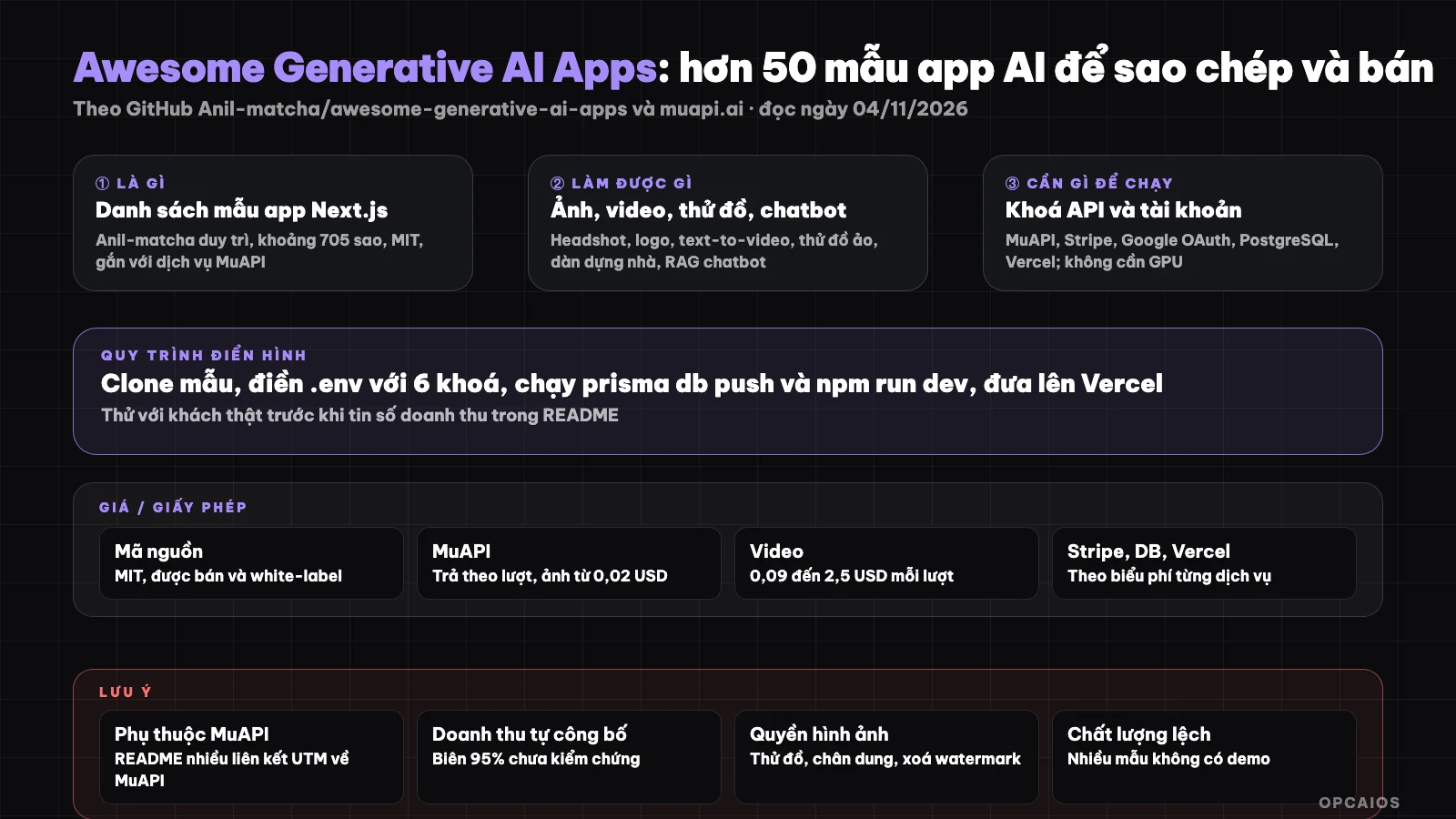
Mỗi mẫu trong danh sách là một ứng dụng Next.js cắm vào MuAPI, Stripe, Google OAuth và PostgreSQL. Sơ đồ: OPCAIOS.
Awesome Generative AI Apps là gì và ai đứng sau?
Awesome Generative AI Apps là một trang danh mục, không phải một phần mềm: README chia các mẫu ứng dụng thành bảng theo nhóm, mỗi dòng có tên, mô tả, liên kết kho mã và đôi khi liên kết bản demo. Các kho mẫu phần lớn nằm dưới tổ chức SamurAIGPT và các kho khác của Anil-matcha trên GitHub.
Theo README (đọc ngày 04/11/2026), người duy trì liên kết tới tài khoản X "matchaman11" và LinkedIn "anilmatcha"; README không ghi họ tên đầy đủ nên chúng tôi không khẳng định thêm. Điểm cần nhìn rõ ngay: trang chủ khai báo trên GitHub là muapi.ai kèm tham số theo dõi UTM, và nhiều liên kết trong README cũng mang UTM trỏ về MuAPI, dịch vụ API mô hình AI mà các mẫu dùng. Nói cách khác, danh sách này vừa là tài nguyên mở, vừa là kênh tiếp thị cho MuAPI. Điều đó không làm mã kém giá trị, nhưng bạn nên đọc các lời hứa doanh thu trong README với tinh thần đó.
Awesome Generative AI Apps có những mẫu ứng dụng nào?
Danh sách có khoảng 60 dòng trong các bảng dù tiêu đề nói "hơn 50", vì một số mẫu xuất hiện hai lần và bảng "Featured" lặp lại vài mục. Các nhóm theo README (GitHub, đọc ngày 04/11/2026):
| Nhóm | Ví dụ mẫu và số lượng ước chừng |
|---|---|
| Nền tảng AI mở | Studio ảnh và video, công cụ lên lịch mạng xã hội, agent thiết kế, chat đa mô hình, trình dựng quy trình, API media hợp nhất |
| Tạo ảnh (khoảng 6) | Ảnh chân dung công sở (headshot), logo, phục hồi ảnh cũ, xoá watermark |
| Tạo video (khoảng 17, nhóm lớn nhất) | Cắt video ngắn, text-to-video, hiệu ứng VFX, trình chỉnh sửa |
| Làm đẹp và thời trang (4) | Thử đồ ảo |
| Thương mại điện tử (3) | Ảnh sản phẩm bằng AI |
| Nhà ở và bất động sản (2) | Dàn dựng nội thất ảo, dọn bừa ảo |
| Chân dung và avatar (8) | Tạo avatar nhiều phong cách |
| Viết và nội dung (8) | CMS blog, tạo CV, công cụ email lạnh |
| AI agent và chatbot (7) | Chatbot RAG trên kho tri thức, trợ lý Slack tự host, agent giọng nói |
| Âm thanh và giọng nói (2) | Thuyết minh podcast, agent giọng nói speech-to-speech |
Ngăn xếp công nghệ chung do README nêu: Next.js 14 (App Router), Prisma, PostgreSQL (Supabase hoặc Neon), NextAuth với Google OAuth, Stripe Checkout và webhook, Tailwind CSS, triển khai Vercel. Phần AI đi qua MuAPI, được quảng cáo có hơn 100 mô hình hoán đổi được mà không sửa mã ứng dụng; các mô hình được nêu tên gồm GPT Image 2, Google Veo, Seedance, MiniMax Speech 2.6. Đây là ngăn xếp JavaScript, không có Python, LangChain hay Ollama. Nếu chưa quen, đọc Next.js là gì? và RAG là gì?.
Do Awesome Generative AI Apps have free options? Where are the hidden costs?
The code of the list and templates are under the MIT license, meaning they're free, modifiable, sellable, and rebrandable. But a template only runs when you plug into at least four outside services, and the AI part is a pay-per-use service.
| Item | Details (read 04/11/2026) |
|---|---|
| Source code | MIT, 0 đồng; README allows selling and white-label |
| MuAPI (calling AI models) | Pay per use; pricing page muapi.ai/pricing (read 04/11/2026) gives examples: flux-kontext-pro images around 0.03 USD per call, veo3 video around 2.5 USD, veo3-fast around 0.6 USD, wan2.2 around 0.30 USD per call; no free tier seen |
| Stripe | Transaction fees per Stripe's pricing, we haven't read their pricing page |
| Database | Supabase or Neon have limited free tiers, we haven't read their current pricing pages |
| Vercel | Free hobby plan for individuals, commercial use needs a paid plan; we haven't read their pricing page |
| Google OAuth | Free, requires creating a Google Cloud project |
All prices above don't include tax and may change; the MuAPI pricing page doesn't list an effective date. The README gives revenue examples for a headshot app (29 USD per 10-photo package, roughly 95% margin) and cites competitor revenue without sources; these are project claims, not verified. Note also: MuAPI is a middleman, so your app depends on their pricing and uptime; a way to lower risk is reading What is OpenRouter? to understand the API gateway model and prepare a backup.
How do I run a template from Awesome Generative AI Apps?
Running a template has four steps per the README (GitHub, read 04/11/2026), and every template needs you to already have accounts at outside services. The README lists clone commands for each specific template repository under the SamurAIGPT organization, so we're not copying a specific address here; the common run command the README gives is:
npx prisma db push && npm run dev
- First, pick a template and clone the repo: open the table in the README, go to the template repo you want, run
git clonewith that repo address. - Next, create a config file: copy
.env.exampleto.env. - Fill in the keys:
DATABASE_URL(PostgreSQL),NEXTAUTH_SECRET, Google OAuth client ID and secret,STRIPE_SECRET_KEY,STRIPE_WEBHOOK_SECRET,MUAPI_API_KEY. Don't push the.envfile to GitHub. - Finally, run the command above to create tables and start the dev server, or hit the deploy button to Vercel in the template's README.
Someone with no coding knowledge can still do steps 1 to 4 if they're used to making accounts and pasting keys, but when you need to change pricing logic, add Vietnamese language, or fix a bug, you'll need to read Next.js or ask an AI agent like Claude Code to help.
Limits, risks, and legal notes
The main risks of relying on this list are three things: API provider lock-in, uneven template quality, and AI-generated content may infringe others' rights. This section is for reference only, not legal advice.
- MuAPI lock-in: templates are written to call MuAPI; switching to another provider means code changes. Per-use pricing can go up, and service outages mean your app stops working too.
- Uneven quality: the README admits many templates have no demo; the stars and revenue cited in the README are self-reported. Test-run each template before you sell it.
- Watermark removal, virtual try-on, headshots: these templates are easy to misuse for stripping copyrights or creating images of real people without consent. When selling a product from a template, you're liable for the terms of use, content moderation, and your end user's image rights.
- Personal data: user face images are sent to MuAPI and models behind it; you need a clear privacy policy and should consider Vietnam's personal data protection law and GDPR if you have European customers; we haven't checked the original text.
- Marketing links: the README has discount links and UTM codes to MuAPI, some of the author's other repos are promoted alongside; treat the introduction as marketing content.
Awesome Generative AI Apps compared to other options
This list sits between "resource lists" and "sellable SaaS templates," so I compare it against both groups. The table below is a general description, not a measurement:
| Option | What's different | Good for |
|---|---|---|
| Paid SaaS boilerplate (ShipFast and similar) | Buy once, get docs and community; I haven't read their pricing page | People who want solid payment and login infrastructure, then add AI themselves |
| Dify, Flowise | Build AI apps by drag-and-drop, no Next.js code needed | Non-coders who just need a chatbot or workflow; see What is Dify? |
| free-for.dev | List of free packages for developers, no app templates | Finding free infrastructure to run templates; see What is free-for.dev? |
| Build it yourself with AI agent | Full control, takes more time | People with their own product who don't want to depend on one API provider |
| Call OpenAI, Google, fal.ai directly | No middleman, you write the API call layer yourself | Developers who want to optimize costs |
The strength of this list is speed: a demo mock-up can run on Vercel in a day. The weakness is every template ties to one API provider and has no independent proof of revenue.
When should I use Awesome Generative AI Apps?
This list fits people who want to quickly test a micro-SaaS idea about images or video, already have potential customers, and accept paying API costs per use.
| Situation | My suggestion |
|---|---|
| I have a specific customer group (fashion shops need virtual try-on, brokers need photo staging for homes) | Clone the matching template, test it with 20 real images before you set a price |
| I want to learn how to tie together Next.js, Stripe, OAuth, and AI APIs | Use one template as a lesson, read the code together with an AI agent |
| I don't have customers yet, just thinking "95% margin sounds great" | Stop; that number is claimed by the project, unverified, and doesn't count customer acquisition costs |
| I need an internal chatbot, not selling it outside | Dify or Flowise is simpler |
| I'm worried about sending customer images to third-party APIs | Not a fit; consider self-hosted models like ComfyUI |
Example (hypothetical): someone doing product photos for online shops clones the product photo template, hooks up Stripe to charge 99,000 đồng per 20-photo package, tests with three familiar shops. After two weeks, they check actual MuAPI costs per package, then decide to keep the price or raise it; they don't rely on the margin in the README.
OPCAIOS experience
We added Awesome Generative AI Apps to the Repos section of Tools on opcaios.org after reading the README and checking that the repo is still maintained; I haven't test-run any templates, so this section states the criteria I use to consider it, not a review after using it. Four criteria:
- Is the repo still maintained: yes, last commit 22/10/2026, but around 705 stars is small compared to other awesome lists, so I see this as one author's directory, not a community standard.
- License: MIT, allows commercial use; need to check each template repo's license separately because they're independent repos.
- Hidden costs: MuAPI API per use, Stripe, database, Vercel; no GPU needed.
- Can it replace a tool I'm already using: opcaios.org website is built with Next.js and already has a docs store, so I don't need a SaaS template; the value for me is learning how to package one AI feature into a packaged product.
The biggest legal risk is end-user image rights in portrait and virtual try-on templates.
Read more: Packaging and selling AI prompts, n8n templates, SOLO model.
Frequently Asked Questions
Is Awesome Generative AI Apps free?
The code is licensed under MIT and is free, including for resale. But for the app to generate images or videos, you have to pay MuAPI per request (the pricing page as of 04/11/2026 shows images at around 0.02 to 0.03 USD, videos from around 0.09 to 2.5 USD per request depending on the model, before tax, subject to change), plus Stripe fees and database infrastructure, Vercel if you exceed the free plan.
Can someone who doesn't know how to code use it?
You can set up a trial version if you're comfortable creating an account and pasting the API key into the .env file, since the README has only four steps and a button to deploy to Vercel. But to change the interface to Vietnamese, adjust pricing logic, or handle Stripe webhook errors, you need to be able to read Next.js, or hand it off to an AI agent like Claude Code and verify the results yourself.
Do the templates require MuAPI?
According to the README, the templates are written to call MuAPI through the MUAPI_API_KEY variable, and MuAPI is advertised as a gateway to over 100 models. If you want to call OpenAI, Google, or fal.ai directly, you have to modify the API calling layer in each template. Plan ahead for an alternative so you don't depend on a single provider.
Are the revenue figures in the README trustworthy?
The README gives an example of 29 USD per package of 10 headshot images with margins around 95% and cites competitor revenue without citing sources. These are figures published by the project, unverified, and don't include advertising costs, customer support, or refunds. We haven't measured any of the templates, so treat those numbers as assumptions to test yourself, not results.
What legal things should I watch out for when selling an app from this template?
Three things to do before you collect money. First, write terms of use and a privacy policy that clearly state that user images are sent to third-party API providers for processing. Next, block misuse like creating images of real people without consent or removing watermarks from other people's work; the template doesn't do this for you. Finally, check the license of each template repository, the license of the model that MuAPI calls, and tax obligations when you take money through Stripe from Vietnam. We haven't reviewed the legal text, so this is not legal advice. To learn how to package an AI feature into a controlled product, see OPCAIOS's AI application training course.
Source: GitHub Anil-matcha/awesome-generative-ai-apps (README, API, read 04/11/2026), muapi.ai/pricing (read 04/11/2026, effective date not recorded); not read/not verified: README and licenses of each template repository, demo pages, revenue figures published by the project, Stripe pricing, Supabase, Neon, Vercel; star count and price subject to change. Experience is from OPCAIOS.
Translated from Vietnamese with AI. Read the original.
Want to apply this in your business?
Book a free 30-minute call (Vietnam time, in English or Vietnamese).