


OpenRouter is what? OpenRouter is an API gateway service that allows you to call hundreds of language models from multiple providers through a single endpoint, compatible with OpenAI's SDK: you change the base address to https://openrouter.ai/api/v1 and use one key, instead of opening accounts and managing separate keys with each vendor. According to the official pricing page (read on 25/10/2026), OpenRouter has over 500 models from over 80 providers; inference pricing is calculated according to each provider's listed price, and OpenRouter charges a 5.5% platform fee on credit purchases in the standard plan (8% in the Business plan); plus 25+ free models with limits. For example, an application written using OpenAI's SDK only needs to change the base address to try another vendor's model. The post has four parts:
- First, what OpenRouter is, how to use it, and the fee table.
- Next, the data policy according to the pricing page.
- Then, when to use the gateway or call the provider directly, and the risks.
- Finally, OPCAIOS's experience.
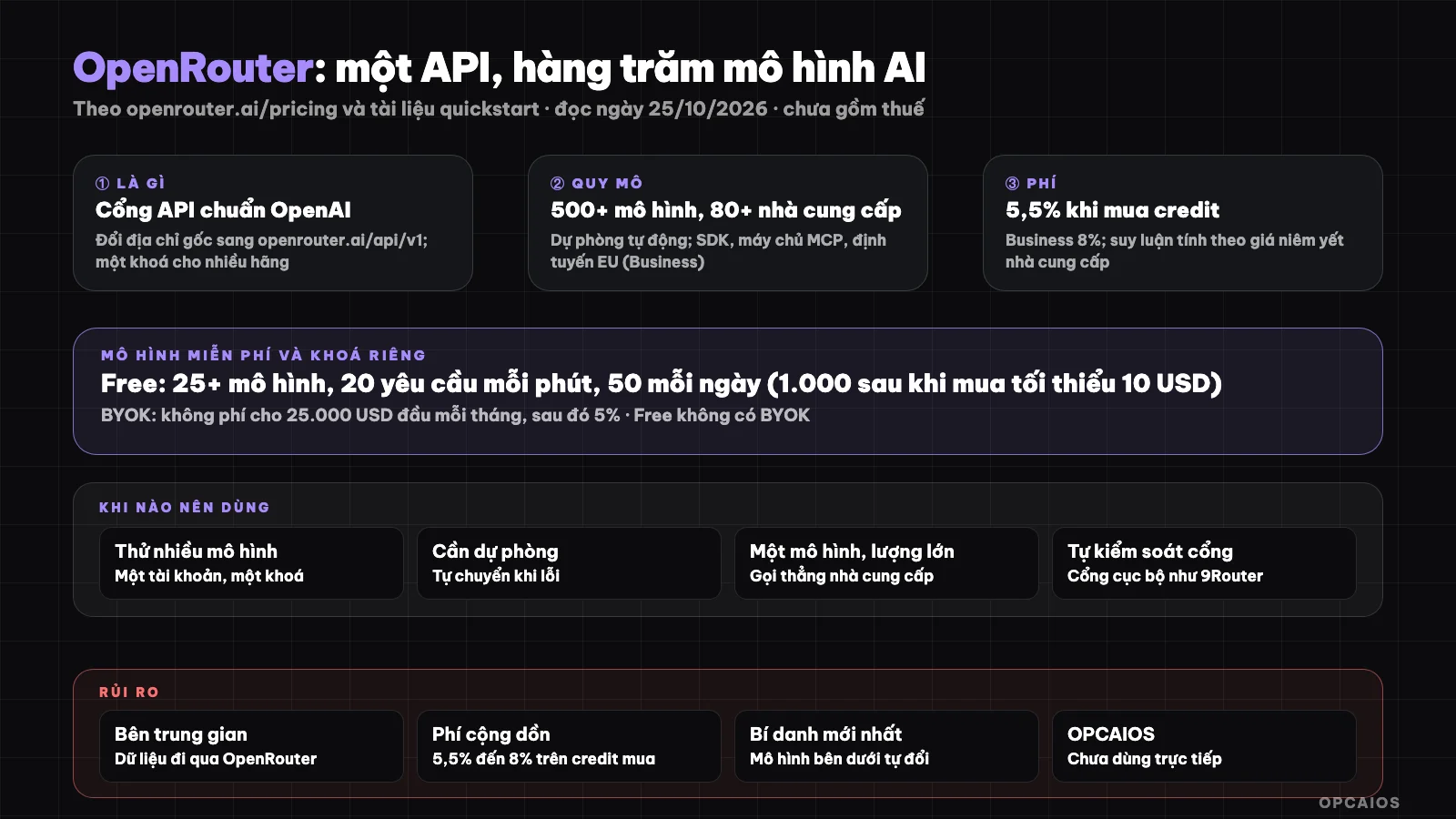
One key, one standard OpenAI API, many models; fee calculated on credit purchased. Diagram: OPCAIOS.
What is OpenRouter and how does it work?
OpenRouter is an API gateway that allows access to hundreds of AI models through a single endpoint, and automatically handles fallback and cost-saving options for each request. According to OpenRouter's getting started documentation (read on 25/10/2026), a request goes through three steps:
- First, the application sends a request to
/api/v1/chat/completionswith the headerAuthorization: Bearer <key>. Two optional headers (HTTP-Referer,X-OpenRouter-Title) identify the application. - Next, the model is called by "slug", for example in the form
provider/model-name. The~prefix is a "latest" alias for a model line, so code doesn't need redeployment when a new version comes out. - Finally,
GET /api/v1/modelslists all models.
The service has SDKs for JavaScript and Python, agent SDK, supports streaming, EU routing for Business and Enterprise plans, and an MCP server that provides model data and pricing. We could not find in the documentation information about routing by provider and model variations like :free, :nitro. If you're new to APIs, see What is an API? and What is an LLM?.
What are OpenRouter's pricing tiers and fees?
OpenRouter has four plans: Free, Standard, Business, and Enterprise, and platform fees only apply when you purchase credits. According to the official pricing page openrouter.ai/pricing (read on 25/10/2026, before tax), inference pricing is calculated according to each provider's listed price across all plans. The main fee levels:
- Standard: 5.5% platform fee on credit purchases.
- Business: 8% platform fee, plus EU/US regional routing.
- Using your own keys (BYOK) on Standard plan: no fee for the first $25,000 per month at listed price, then 5%.
- Free: 25+ free models from 4 providers; Enterprise: discounts through sales.
Example scenario: purchase $100 credit on Standard plan, then the platform fee on that purchase is $5.50. A negative balance will block free models, and a failed attempt to use a free model still counts toward the daily limit.
Pricing tier comparison table
According to the official pricing page (before tax):
| Free | Standard (pay as you go) | Business (pay as you go) | Enterprise | |
|---|---|---|---|---|
| Platform fee on credit purchase | Not applicable | 5.5% | 8% | Discounts through sales |
| Number of models | 25+ free models | 500+ | 500+ | 500+ |
| Providers | 4 free providers | 80+ | 80+ | 80+ |
| Free model limits | 20 requests per minute, 50 per day; 1,000 per day after purchasing minimum $10 credit | Not applicable | Not applicable | Not applicable |
| Using your own keys (BYOK) | Not available | No fee for first $25,000 per month at listed price; then 5% | Same as Standard | Customizable |
| Data | Non-data-retention routing available; opt out of provider-side storage available | Additional routing by data policy | Additional EU/US regional routing | Additional policy enforcement |
OpenRouter states it does not train on customer data; we have not verified this claim, please read the full policy.
When Should I Use OpenRouter?
| Situation | Recommendation |
|---|---|
| Want to try many models without opening multiple accounts | OpenRouter is convenient |
| Need backup when one provider fails or hits limits | Suitable |
| Using only one stable model, large volume | Call the provider directly to reduce platform fees and one layer of dependency |
| Want to self-host the gateway, full control | Local gateway, for example 9Router |
| Very sensitive data | Check data policy, prioritize no-logging routing, or run models in-house |
What are the risks of using OpenRouter?
The biggest risk is adding one more intermediary: requests and data go through OpenRouter before reaching providers like OpenAI or Anthropic. According to the official pricing page (read on 25/10/2026) and our assessment, six points to note are:
- Data policy: read the policy on storage and sharing before sending sensitive data.
- Platform fees: 5.5% or 8% on purchased credits, cumulative at large volumes; calculate beforehand.
- Free model quality and low limits: enough to try, not enough for production.
- API key: treat it like money; set spending limits and never expose the key (see What is MCP? on least privilege).
- Model changes: the "latest" alias automatically switches the underlying model, which can change behavior; use a fixed version for production.
- Provider terms: using through a gateway still means you're bound by each provider's terms.
For example, a product for customers should pin a specific model version instead of using the "latest" alias.
OPCAIOS's Experience
We haven't used OpenRouter directly, so this post is based on the pricing page and official documentation, not operational experience. Two relevant points in our system:
- The AI connection setup section on our website accepts any service with a standard OpenAI API and mentions OpenRouter as an example.
- Our self-hosted routing gateway, 9Router, lists OpenRouter as a provider that the gateway can connect to using an API key (see What is 9Router?).
This means the same standard API interface allows switching providers with minimal code changes. We have no data on OpenRouter's cost or latency compared to calling providers directly, and we haven't verified their data policy.
Read more: Running multiple AI models through one gateway.
Frequently Asked Questions
What is OpenRouter?
A gateway API that lets you call hundreds of AI models from many providers through one OpenAI-compatible API and one key.
Is OpenRouter free?
Yes, but with limits. According to OpenRouter's official pricing page (read on 25/10/2026), the service has over 25 free models from 4 free providers. Free model limits are:
- Free plan: 20 requests per minute and 50 requests per day.
- After buying at least $10 credit: 1,000 requests per day.
- Failed requests still count toward daily limits, and negative balance blocks free models.
Paid models are billed at the provider's listed price, plus 5.5% platform fee when buying credit in the Standard plan. For example, a test app with a few dozen requests daily fits the Free plan, but a real customer product needs paid models because the limits are low.
How much is the platform fee?
5.5% at Standard plan, 8% at Business, per credit purchase.
Is my data safe?
OpenRouter says they don't train on customer data and offer no-logging routing; we haven't verified this, so read their policy.
Should I use OpenRouter or call the provider directly?
A gateway is convenient for trying many models and needing backup; one stable model at large volume means calling directly to save the 5.5% platform fee. Want to learn how to integrate AI models into your workflow? Check out OPCAIOS's AI application training course.
Source: openrouter.ai/pricing and openrouter.ai/docs/quickstart, decolua/9router GitHub repo (about OpenRouter as a provider), read on 25/10/2026; haven't read the provider-based routing and model variant sections. Prices exclude tax and may change. Experience is OPCAIOS's.
Translated from Vietnamese with AI. Read the original.
Want to apply this in your business?
Book a free 30-minute call (Vietnam time, in English or Vietnamese).