



Cold outreach without spam
Cold outreach without spam is reaching out to an unfamiliar business on your own initiative, only when you have a specific, relevant reason that benefits them. Messages are sent in small numbers, with a clear way to decline and respect for legal rules. The idea of this post: a public job posting shows that a business is spending money on repetitive work like data entry, reconciliation, customer replies or reporting, and that's a "buying signal" to suggest automation. AI like Claude helps read and sort job postings using Excel or Google Sheets, then draft short, personalized message versions.
The honest part has 4 points. First, the post doesn't promise any response rate or revenue. Second, the hiring signal is just a hint, not proof of need or budget. Third, OPCAIOS has not run mass cold outreach. Finally, the legal section is for reference only, not legal advice, and comes from secondary sources so you must check the original documents.
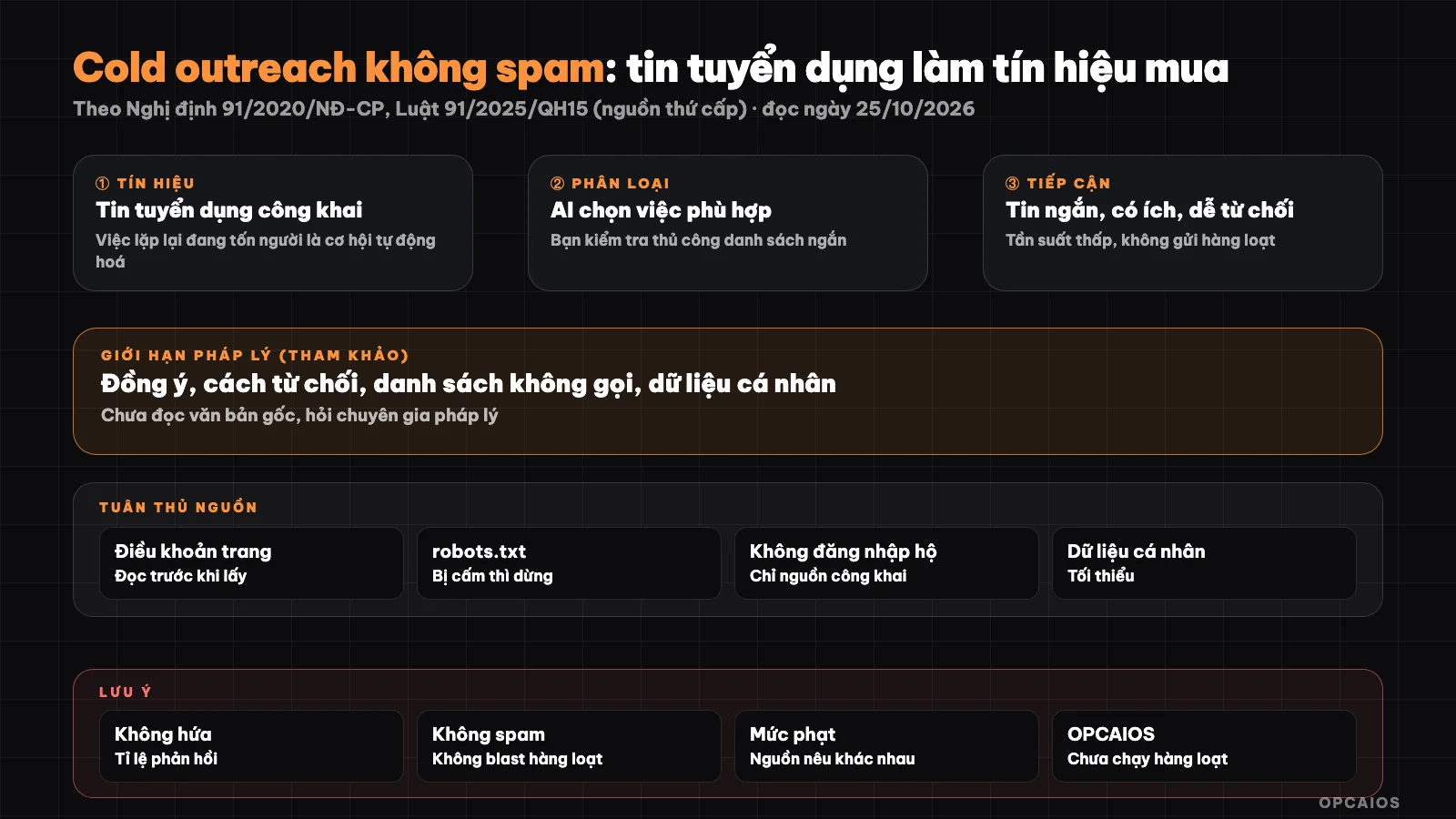
From public job posting to one short message that's useful and has an unsubscribe path. Diagram: OPCAIOS.
What is a buying signal from a job posting?
A buying signal from a job posting is a sign that a company is paying salaries for work that can be partly automated. For example, when a company posts for "data entry staff," "order reconciliation assistant," or "customer care staff replying to messages," that role describes repetitive daily work. This is a reason to reach out with intent using a genuine question, instead of sending a template to the whole list.
You need to understand 3 limits. First, a job posting may be old, closed, or posted on behalf of a third party. Second, having repetitive work doesn't mean the business wants to automate or has a budget. Third, much work needs people, automation only cuts part of it so you shouldn't promise "replacing staff." So treat the signal as a hypothesis to ask about, not a fact to state. For example, if a post on Facebook or Google Jobs is 60 days old, check if it's still active before drafting a message. Write each posting into Excel with the reading date 25/10/2026 so you can check later.
What does using only public sources and respecting terms mean?
Public sources that respect terms are job postings anyone can see, and reading them automatically isn't blocked by the website. This is the difference between "not spam" and breaking rules. There are 5 rules. Rule 1: use only public postings. Rule 2: read the terms of use and robots.txt file of each job site before automatic scraping; many sites ban or limit it, and if they ban it, don't do it. Rule 3: don't get past login screens, don't use fake accounts, don't bypass blocking measures.
Rule 4: prefer an API or official data feed if available; if unsure, read a few dozen postings by hand each week. Rule 5: save only minimum information: business name, position, posting link, reading date, and avoid collecting personal data of the person posting or applicants. About robots.txt, it's a convention for automated scrapers, it doesn't replace terms of use and it's not a license. Check both for 5 job sites in Vietnam, then write the result in Google Sheets (read date 25/10/2026).
How do I use AI to sort job postings?
Sorting job postings with AI is a fast reading step, where the model returns structured data for each posting. For example, you paste a posting into Claude and ask for 5 fields: job group (data entry, reconciliation, customer care, reporting, scheduling), repetition level (low, medium, high), tools mentioned (spreadsheets, accounting software, messaging channels), automation opportunity written in one line, and confidence.
The principle has 3 points. First, use only information inside the posting. Next, don't let AI make up information about the business and mark every conclusion as "guessed." Finally, a real person reviews the short list before any messages are drafted. You can link the sorting step to n8n self-hosted on VPS and filter more by custom rules; see also AI tools to find B2B customers to compare other ways to find customers. For instance, 30 postings a week processed with Google Sheets and Claude is enough for small scale.
Compose Personalized, Short, Honest, and Helpful Messages
A good message answers three questions from the recipient: who is sending it, why I'm reaching out, and what they get if they reply. The suggested structure has 4 parts:
- One sentence stating the specific reason ("I see you're hiring for an order reconciliation role").
- One sentence describing what might help, without promising results.
- A small, easy-to-answer request, like asking if I can send a sample process description or if they want to discuss.
- A sentence allowing them to decline.
Writing rules: under about 100 words, don't pretend to already know them, don't create time pressure, don't claim you've "carefully reviewed the company's system" if you haven't. For example, Claude drafts the message, you edit it in your own voice over Zalo or email and review each message before sending.
Sample Message (hypothetical)
Hi sister Lan, I'm A, doing process automation for small businesses. I see your company is hiring daily order reconciliation staff. Some businesses with similar processes have tried automating order matching and reporting, but it depends on how you operate so I can't say it fits your company. If you'd like, I can send a one-page description of how it works for you to reference, no need to reply. If you don't want to hear from me, just reply "no" and I won't contact you again.
The name, position, and company in the sample are hypothetical, not real people.
What should I watch out for on each contact channel?
Every contact channel is subject to its platform's terms and Vietnamese law. The section below is for reference only, all from secondary sources (read 25/10/2026), so you must check against the original texts.
| Channel | General Notes |
|---|---|
| See Decree 91/2020/NĐ-CP on combating spam messages, spam emails, and spam calls; need clear decline option and stop sending when requested | |
| Subject to platform terms; limit bulk sending, don't use auto-messaging tools if terms forbid it (not verified in detail) | |
| Zalo | Zalo account terms and policy; ads to unknown numbers may be reported and account locked (not verified in detail) |
| Phone, SMS | Decree 91/2020 applies to ads via call and SMS; Do-Not-Call list |
What does Decree 91/2020/NĐ-CP say about advertising messages?
Decree 91/2020/NĐ-CP is the text on combating spam messages, spam emails, and spam calls in Vietnam, effective from 1/10/2020. Legal summaries read on 25/10/2026 (not cross-checked against original text) state that under Decree 91/2020/NĐ-CP, spam is an ad sent without prior consent from the recipient or in violation of ad messaging rules.
There are 3 main requirements. First, ad messages must include decline instructions. Second, the advertiser must stop sending that message type if declined. Third, don't call or message numbers on the Do-Not-Call list. For example, if a business owner replies "no" on Zalo or email, you immediately add them to your do-not-contact list and send no more messages. OPCAIOS has not verified how the decree applies to B2B messages to work email addresses and has not confirmed current penalty levels, so you should consult a lawyer.
How does the 2025 Personal Data Protection Law affect this?
The 2025 Personal Data Protection Law (Law No. 91/2025/QH15) is Vietnam's new law on personal data processing, effective from 1/1/2026 along with Decree 356/2025/NĐ-CP for guidance. Analysis articles read on 25/10/2026 (secondary sources) state that under Law No. 91/2025/QH15, data subject consent must be clear and for each specific purpose. Using personal data for advertising is not banned but must meet law conditions.
Points not verified include 3 things: how the law applies to B2B messages to work email addresses, current penalty levels, and specific content on advertising in the new law. If you target businesses, consult a lawyer to know when prior consent is needed. The safe way is to prioritize channels with public interaction, like contact forms businesses publish for partnership purposes on their website, and avoid using unnecessary personal information. This is not legal advice.
How Not-Spam Differs From Mass Outreach
| Criteria | Not-spam | Mass outreach |
|---|---|---|
| Reason to contact | Specific, from public signals | Generic |
| Volume | Small, manually reviewed per message | Hundreds, thousands |
| Frequency | One message, remind at most once after a few days, then stop | Repeated reminders in quick succession |
| Rejection | Clear, stop immediately, add to do-not-contact list | Hard to find or ignored |
| Content | Short, honest, useful | Over-promises |
Keep a list of people who have declined and never add them again.
How to Measure Real Response Rate?
Real response rate is the number of responses divided by the number of messages sent, including negative responses. Track a simple table in Google Sheets each week with 5 columns: messages sent, responses received, rejections, conversations started, quotes given. With a small sample of just dozens of messages, the numbers are very noisy, so don't draw big conclusions. Example: send 20 messages over 2 weeks and get 3 responses—that only tells you the direction, not a reliable rate.
If your rejection or spam report rate is high, stop and fix your reason to contact before sending more. There is no universal "good" rate. OPCAIOS doesn't offer benchmarks because we haven't verified a trustworthy source, and this post doesn't include any percentage figures on response rates. Ultimately, compare each batch sending the same template to see which changes work, rather than changing many things at once.
Risks
| Risk | How to handle |
|---|---|
| Violating job board terms | Read the terms and robots.txt, don't bypass login |
| Sending to the wrong person, wrong context | Manually review, check if the post is still active |
| AI making up business details | Use only facts from the post, label guesses |
| Being seen as spam | Send few messages, have clear rejection, stop when asked |
| Over-promising | Don't promise results, state limits clearly |
| Legal risk with personal data | Collect minimally, ask a lawyer, compare against original text |
OPCAIOS Experience
OPCAIOS has not run large-scale cold outreach and has no response figures to share. We do use n8n to save and use AI to sort and draft in other workflows, with the rule that a person reviews everything by hand before sending. The process in this post is a proposed framework for you to test at small scale, not our measured results. For broader sales process, see automated sales funnel for OPC and productized service.
Frequently Asked Questions
Is scraping job posts legal?
It depends on the source and method. Use public posts, follow each site's terms and robots.txt, don't bypass login; if a site bans automated collection, don't do it. This is not legal advice.
How many messages per week can I send without being called spam?
There is no verified universal number. Keep it small, manually review each message, have a specific reason and a clear rejection option.
Do I need permission before messaging?
Decree 91/2020/NĐ-CP relates to advertising messages sent without consent, and the Personal Data Protection Law effective 1/1/2026 requires explicit consent for each purpose. How this applies to B2B outreach, you should ask a lawyer.
How long should a message be and what should I promise?
Short, around 100 words, state your reason to contact, make one small offer, and explain how to decline. Don't promise specific results or savings.
Can AI do all of it?
AI cannot do all of it. AI like Claude or ChatGPT helps sort job posts and draft messages, but deciding who to contact, what to send, and when to stop is your job. For example, with 30 job posts each week, AI can narrow it to 5 suitable companies and draft 5 messages, but a real person must check if posts are still active, re-read each message, and log rejections to the do-not-contact list. This process keeps cold outreach small and defensible. To learn how to build such a workflow, see OPCAIOS's AI application training course.
Source: legal summaries from news outlets and law sites on Decree 91/2020/NĐ-CP and Personal Data Protection Law 2025 / Decree 356/2025/NĐ-CP (read 25/10/2026, secondary source, not checked against original text); unverified: each platform's terms, application to B2B, current penalties, response benchmarks; sample messages are assumed; not legal advice. Experience is OPCAIOS's.
Translated from Vietnamese with AI. Read the original.
Want to apply this in your business?
Book a free 30-minute call (Vietnam time, in English or Vietnamese).