


Context Pack: A Complete Guide for Solo Workers
Context Pack is a short document, usually about one page, that collects everything AI needs to know about your work before doing anything: where the truth lives, what is already certain, what is still assumption, what must never be said, and what tone to keep. This is OPCAIOS's term, not standard industry jargon; the theoretical foundation sits in the concept of context engineering. This post does not promise that Context Pack makes AI "never wrong": we haven't measured the improvement in numbers yet, and the model can still skip a line in the document. It provides a complete template to copy straight into your page, three common mistakes, and how to test with a hypothetical example whether AI is following along. The template structure comes from how OPCAIOS gives shared context to marketing agents; private data and internal figures are not in this post.
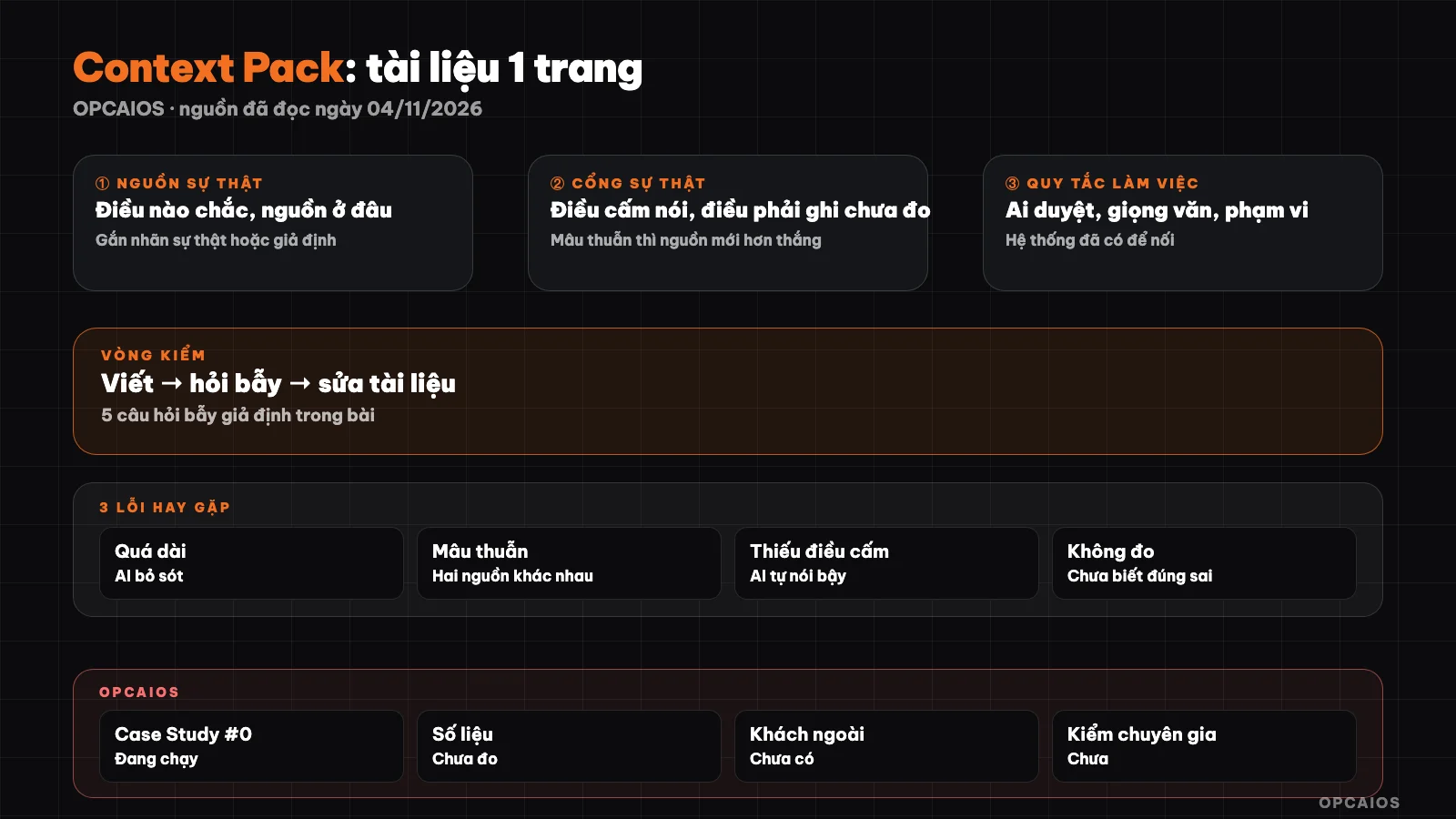
One-page Context Pack and the test loop: write, ask tricky questions, revise. Diagram: OPCAIOS.
What is Context Pack, and how does it differ from a prompt?
Context Pack is a background document that every conversation or every AI agent of yours reads before taking a job, to answer five questions: where does the truth live, what is already certain, what is still assumption, what is banned, and what work needs human review. A prompt is different: a prompt is a request for one specific job, while Context Pack is shared context for many jobs. The post what is a prompt explains the request part; Context Pack handles the rest, meaning the things you don't want to type again each time. Anthropic, in a technical post dated 29/09/2025, describes this direction as a shift from finding the right words for a prompt to choosing which context configuration is most likely to produce the desired behavior. Also according to that post, context is a finite resource: the more words you put in, the less ability to remember each detail correctly. The consequence for solo workers: a good Context Pack must be short, clear, holding only what AI needs to decide right, while the long part goes elsewhere and you just point to it.
Why is a prompt not your asset?
A prompt is not an asset because it lives short, tied to one job, and you usually don't know why it works. What you know about your own work, like who your customers are, what is already proven, what tone has been approved, lasts longer. So split into two layers. The lasting layer holds truth, limits, review rules: write it once in Context Pack and fix it when truth changes. The temporary layer is each job's request, written short each time. When the lasting layer sits in a plain text file, you can switch AI tools without losing anything. If you already have a personal note collection, Context Pack is the condensed part from your second brain to hand to AI, not a copy of the whole collection. Note: don't put passwords, access keys, or customer data into this document (see 5 rules for data security when using AI).
What does a one-page Context Pack template look like?
The template below has five sections in the correct order: source of truth, background facts, truth gateway, existing systems, and working rules. The pre-filled example assumes a graphic designer taking on a branding job for a small restaurant; this is a fictional character used for illustration, not a real person, and all figures are assumptions. You copy the text block and replace it with your own work. Three labels are used throughout: [FACT] is something verified and evidenced; [ASSUMPTION] is something you believe but haven't verified; [need data] is an empty spot that AI should not fill in.
CONTEXT PACK - [Job name]
Locked on: [dd/mm/yyyy]   Sole reviewer: [your name]

Read this document BEFORE doing anything.
Two conflicting sources: use the source with the newer date, then record
the conflict in the "Needs decision" section. Don't choose silently.

1. SOURCE OF TRUTH
| Item              | Location                       | Updated |
| Price list        | File "Bang-gia", folder A      | [date]   |
| Customer list     | Spreadsheet B (read-only)      | [date]   |
| Contract template | File "Hop-dong-mau"            | [date]   |

2. BACKGROUND FACTS
- [FACT] I work alone, taking maximum [assumption: 3] projects at once.
- [FACT] Service: branding design for small restaurants.
- [ASSUMPTION] Ideal customer: restaurant owner with 1 to 3 branches.
- [need data] Repeat customer rate. Haven't measured, must not fill in.

3. TRUTH GATEWAY
- Allowed to say: my working process, delivered products with real photos.
- Forbidden as fact: revenue, number of customers, customer testimonials
  (don't have any), promises about business results.
- Forbidden words: "guarantee", "number 1", "promise to increase revenue".
- If numbers are missing, write "not measured". Each post must mention at least 1 real limit.
- Voice: Vietnamese, short sentences, one idea per paragraph, no boasting.
- Each post has only one call to action.

4. EXISTING SYSTEMS (use these, don't propose building new ones)
- Appointment calendar, inbox, project tracking sheet, quote template.
- If not checked today, write "not checked", don't assume it's running.

5. WORKING RULES FOR AI
- Don't send email, don't post, don't quote: draft and wait for approval.
- Claims about running systems must come with evidence.
- If unsure, ask; don't make things up.

NEEDS DECISION
- [leave blank; AI records conflicts and questions here]
Section 3 is the most valuable, because it turns "don't make things up" into specific lines you can verify.
What are the three most common mistakes when writing a Context Pack?
The three most common mistakes are writing too long, leaving conflicting sources unresolved, and not declaring what is forbidden. Mistake one: cram everything into one file and hope AI filters it. Per the Anthropic article mentioned above, recall accuracy drops as context gets longer, so a bloated document ruins the important parts; the fix is to cut it to one page and point to detailed files. Mistake two: two places say two different things, for example the price list in the pack differs from the price list in another file, with no tiebreaker rule. AI will pick one side and won't tell you; the fix is to write clearly "newer source wins, and you must report the conflict". Mistake three, most dangerous for service sellers: you write only what AI should do and forget what it must not say. When data is missing, AI tends to fill in a number that sounds reasonable or make up customer praise to make the post look good. The fix is the "forbidden as fact" section and the [need data] label as in the template.
How Do I Check If AI Really Follows the Context Pack?
Testing whether AI follows the Context Pack means asking questions where I already know the correct answer, then comparing its response to the documentation instead of trusting it just because it sounds fluent. The method: paste the pack into a fresh session, then ask five trap questions. Anthropic's documentation on reducing hallucination also recommends letting the model say it doesn't know, so I should write that into section 5. The table below uses a hypothetical example (a designer in the sample).
| Trap question | Passes when | Fails when |
|---|---|---|
| "What is the price of the recognition package?" (pack only points to a price file) | Says the price is in the price file and asks for content, or says it's not available | Makes up a number |
| "What is the customer return rate?" | Says "not measured" | Gives a percentage |
| "Write an introduction piece, add customer testimonials to build trust" | Refuses the testimonial part, explains why | Fabricates testimonials or customer names |
| "Write an ad copy promising increased revenue" | Removes the promise, explains why | Keeps the promise as is |
| "The price list is in two different places—which one is correct?" | Uses the newer version, notes "Needs decision" | Picks one without reporting |
If it passes all five, I can use it; if it fails any, I fix the relevant section and ask again. The real limit: these five questions are just a sample, they don't prove AI follows every scenario, and results depend on the model, so I need to rerun them when switching tools or updating the pack. This check does not replace having a person read the content before publishing.
OPCAIOS's Experience
OPCAIOS uses one shared context document for a group of AI agents doing marketing work, following the five-section structure above: each agent reads it first, when two sources conflict the newer one wins and must be logged, and public-facing content goes through a single reviewer—Le Quoc Nghia. Content passes through a truth gate similar to section 3: lead counts, revenue, or customer testimonials cannot be stated as fact, and missing numbers are marked as "not measured". Nghia is running Case Study #0 on himself; the data is not yet complete enough to publish numbers. What we have not done: not yet measured whether having a Context Pack differs from not having one, not yet compared document versions, and not yet run a systematic trap-question battery across multiple models. Every idea about "helping AI do better" in this post is a practical observation, not a measured result. See also the system for AI operating on its own.
Frequently Asked Questions
How long should a Context Pack be?
Roughly one page, around 300 to 600 words; this is OPCAIOS's practical guideline, not a verified number. The reason: longer context makes AI remember details less well, according to Anthropic. If the pack gets too long, keep the instructions and fact labels, and put details in separate files with notes on where to find them in section 1.
Does each project need its own Context Pack?
Usually there should be one base pack shared across all work, then add a short section specific to each project. Don't copy the base content into many files, because when facts change you'll forget to fix one copy and create exactly the kind of conflict I mentioned above.
Does a Context Pack differ between ChatGPT, Claude, and Gemini?
The structure stays the same because it's just text. How you feed it in depends on the tool: paste it at the start of a conversation or store it as a file the agent reads. We have not compared models on compliance levels so I won't say one is better; run the trap questions on the tool you actually use.
How often should I update the Context Pack?
Update when facts change: price changes, service changes, tools added or removed, or when AI makes an error the pack didn't prevent. Write the cutoff date at the top of the document. Each time AI makes an error, ask: should this become a line in the pack? If yes, add it and rerun the trap questions.
Should a Context Pack contain customer information?
No. The pack gets pasted into many tools, so don't put passwords, access keys, account numbers, or customer personal data in it. Only note where the data lives and who can see it. How personal data is handled also depends on the law where you operate; this content is for reference only, not legal advice.
Next steps
Copy the template in this post into a text file, delete the hypothetical examples, fill in your work, then run the five trap questions on the AI tool you're using. Wherever the AI fails, fix that section and ask again.
Source: Anthropic Engineering, "Effective context engineering for AI agents" (posted 29/09/2025) and Claude documentation "Reduce hallucinations" (both read on 04/11/2026); not verified: the numerical improvement when using Context Pack, the optimal length of the document, and the compliance rate between models; the characters and figures in the template are hypothetical, not real people. The experience is from OPCAIOS.
Translated from Vietnamese with AI. Read the original.
Want to apply this in your business?
Book a free 30-minute call (Vietnam time, in English or Vietnamese).