



GEO (Generative Engine Optimization) là gì? Là việc làm cho nội dung website dễ được các công cụ tìm kiếm và trợ lý AI đọc, hiểu và nhắc tới (trích dẫn, gắn liên kết) khi trả lời câu hỏi của người dùng. Bài hướng dẫn cách đo xem AI có trích dẫn website của bạn không, theo kiểu thực hành cho người làm một mình, dựa trên tài liệu của OpenAI, Google và llmstxt.org (đọc ngày 25/10/2026). Phần trung thực: không ai có số liệu chính thức cho biết website bạn được AI trích dẫn bao nhiêu lần, câu trả lời của AI thay đổi theo thời điểm, câu hỏi và công cụ, nên mọi phép đo chỉ là mẫu tham khảo. Bài không hứa bạn sẽ được trích dẫn, cũng không có bí quyết đảm bảo. Bạn sẽ có: các lớp nền kỹ thuật cần kiểm tra, cách tự kiểm tra thủ công bằng bộ câu hỏi chuẩn, cách ghi sổ, và kinh nghiệm của OPCAIOS khi dựng công cụ kiểm tra riêng. Muốn nền tảng khái niệm trước, đọc SEO và GEO là gì.
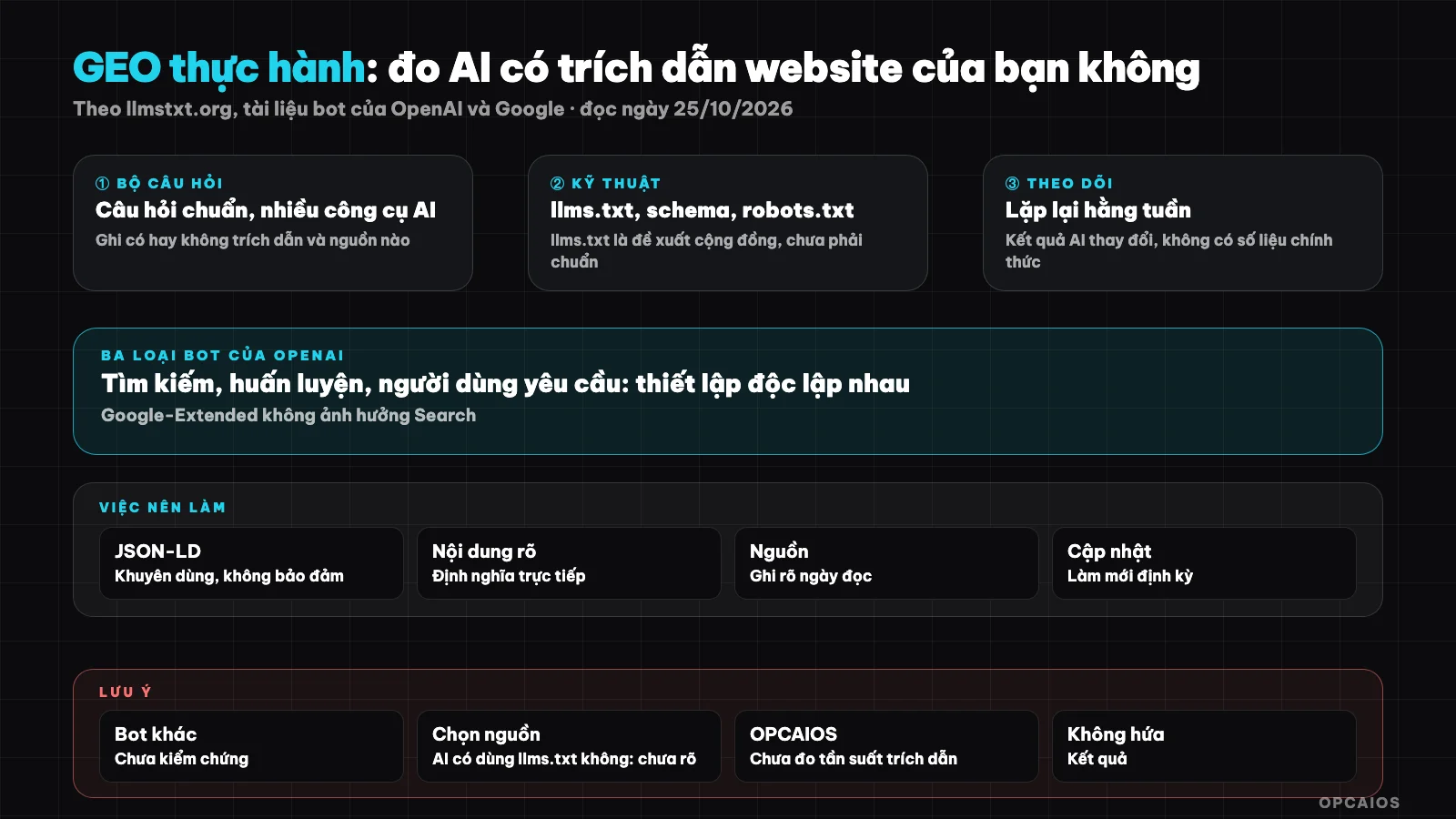
Hai nửa của GEO thực hành: chuẩn bị nền kỹ thuật, rồi đo bằng bộ câu hỏi lặp lại. Sơ đồ: OPCAIOS.
Được AI trích dẫn nghĩa là gì và đo có chính xác không?
Được AI trích dẫn nghĩa là câu trả lời của một trợ lý như ChatGPT, Gemini hoặc Perplexity nhắc tên thương hiệu bạn, gắn liên kết tới trang của bạn, hoặc không nhắc gì. Ba trường hợp khác nhau, nên khi đo hãy ghi riêng: có nhắc tên, có liên kết, hay không có. Phép đo có 4 giới hạn bạn phải chấp nhận:
- Cùng một câu hỏi, hỏi 2 lần có thể ra 2 câu trả lời khác nhau.
- Mỗi công cụ AI có cách chọn nguồn riêng và thay đổi theo thời gian; tính năng tìm web có thể bật hoặc tắt tuỳ gói và tuỳ lúc.
- Không có bảng điều khiển chính thức nào cho biết "AI đã trích dẫn site bạn N lần". Mọi con số đều do bạn tự lấy mẫu.
- Được trích dẫn không đồng nghĩa có khách hàng, mà chỉ là một tín hiệu hiện diện, đừng coi là chỉ số doanh thu.
Vì thế, hãy đo theo xu hướng, tức so cùng một bộ câu hỏi qua nhiều tuần, thay vì đọc từng kết quả riêng lẻ. Ví dụ giả định: một lần đo cho thấy ChatGPT nhắc tên bạn và lần sau thì không, một lần đo chưa đủ để kết luận gì.
Level 1: technical foundation for AI to read your site
Before measuring, check the things that might block or make it harder to read content.
What is robots.txt for AI crawlers?
robots.txt is a file at the root of your website, where you tell crawlers which ones can access which pages. Each AI provider can use multiple crawlers with different purposes. According to OpenAI (documentation read on 25/10/2026), there are 3 crawlers: OAI-SearchBot puts your website into ChatGPT's search feature, GPTBot collects content that can be used to train models, and ChatGPT-User accesses by user request and the documentation says robots.txt rules may not apply. The settings are independent, so you can allow the search bot but deny the training bot. For example, to appear in ChatGPT search but not allow training, you set User-agent: OAI-SearchBot with allow rules, and deny GPTBot. First, open your existing robots.txt file. Next, add rule blocks for each crawler by name. Finally, check the file again by opening the robots.txt address in your browser. According to Google (per Google), the Google-Extended token in robots.txt controls whether content is used for Gemini training and grounding, and doesn't affect presence in Google Search. The bot names and behaviors of Anthropic, Perplexity and others — OPCAIOS hasn't read their official documentation so won't mention them; open the provider's own documentation before editing robots.txt. Blocking or allowing is your business decision (paid content, copyright, desire for presence), and this post doesn't recommend either way.
What is structured data (schema.org) and does it help with citations?
Structured data is code that describes your page (this is an article, who is the author, publication date, which organization) according to schema.org vocabulary. According to Google (per Google), Google Search's structured data documentation recommends JSON-LD format if your system allows, and says structured data doesn't guarantee rich results. With AI, OPCAIOS has no official documentation proving structured data increases citation chances. So treat structured data as a good foundation for machines to understand, not a proven lever. For example, a blog post should declare Article type, author name, publication date and publishing organization. First, add a JSON-LD block to your post template. Next, check it with Google's tool. Finally, keep author info and update dates matching what displays on the page, because data mismatched with visible content is usually useless.
What is llms.txt and is it required?
llms.txt is a community proposal (llmstxt.org, proposed by Jeremy Howard from September 2024): a Markdown file at your website root, with a title, summary paragraph and list of links to model-language-friendly content. The proposal page calls itself a "proposal", meaning it's not yet a mandatory standard, and positions itself as a supplement to robots.txt and sitemap, not a replacement. Many sites have posted one, but whether each AI provider like OpenAI, Google or Anthropic actually reads llms.txt files, OPCAIOS hasn't verified from official documentation. For example, a small website can create llms.txt by listing 10 to 20 of its most important pages. First, write a title and summary paragraph. Next, list links by section. Finally, place the file at your website root. It's cheap to do, but don't expect much, and don't treat llms.txt as decisive compared to good content and clean technical setup.
What content gets cited easily?
Content that gets cited easily is content with an opening paragraph that defines directly, clear sub-headings, short tables and lists, cites sources, credits the author and update date. This is the part with the most practical impact by common experience, though no official numbers prove it. Self-standing paragraphs, meaning reading alone still makes sense, get extracted more than paragraphs dependent on context. For example, a paragraph answering "What is GEO?" should start with one complete definition sentence, then move to reasons and how-to. The recommended process has 3 steps. First, write the answer sentence right below the question heading. Next, add source and read date for each number, like "according to Google, read on 25/10/2026". Finally, avoid vague pronouns like "it" or "this" at the start of paragraphs, because the paragraph might be pulled from context when AI extracts it.
Class 2: manual self-checking, step by step
This method doesn't require paid tools.
Step 1: build a standard question set
Write around 10 to 20 questions that real customers would ask, divided into three groups:
- Conceptual questions in your field ("What is X?").
- Comparison or tool selection questions within your niche.
- Questions with your brand name ("What is OPCAIOS?" kind of thing), to see if AI knows about you.
Keep the exact wording of questions between measurements, otherwise you can't compare.
Step 2: ask multiple AI tools
Run the same question set on at least a few tools (an assistant with web search, a search tool with AI summary, another assistant). Record both the tool name and mode (whether web search is turned on or not), because results differ noticeably.
Step 3: keep a log
Use a spreadsheet with these columns:
| Date | Tool / mode | Question | Mentions you? | Links to your site? | Other sources cited | Notes |
|---|
The "other sources cited" column is very valuable: it tells you which competitors or what types of pages are being picked, so you see what kind of content you're missing.
Step 4: repeat on schedule
Measure again each week or every two weeks, with the same question set. Ask each question a few times because results fluctuate. Don't change your page every day and then infer the cause from one measurement; change one thing, wait a few rounds, then draw conclusions.
Step 5: act on results
- Questions where AI answers correctly for your niche but doesn't mention you: check if you have a page answering that question directly, and whether the opening paragraph defines things clearly.
- AI mentions you incorrectly: fix the information on your own about page, keep your name and description consistent everywhere you appear.
- No tool mentions you: normal for a small site, don't read too much into it; focus on content and technical foundation.
OPCAIOS experience
OPCAIOS built an internal management tool to check how ready an address is for AI search. What we learned, at a conceptual level:
- Deterministic checking. The tool scores using fixed rules (like paragraph extractability, AI crawler permission status, whether an llms.txt file exists) rather than asking an AI model to score. Reason: AI scores fluctuate between runs, but we need to compare this month to last month. This also means the tool measures page readiness, not whether AI actually cites it or not.
- Weekly crawl. The system crawls a limited number of pages from the website each week and sends an alert email when meaningful changes happen. We treat this as background alert, not a ranking board.
- llms-full file respects permissions. The full version of the file for AI reflects the site's actual display rules: member-only content shows only the intro, blocked tools are skipped. Lesson: any aggregate file you create for AI must go through the same permission gate as the website, or you accidentally expose paid content.
- Tool only recommends, doesn't self-edit robots.txt. Blocking or allowing AI crawlers is the site owner's decision.
What we haven't done: we don't have reliable numbers on how often AI cites OPCAIOS, so we don't publish any figures. Manual measurement using a question set like the above is also how we sanity-check.
Common mistakes
- Blocking search bots by mistake when you only want to block training bots (because they're independent).
- Measuring once then drawing conclusions; or measuring only one tool.
- Believing a single file or tag (llms.txt, schema) is the key.
- Writing content to please AI while forgetting the real reader.
- Lying about information, keyword stuffing, or creating many thin pages. Beyond ethical risk, platforms can ignore untrusted sources.
Related: if you're picking tools and costs, see AI toolset for OPC model; if you care about customer data when using AI, see business data security when using AI: 5 rules; about how we operate the whole site, see AI system running on its own.
Frequently Asked Questions
How is GEO different from SEO?
SEO optimizes so your page ranks in search results; GEO optimizes so AI reads, summarizes, and mentions your content in its answer. The two overlap a lot (good content, clean technical setup), so don't drop SEO for GEO.
Is there a tool that tells me exactly how many times AI cites my site?
There's no official data from AI providers on this. Some third-party tools sample questions to estimate, but that's still an estimate. The safest way is a standard question set that you run yourself and keep records of.
Do I have to create llms.txt?
No. It's a community proposal, not a mandatory standard yet, and we haven't verified that any major AI provider commits to using it. Creating it is cheap but don't treat it as the deciding factor.
If I block GPTBot, does my site disappear from ChatGPT?
According to OpenAI documentation, GPTBot is related to training, while OAI-SearchBot is related to search features—two separate settings. Read the current documentation from the provider before making changes because policies can shift.
How long does GEO take to show results?
No one can promise a specific timeline, because GEO results depend on your niche, competition level, content quality, and changes to the AI tools themselves like ChatGPT, Gemini, or Perplexity. The practical approach has three steps. First, run a standard question set to get a baseline—for example 10 to 20 questions asked again every 1 to 2 weeks. Next, change one thing at a time, like rewriting the opening paragraph of a page, then wait a few measurement rounds. Finally, compare trends rather than individual results. Think of GEO as a long-term effort, and if you want to learn how to apply AI to content operations properly, you can look into OPCAIOS's AI application training course.
Source: llmstxt.org (llms.txt proposal), OpenAI crawler documentation, Google common crawler documentation (Google-Extended), Google Search structured data documentation (read 25/10/2026); unverified: documentation of other AI providers' bots, whether AI providers use llms.txt or structured data to select citation sources; Experience is from OPCAIOS.
Translated from Vietnamese with AI. Read the original.
Want to apply this in your business?
Book a free 30-minute call (Vietnam time, in English or Vietnamese).