


Using AI to Write Contracts for Small Services
What does it mean to use AI to write contracts for small services? It means asking a language model to draft a contract framework, explain terminology, compare clauses, and create a checklist so you don't have to start from a blank page. This post is for reference only, not legal advice, and OPCAIOS is not a legal entity. AI is not a lawyer: it can make up laws, cite incorrectly, miss important clauses, and doesn't know your specific context. This post will cover core clauses at a general level, where AI can help and where you shouldn't trust it, how to keep client data confidential, and situations where you should consult a lawyer. This post deliberately does not draft a complete contract ready to copy; only a framework and a few short sample clauses with notes for illustration.
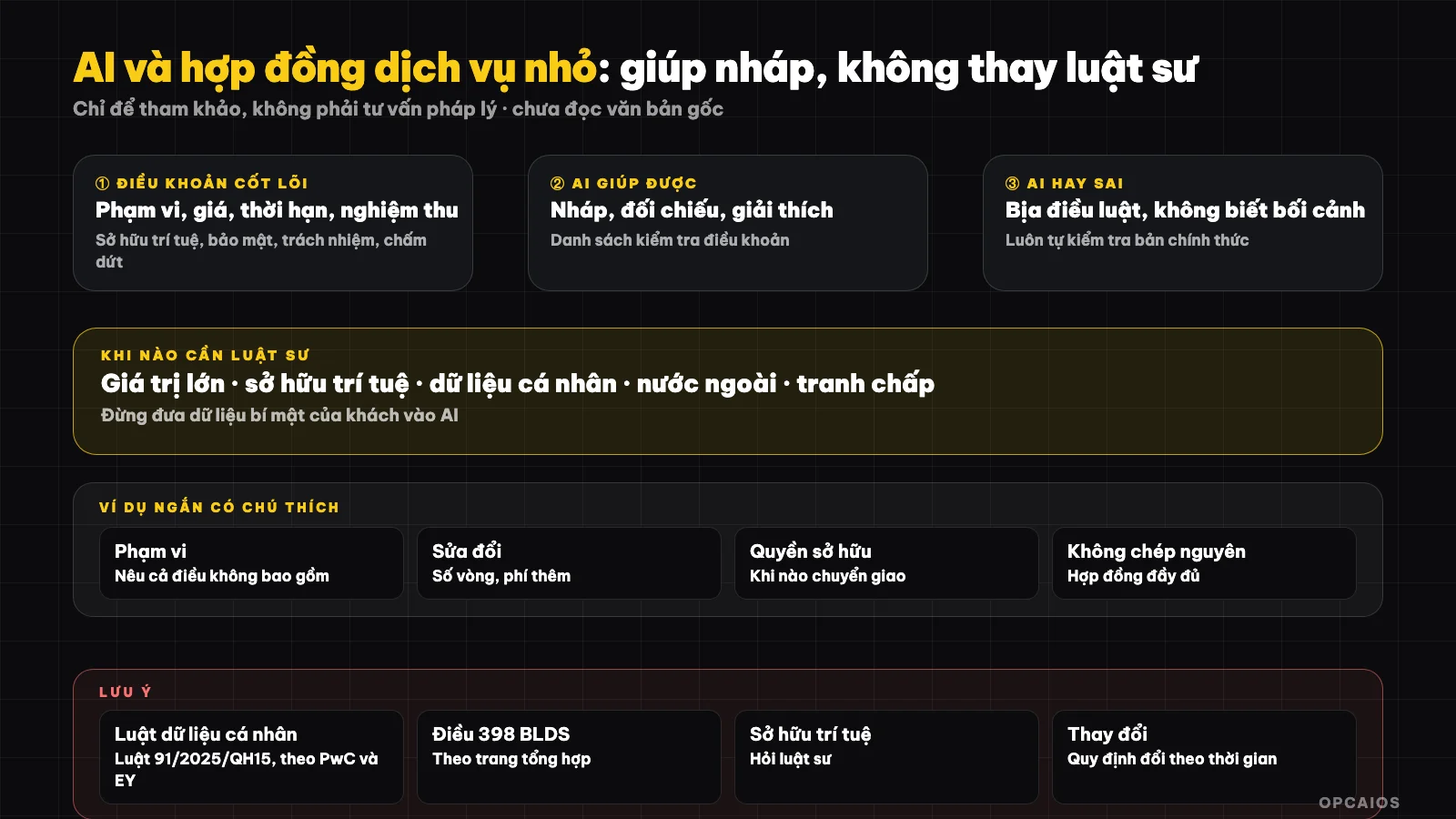
AI helps with drafting and review; legal decisions still need an expert. Diagram: OPCAIOS.
What core clauses does a small service contract need?
A small service contract needs a framework of 10 clause groups: scope of work, price and payment, term, modifications, acceptance, intellectual property, confidentiality, liability, termination, and dispute resolution. Under the Civil Code 2015, Article 398 says the parties may agree on contract content. This article lists possible content areas. These are the object, quantity and quality, price and payment method, term, place and method of performance. There is also the rights and obligations of the parties, liability for breach, and method of dispute resolution. Note: OPCAIOS only cross-checked legal summary pages (search results as of 25/10/2026), has not read the original text. Before relying on it, read the original version on Vietnam's official legal document portal and verify it remains in force. Example scenario: in the modifications group, you write "maximum 2 revisions included free, new requests quoted separately"; in the acceptance group, you write "client feedback within 7 days, past deadline counts as accepted".
Table of 10 clause groups and questions to answer
| Clause | Question to answer |
|---|---|
| Scope of work | What to do, what not to do, what deliverable, what format |
| Price and payment | Total fee, instalments or not, payment deadline, extra fees, invoice, late payment penalty |
| Term | Start, end, milestones, what extends a milestone (client late with feedback) |
| Modifications | How many revision rounds included free, how are new requests charged, scope change must be in writing |
| Acceptance | Acceptance criteria, time for client to give feedback, counted as accepted when |
| Intellectual property | Who owns the product, when transferred (after payment?), pre-existing materials of each party, right to include in portfolio |
| Confidentiality | What information is confidential, obligation duration, exceptions |
| Liability | Limit on damages, force majeure cases, what you don't guarantee |
| Termination | Who can terminate, notice period, how to handle paid amounts and unfinished work |
| Dispute resolution | Negotiate first, then escalate to where; which law applies |
Sample short clauses with notes (for illustration only)
Below are very short sample sentences, not ready-to-use templates. Numbers are blank or marked "[...]" because they depend on your agreement.
Scope: Party B performs [specific description of work] and delivers [product, format]. Work not listed here is outside this contract.
Note: vague scope is the most common source of dispute in small services; include what is "not included".
Modifications: Fee includes [number] revision rounds. Requests beyond scope are quoted separately and only performed after both parties confirm in writing.
Note: without this, "a small tweak" easily becomes endless work.
Intellectual property: Rights to the deliverable are transferred to Party A when Party A pays in full.
Note: transfer of rights, especially for works, software, images, has specific rules; this is a point where you should consult a lawyer (see below).
What can AI help with when drafting a contract?
AI can help with 5 things when drafting a contract, all at the draft and review level, not legal decision-making.
- Draft an initial framework from a list of terms and information you provide (scope, duration, payment method), giving you something to revise.
- Explain terminology in plain language (force majeure, compensation, acceptance...), with examples.
- Compare: match two versions, find contradictions (for example, timeline in clause 3 differs from clause 7), remind you of clauses commonly included that yours lacks.
- Create a checklist for you to review before signing, and a list of questions to bring to a lawyer.
- Translate and simplify a contract a client sends you, so you understand the intent (not to reach a final conclusion).
Example: you ask ChatGPT to list what terms are missing from your draft, then bring the list to a lawyer; any legal references must be checked against the original document.
What can't AI do and where does it go wrong?
AI goes wrong in 5 main ways when drafting a contract, each with its own solution. The first is making up or citing the wrong law: AI states a clause number and law name that sound real but are wrong or outdated, so you must check the original document on official sources and not copy citations without verification. The second is lacking context: AI overlooks your industry, client type, and specific situation, so provide anonymized background and ask again "what else is missing". The third is being too general or biased toward one side, so ask AI to list risks for your side and the other side. The fourth is sounding confident because the text is smooth, so treat every output as a draft needing expert review. The last is forgetting to update regulations, since laws and decrees change, so check the effective date and ask a lawyer for major work. Example: AI confidently states a "Clause" from a law, but that clause has been amended; only the original text on the official portal shows the current version.
Why not put client confidential data into AI?
Confidential client data is the name, address, tax ID, pricing terms, and business information in the contract, and should not go into AI tools without anonymizing first. Before pasting into any AI tool, do 3 things:
- Replace names with dummy names, for example "Party A" and "Party B".
- Remove account numbers, specific values, and personal information.
- Read the data policy of the service you're using.
Don't put a contract with strict confidentiality clauses into a tool you're unsure about its data handling. Example: a contract with a client that has a clause keeping information confidential for 30 days after completion should not be pasted as-is into a free AI tool, because you could breach your own confidentiality obligations. See 5 rules for protecting business data when using AI.
What steps are in the process of using AI to write a contract?
The proposed process has 6 steps, from your spoken description to file storage after signing.
- Write out in your own words: who does what for whom, for how long, at what price, when is it done.
- Ask AI to draft a framework from your anonymized description.
- Read each clause yourself, ask "if a dispute happens, who does this help".
- Ask AI to compare and list missing or contradictory points; verify every legal reference AI mentions.
- Use the checklist, then decide if you need a lawyer.
- Save the signed version, any written changes, related exchanges.
For example, someone doing design work taking on a 1-logo project could use step 1 to spell out how many free revision rounds, then use step 4 to have AI point out that the contract doesn't mention intellectual property transfer. Step 5 is when you decide if you need a lawyer, since intellectual property is something to ask an expert about.
When Do You Need to See a Lawyer?
You need to see a lawyer when you're in one of 6 situations where getting one clause wrong could cost you many times the consultation fee. First, the contract value is large relative to your scale. Second, intellectual property matters (software, trademarks, proprietary content, AI models), since transfer or licensing has long-term consequences. Third, customer or user personal data: according to summaries from PwC and EY, Law on Personal Data Protection No. 91/2025/QH15 takes effect from 01/01/2026, along with Decree 356/2025/NĐ-CP replacing Decree 13/2023/NĐ-CP; OPCAIOS has not read the original text. Fourth, there are foreign elements involving customers, payment, or applicable law. Fifth, you are in or about to enter a dispute, since every additional word you write could be evidence. Sixth, your industry has specific regulations like healthcare, finance, education, or advertising. You can still use AI to prepare: bring your lawyer a draft, a list of uncertain points, and questions—it will save time for both of you. For business registration, taxes, and foundational procedures, see legal checklist for solopreneur business registration. If you package your service into a fixed scope, clear boundaries also make contracts shorter (What is Productized Service).
OPCAIOS's Experience
We use AI to draft text and proofread, but we do not publish contract templates and have no data on how effective using AI for contracts is. We are not a legal consulting firm, so this post is not a substitute for a lawyer's opinion. The internal principle we follow: do not put customer data into AI tools unless it is anonymized first.
Frequently Asked Questions
Can AI write a contract instead of a lawyer?
No. AI helps with drafting and review but can make things up or cite laws incorrectly and doesn't know your specific context. For important matters, you need someone with legal expertise. This post is for reference only, not legal advice.
What clauses should a small service contract have?
Usually 10 groups: scope, price and payment, duration, modifications, acceptance, intellectual property, confidentiality, liability, termination, and dispute resolution. Details vary by case.
Should I paste a real customer contract into AI?
Not unless it's already anonymized and you're clear on the data terms of the tool. Real contracts usually contain names, addresses, tax IDs, pricing conditions, and business information about the customer, so you need to process them first. The process has 3 steps:
- Replace names with dummy names like "Party A" and "Party B".
- Remove account numbers, specific values, and personal information.
- Read the data terms of the service you're using, especially for ChatGPT, Claude, or other tools.
Example scenario: if a contract has strict confidentiality terms, you shouldn't paste it as-is, because you could violate your own confidentiality obligation. OPCAIOS's internal principle is not to put customer data into AI tools unless it is anonymized first.
What does the Civil Code 2015 say about contract content?
Article 398 allows parties to agree on content and lists groups of content that may be included, according to summary pages OPCAIOS has cross-checked on 25/10/2026; OPCAIOS has not read the original text, so please check the official version yourself.
Where should I start?
Write out your service scope and process clearly first, then use AI to draft and review. If you want to learn how to use AI safely in your work, see OPCAIOS's AI application training course.
Source: synthesis of searches on Article 398 of the Civil Code 2015 from legal and consulting pages, together with PwC and EY summaries on personal data law (read on 25/10/2026); unverified: original text of both, newer current regulations, rules on intellectual property transfer; this is not legal advice; experience is OPCAIOS's.
Translated from Vietnamese with AI. Read the original.
Want to apply this in your business?
Book a free 30-minute call (Vietnam time, in English or Vietnamese).