


Organic reach on Facebook is the number of people who see your Page post without you paying for advertising. The article makes clear from the start: there is no "hack" that guarantees increased reach, Meta does not fully disclose its algorithm, and AI does not "know" Facebook's algorithm. What AI can do is read your Page's own data, find repeating patterns in posting time, format, topic, opening sentence, then cross-reference them with principles Meta has publicly shared to design small experiments.
The ranking system considers thousands of signals according to Meta Transparency Center (read on 25/10/2026), so the article makes no promises about results. The article goes through 6 parts: (1) signals Meta publicly states; (2) how to export Page data; (3) how to ask AI to analyze using ChatGPT or Claude, usually in one session; (4) how to run small A/B tests; (5) traps to avoid; (6) metrics to measure. Everything here is a trial-and-error process, not a promise of results.
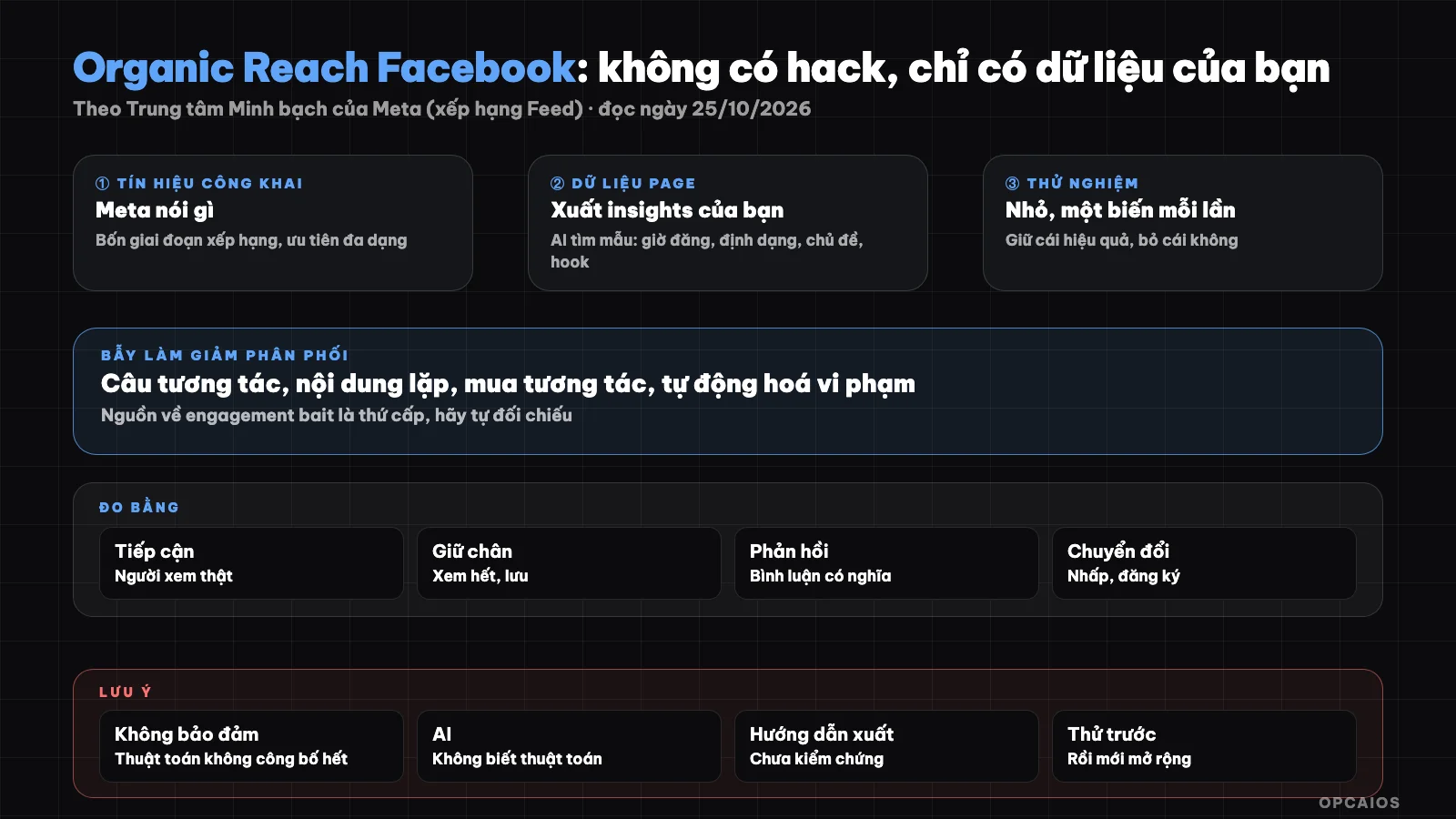
The process of turning Page data into hypotheses and small experiments. Diagram: OPCAIOS.
What does Meta publicly say about Feed ranking?
Feed ranking is the process Meta uses to select and order posts shown to each viewer. The process goes through four stages, according to Meta's Transparency Center (Facebook), the page explaining Feed ranking (read on 25/10/2026). Stage 1 is content inventory: gathering recent posts or posts with new interactions from sources you are connected to, excluding content that violates Community Standards. Stage 2 is signals: Meta considers thousands of signals about the viewer, the post, and the poster.
Stage 3 is prediction: more than 100 models estimate the likelihood that the viewer will click, comment, share, watch a video, or spend time on the post, and some models use surveys asking whether the post is "worth your time." Stage 4 is ranking by relevance score, with a bias toward diversity so viewers see fewer consecutive posts from the same source. Sensational, spam, or clickbait content may see reduced distribution. OPCAIOS could not read the full and current text of "Content Distribution Guidelines," so the details of each rule are unverified; please read directly at transparency.meta.com.
Step 1: Export your Page's own data
Page data is a table of statistics for each post, taken from Meta Business Suite (Meta), under Insights, and is the best data source you have. Export it to Google Sheets and select the past 90 days or so. The interface and export options (format, time range) change over time, so this version read on 25/10/2026 may differ from yours. OPCAIOS could not verify Meta's official guidance page when writing, so check for yourself in your current interface. The goal is to have one table, one row per post. Example (hypothetical): a table of 80 rows with 6 columns like below is enough to ask ChatGPT or Claude to compare format and posting time.
The topic and hook type columns usually don't exist, so you add them yourself. First, get at least 60 to 90 posts if you have them; fewer than that and the conclusion is very shaky. Next, hide or delete personal information of commenters before giving the data to any AI tool; see business data security when using AI.
Table with six required columns
| Column | Meaning |
|---|---|
| Date, time posted | To find posting time patterns |
| Format | Image, short video, link, text, carousel |
| Topic | You tag with 3 to 6 groups |
| Opening sentence (hook) | First line of the post |
| Reach, views | Number of people reached |
| Engagement | Comments, shares, saves, clicks |
Step 2: How to Ask AI to Find Patterns, Not to "Guess the Algorithm"?
The right way to ask is to give AI a data table from Google Sheets and ask it to describe what the data shows, along with confidence level. There are 5 analyses to request: (1) group posts by format and compare median reach, not average because one viral post skews the number; (2) group by time slot and day of week; (3) group by topic, see which topics usually rank in the upper half; (4) classify hooks into question, number, story, or statement then compare; (5) list high and low outlier posts, ask what common points might be.
Rule for reading results: for each pattern AI mentions, ask how many posts it's based on. A pattern from 3 posts is not evidence. Everything AI derives is a hypothesis to test, not truth about Facebook's algorithm. For example, if short video has higher median reach than images in an 80-post table, that's just a hypothesis to test, not a conclusion yet. Post time, format, and topic often intertwine, so it's hard to isolate individual impact. Ranking also depends on over 100 prediction models according to Meta (read as of 25/10/2026), so a single pattern rarely explains everything.
Step 3: How to Run Small A/B Tests?
Running small A/B tests means posting two versions of the same idea to compare reach, changing only one factor each time. From the hypothesis in step 2, design experiments by 4 rules below (these are general practice rules, not official Meta guidance). Rule 1: change only one variable at a time, like same content but different hook style. Rule 2: post at least 6 to 10 posts per branch if volume allows, spread across days and times to avoid overlapping other factors. Rule 3: write down the winning criteria beforehand, like higher median reach plus no drop in quality engagement. Rule 4: conclude only after finishing, don't change mid-way.
With a small Page, noise is very high, so small differences might just be random. OPCAIOS does not set any statistical confidence threshold; if the difference is small, treat it as inconclusive. Example assumption: each branch 8 posts over 21 days, number-hook branch slightly higher than question-hook branch, then you should repeat the test one more time.
What Traps to Avoid When Boosting Reach?
Reach traps are shortcuts that seem fast but corrupt data or violate platform terms. There are 6 common traps, as of read date 25/10/2026. First, engagement bait (Meta's term for engagement-asking content): asking people to like, share, tag friends in exchange for engagement. Facebook's past announcements said this type of post may get reduced reach (secondary source, haven't read current original terms). Second, clickbait and hidden information: Meta once announced reduced distribution of "watchbait" (secondary source). Third, repeated content: the system favors diversity, so posting the same thing many times, especially via AI, easily backfires.
Fourth, buying engagement or joining like-exchange groups violates terms and corrupts data. Fifth, unofficial auto-posting tools may breach terms and risk account lockout; use Meta's official scheduling feature. Last, letting AI write batches of posts without review creates generic content and brand voice drift. For example, a Page posting 3 times daily with the same idea via ChatGPT often bores viewers. Write posts that make readers want to engage because the content is useful.
What Real Metrics Should You Measure?
Real metrics are numbers recorded from Insights and websites, not feelings. Track weekly: median reach per post, video views, saves and shares, comments with substance not just emoji. Most important is business metrics: clicks to website, messages, signups, and orders. More reach with no extra customers has no value. If you tag UTM on links, measuring from post to conversion will be clearer in Google Analytics. Example assumption: after 4 weeks, you compare median reach of week one to week four, then compare website clicks in the same period, and keep only the hypothesis that lifts both. Write each week into a spreadsheet so your next test builds on old data.
OPCAIOS's Experience
OPCAIOS has not published Facebook reach figures and has no verified case studies about increasing reach with AI, so we don't promise results. What we actually have are internal tools: a link shortener system with statistics to know which posts drive traffic to the website, and an AI process that drafts copy and then a person reviews it by hand. The same spirit applies to Facebook: use AI to analyze and draft, and a person decides whether to post. See also one-person marketing agency with AI, AI tools for the OPC model, and automating the sales funnel for OPC.
Frequently Asked Questions
Is there a "hack" that guarantees increasing Facebook reach?
There is no hack that guarantees increasing reach. Meta does not fully disclose its ranking algorithm, and the system changes over time. According to Meta's Feed ranking explanation page (read on 25/10/2026), the system considers thousands of signals and over 100 prediction models, so there is no single trick that controls the result. What you can do is run controlled tests on your own Page data: export 60 to 90 posts, have AI find patterns, form hypotheses, then run small A/B tests with 6 to 10 posts per branch. For example, if you hear someone promise "double reach in 7 days", ask them what data proves that and on which Page.
Does AI know Facebook's algorithm?
AI does not know Facebook's algorithm. Models like ChatGPT or Claude can only analyze data you feed them and cross-reference it with what Meta has made public, such as the four stages of Feed ranking that Meta describes. Meta does not disclose the weight of each signal, so any tool that claims to know the weights is just guessing. The right way to use it is to ask AI to describe patterns in your Page's 60 to 90 posts, along with the number of posts that form the basis for each pattern and the confidence level. For example, a good question is "how much higher is the median reach of short videos compared to photos in this data", while a bad question is "does Facebook's algorithm prioritize short videos".
When should I post?
There is no universal best time. The right time depends on your Page's audience, so check your Insights data and experiment.
Should I have AI write posts and then automatically post them in bulk?
No. Repetitive or generic content is easy for viewers to skip and may get reduced distribution. Have AI draft and you edit, adding real experience.
How do I systematically learn to use AI for marketing?
Start with your own Page data and small documented experiments. The suggested sequence has 3 steps. First, export a table of 60 to 90 posts from Meta Business Suite. Next, have AI find patterns and record the confidence level of each pattern. Finally, run small A/B tests and record the results each week. If you need direct guidance from OPCAIOS, see AI application training course.
Source: Meta Transparency Center, Feed ranking explanation page (read on 25/10/2026); information about engagement bait and watchbait from secondary review posts; unverified: current text of Content Distribution Guidelines, Business Suite data export instructions, specific reach reduction; Experience is from OPCAIOS. This post is for reference only and does not guarantee results.
Translated from Vietnamese with AI. Read the original.
Want to apply this in your business?
Book a free 30-minute call (Vietnam time, in English or Vietnamese).