


Learning AI as a beginner means learning three things in order: understanding what AI can and cannot do, knowing how to delegate and check results, then applying it to real work of your own. The 4-week roadmap below is a suggestion from OPCAIOS, not yet tested with any learners, so I'm not promising you'll be "proficient" after 4 weeks. Each week has one goal, one real task, and one free resource with an official name and address, verified as working on 04/11/2026. Things to know upfront: all selected courses are in English, many pages don't list duration, and "free" resources may change, so check the original page before signing up.
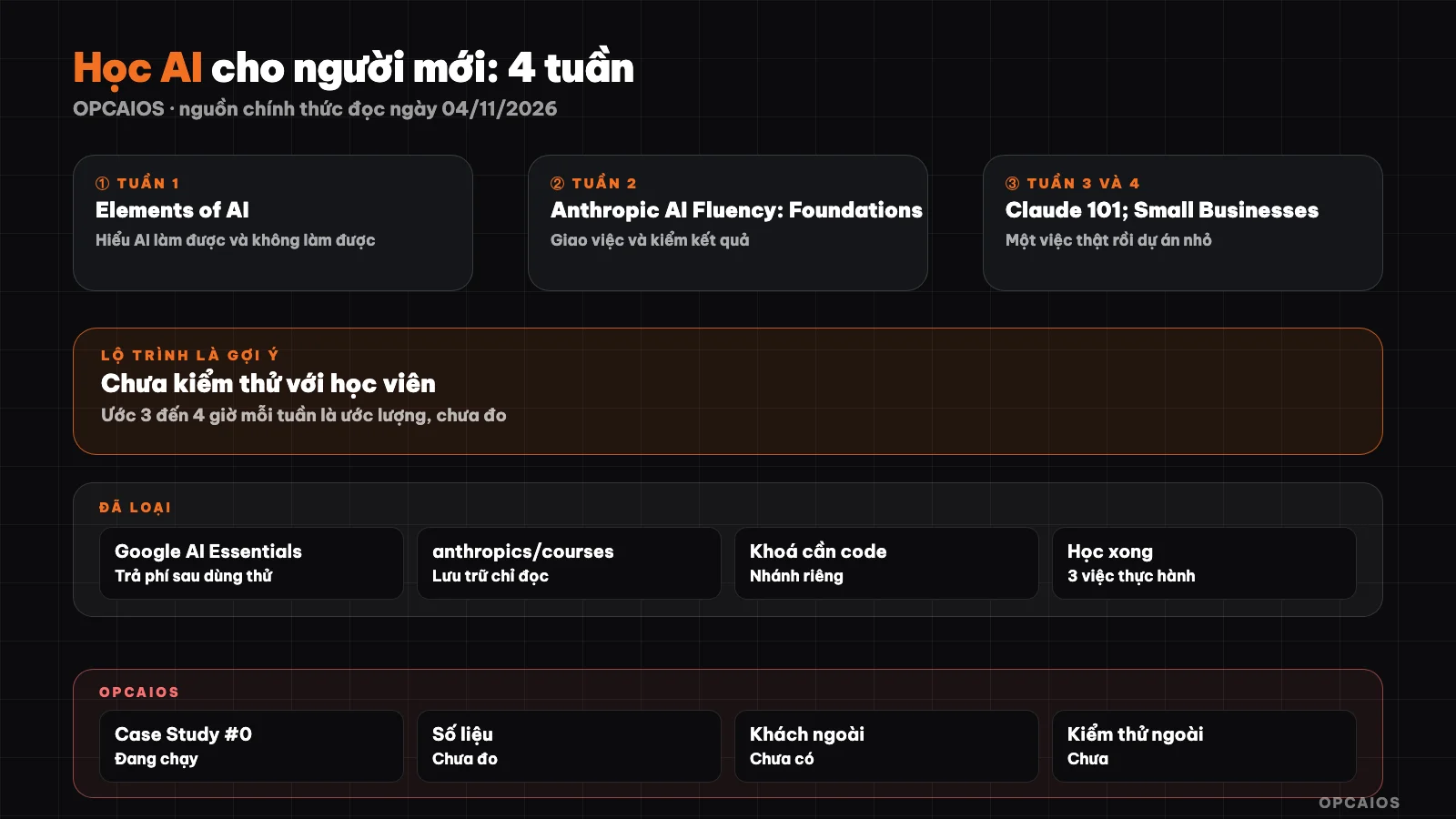
4-week roadmap: understand, delegate, use for real, do a small project. Diagram: OPCAIOS.
Where should a beginner start learning AI?
A beginner should start by using one AI tool for one real task, paired with a short foundational course, rather than starting with math or programming. The reason: most people at work don't need to train their own models; they need to know how to ask AI the right way and spot when it gets it wrong. So the roadmap below prioritizes three skills: understanding a model's limits (see what is LLM), writing clear requests (what is prompt), and checking the output. Suggested time is about 3 to 4 hours each week; this is our estimate to break up the work, not data from learners. You only need an email address, a browser, and one recurring task that you know well.
| Week | Goal | Real task | Free resource |
|---|---|---|---|
| 1 | Understand what AI is and where its limits are | Write 1 page of notes: 3 things AI can help with, 3 things you won't delegate | Elements of AI, Part 1 |
| 2 | Know how to delegate and check | Delegate 1 task, revise the request 3 times, note which attempt was better | AI Fluency: Framework & Foundations |
| 3 | Use a tool for real work | Complete 1 week's task using AI, with a manual check step | Claude 101 |
| 4 | Do a small project with a process | Build 1 repeatable process and measure it in a manual spreadsheet | AI Fluency for Small Businesses |
Week 1: How do you understand what AI can and cannot do?
The goal of week 1 is to have an accurate picture of AI, not to memorize terminology. Resource: Elements of AI at elementsofai.com, which has two free courses; beginners take Part 1 "Introduction to AI", the homepage says no complex math or programming needed. Limitations: the homepage doesn't list Vietnamese and doesn't say how many hours, just says learn at your own pace. For more on model limits, Anthropic has a course called "AI Capabilities and Limitations" at anthropic.skilljar.com/ai-capabilities-and-limitations, the sign-up button says FREE, content covers next-word prediction, working memory, and steering a model. Real task: write one page of notes with 3 things in your work that AI can help with and 3 things you won't delegate, with reasons.
Week 2: How do you delegate and check results?
The goal of week 2 is to turn "asking AI" into a controlled habit. Resource: "AI Fluency: Framework & Foundations" from Anthropic at anthropic.skilljar.com/ai-fluency-framework-foundations. The page says Register | FREE, needs a Skilljar account (not an Anthropic account), comes with a certificate after a final quiz, in English, no duration listed. Content covers the 4D framework: Delegation, Description, Discernment, and Diligence, plus a loop of describe then discern. Real task: pick a small task like summarizing a document, give it to AI, then revise your request enough 3 times and note which attempt was better and why.
Week 3: How do I use AI tools for something real?
The goal of week 3 is to use AI completely for one real task in your week, from start to finish, with a manual verification step. Material: "Claude 101" at anthropic.skilljar.com/claude-101, register for FREE, includes a completion certificate, no duration or language listed. The modules cover first conversation, organizing work with projects and artifacts, connection tools and deep research, role-based examples. Limitations: the examples use Claude so you need a Claude account; we haven't verified that any package is complete for every lesson. You can still learn similar ideas using ChatGPT or Gemini (comparison at Gemini, ChatGPT or Claude). Real work: pick a repetitive task, like writing reply emails to customers, complete it with AI during the week, and check each draft before sending.
Week 4: How do I turn a small project into a repeatable process?
The goal of week 4 is to turn the work from week 3 into a process you can repeat. Material: "AI Fluency for Small Businesses" at anthropic.skilljar.com/ai-fluency-for-small-businesses, register for FREE, includes certificate, in English. The page covers applying a 4D framework to small business tasks, using Claude.ai examples but any chatbot works, and recommends learning "Framework & Foundations" first. Real work: write a three-step process for a repetitive task, save a copy of the instructions, test it 5 times and record in a table: works right away, needs edits, or skip. To turn a process into a personal assistant, read What is a personal AI assistant.
If you want to branch into coding, Microsoft's "Generative AI for Beginners" at github.com/microsoft/generative-ai-for-beginners has 21 lessons, MIT license, with Vietnamese translation included. The page notes that knowing Python or TypeScript helps and the lessons need one of the model services (Azure OpenAI, Microsoft Foundry Models, OpenAI API or local runtime); the page doesn't list costs for these services, so we left them out of the main path.
Which materials did we drop, and is learning in English difficult?
We dropped two familiar materials because we couldn't confirm they were free. Google AI Essentials on Coursera: the official page lists 49 USD per month after 7 days free trial in the US and Canada, other countries may differ, so it's not called free. OpenAI Academy: the homepage doesn't list a price, so we haven't concluded. Also, Anthropic's "courses" repository on GitHub (which has interactive prompt-writing lessons) was archived as read-only by its owner from 15/09/2026, so we didn't include it. About English: learn alongside a translation tool or ask your AI assistant to explain terms, but compare back to the original when you hit something important.
After learning, what do I do? Three practice tasks
Learning is not the end; the end is three tasks you can do and verify:
- A repeatable process for your work (writing emails, summarizing, reports), with saved instructions and a manual verification step. For office staff, see AI for office workers.
- A set of data rules for yourself: what you don't paste into AI. Start with 5 data security rules when using AI.
- An assistant with custom instructions for one task, tested for a full week and results recorded in a table by hand.
OPCAIOS experience
OPCAIOS is a website built by one person, Le Quoc Nghia, together with AI agents. The site's tool library has a section of free courses we selected, and this path comes from there and cross-checked against each provider's official page. Real limits: the 4-week path hasn't been tested with learners, no outsiders have followed it yet, no data on completion rates or learning outcomes, and we don't know how long it will take you. The OPCAIOS system itself is being tested on Nghia alone (Case Study #0), no productivity data yet.
Frequently Asked Questions
Do beginners learning AI need to know programming?
Not necessarily. For working professionals, what you need to learn first is understanding AI's limitations, writing clear requests, and checking results; these three skills don't require coding. Elements of AI Part 1 makes clear you don't need complex math or programming. Programming is only needed when you want to build your own applications, at which point you can add the Microsoft bundle at the end of the roadmap, which recommends knowing Python or TypeScript.
Where can I learn AI for free and trust it?
Prioritize the original pages from model providers or educational institutions, and check the date you read it. In this post, we only keep materials with a sign-up button marked free or a homepage marked free when read on 04/11/2026: Elements of AI and Anthropic courses. Free conditions and certificates can change, so review the original page before signing up.
Is learning AI for 4 weeks enough to actually use it?
Enough to use one tool for a few tasks with verification, but not enough to be proficient. The roadmap is a suggestion from OPCAIOS and hasn't been tested with learners yet. If each week you do enough real work, you can have a usable process and your own set of notes. If you need results for sensitive work, learn more and consult someone with expertise.
What if the materials are in English for someone just starting out?
The courses in this post are all in English, except for the Microsoft repository's Vietnamese translation. You can turn on subtitles, use translation tools, or ask an AI assistant to explain terms, then cross-check the original for important sections. If English is a big barrier, check the Vietnamese descriptions of each course in the tools library and spend extra time on week 1.
Should I learn AI first or try using it right away?
Do both in the same week. Take a short course to get the framework, then use it immediately on real work to see where AI gets it wrong. Learning alone without using it makes knowledge hard to retain; using alone without learning makes it easy to trust made-up results. That's why each week in the roadmap has both a material and real work.
Next Steps
Open the tools and free courses library, pick the week 1 material, and schedule 3 to 4 hours for this week. Write on a page: what you're learning today, what real work you're doing, where it went wrong.
Sources: elementsofai.com; Anthropic courses pages on anthropic.skilljar.com (AI Capabilities and Limitations, AI Fluency: Framework & Foundations, Claude 101, AI Fluency for Small Businesses); github.com/anthropics/courses; github.com/microsoft/generative-ai-for-beginners; grow.google/ai-essentials; academy.openai.com, all read on 04/11/2026; duration and language of instruction for many courses are not listed so haven't been verified; 4-week roadmap hasn't been tested with learners yet; Experience is from OPCAIOS.
Translated from Vietnamese with AI. Read the original.
Want to apply this in your business?
Book a free 30-minute call (Vietnam time, in English or Vietnamese).