


What mistakes make the OPC (one-person company) model easy to break?
The mistakes that make a one-person company fragile are choices that cause a business to lose revenue, lose trust, or lose energy before it can stabilize. The five common mistakes are:
- Build before you have customers.
- Depend on one customer or one platform.
- Automate too much without oversight.
- Neglect legal, tax, and customer data matters.
- Make yourself the single point of failure until you burn out.
AI like Claude from Anthropic or ChatGPT from OpenAI help detect and fix most of these mistakes early. AI cannot fix the root error, because the root error lies in the business owner's decisions. This article describes each mistake, signs to watch for, how to use AI to fix it, and what AI cannot do instead. At the end is OPCAIOS experience, including mistakes we have encountered at system scale.
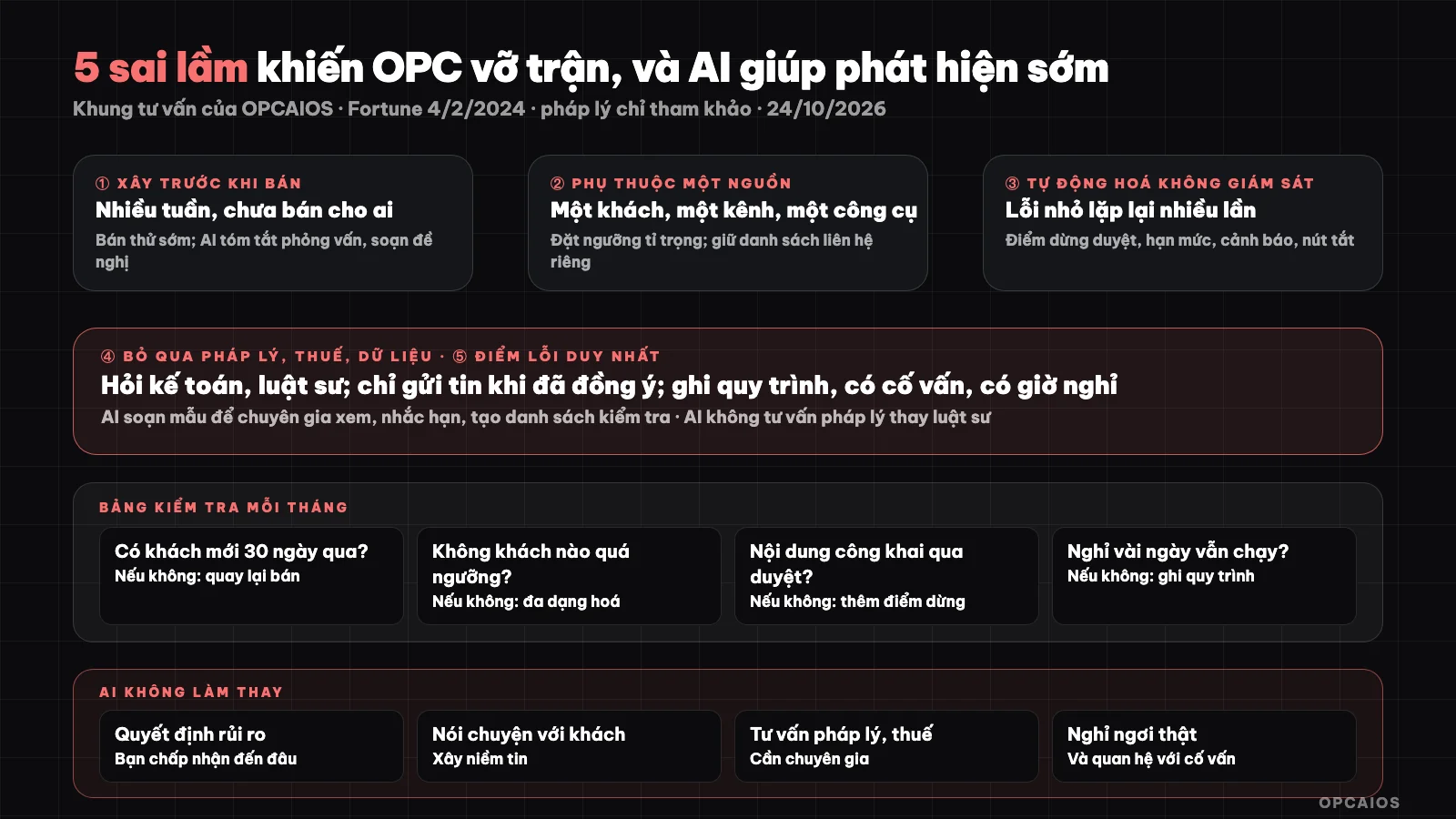
Five fragile points of a one-person company, and how to use AI to detect them early. Diagram: OPCAIOS.
Mistake 1: build too much before you have real customers
Building too much before you have customers means spending many weeks setting up a website, systems, and brand before selling to anyone, while every claim about demand is based only on guesses. Example scenario: a freelance designer spends 6 weeks building a website, brand identity, and automated workflow with n8n, then after 45 days has not sold the service to anyone. The handling approach has three steps:
- Use Claude from Anthropic or ChatGPT from OpenAI to summarize customer interviews, sort feedback, compare competitors, and quickly draft a trial pitch.
- Next, talk to real customers yourself and dare to pitch, because AI cannot do this instead of you.
- Finally, go back to a short timeline and test-sell before investing more (see 30-day roadmap to build an OPC with AI).
The sign to watch for is many weeks passing while the business owner has not yet landed a first customer.
Mistake 2: depend on one customer, one platform, or one tool
Single-point dependence is when one customer makes up most revenue, all customers come from one social media channel, or a process only runs on one tool that can change price and terms anytime (see note about package terms in What is Vercel? and What is Cloudflare Pages?). Example scenario: an OPC owner gets 100% of customers from one Facebook page, so just one algorithm change is enough to drop orders sharply in 30 days. AI helps by:
- Analyze revenue by customer and by channel using Google Sheets or AI, then remind you when one proportion exceeds a threshold.
- Draft a diversification plan and build backup copies, export data regularly.
AI cannot make the decision to open new channels and build relationships with new customers instead of you. The fix involves setting a threshold (no customer over a ratio the business owner accepts) and keeping a contact list on your own through email or CRM rather than relying only on others' platforms.
Mistake 3: automate too much without oversight
Automating without oversight means letting AI agents send emails, post content, or reply to customers while you do not read them back, have no logs, so one small error repeats many times before anyone notices. Example scenario: an agent running on n8n accidentally sends the same email to 300 people on your list for 8 hours straight, and you only find out after 2 days because there was no review checkpoint. AI itself can be the overseer: check outputs against a list of criteria, compare to good samples, and summarize what is unusual each day. AI cannot decide the risk level the business owner will accept instead of you. The fix includes:
- First, add a review checkpoint before all public content.
- Next, set send limits, log to Google Sheets, and alert when you exceed limits.
- Finally, always have an emergency stop button.
Reference architecture is at How to build an AI Agent system working 24/7; risks of unreviewed command mode are noted in What is Antigravity 2.0?.
Mistake 4: overlooking legal, tax, and customer data matters
Overlooking legal matters is a business mistake where you don't clarify what business form you operate under, sign contracts via text message, collect customer data without a policy, or send promotional messages without consent. Example: an OPC owner sends promotional emails to 500 people on a purchased list without an unsubscribe option. AI can help draft contract templates and policies for a lawyer to review, create a checklist of questions to ask experts, remind you of filing deadlines, and summarize regulations you've read. AI cannot replace responsible legal and tax advice, because AI might quote laws incorrectly. The fix has two parts. First, ask an accountant and lawyer about your business structure, since a single-member limited company and a private enterprise differ in legal status and asset liability under the 2020 Law on Enterprises. Next, only send promotional messages when you have consent and an unsubscribe option (see What is email marketing? and Automated sales funnel).
Mistake 5: making yourself the single point of failure and burning out
A single point of failure is when every small decision runs through one person, no one else knows how the system works, the business owner can't take a few days off, and quality drops when tired. Fortune (4/2/2024) quoted an investor saying that loneliness and poor decisions are risks for solo founders. Example: an OPC owner gets sick for 3 days, and all orders, customer emails stop because the process exists only in their head. AI can help document processes in Notion, create checklists, write daily summaries, handle repetitive replies, and limit tasks per day. AI cannot replace actual rest, mentorship or community connection, and difficult decisions. The fix involves finding a mentor or peer group, writing down your processes (see How AI helps one person run an entire business), setting fixed break times, and delegating work to collaborators when needed.
Quick monthly checklist
| Question | If you answer "no" then |
|---|---|
| Do you have new customers in the past 30 days? | Go back to selling and talk to customers |
| No customer exceeds your revenue concentration threshold? | Diversify |
| Has all public content been reviewed? | Add approval steps |
| Have you consulted a legal or tax expert this year? | Schedule a meeting |
| Can you take a few days off and the system still runs? | Document processes, reduce dependency |
OPCAIOS experience
We've encountered these mistakes at system scale: we built many features before we had real customer data, so now we set checkpoints by stage; we had a service go down and only knew through monitoring and alerts; and we had outdated documents that caused misunderstanding about system status, so we now define logs as history only, with current status in a separate file that gets updated. We don't use our own revenue data to illustrate and don't claim any formula guarantees avoiding "breakdown"; these are checks we find useful.
Read more: The illusion of "One-person business getting rich automatically"; AI doesn't kill traditional companies, the "Lazy person using AI" will be eliminated.
Frequently Asked Questions
What is the most common mistake OPCs make?
Building too much before having real customers. Try selling early and measure before investing in systems.
Can AI rescue an OPC that's struggling?
It helps detect and fix many issues quickly (analyzing revenue sources, monitoring, drafting documents), but it cannot replace decisions and relationships with customers.
Should I automate everything?
No. Automate repetitive and low-risk work, keep people reviewing at public checkpoints or tasks that cannot be undone.
How do I avoid burnout when working alone?
Avoiding burnout means keeping work from depending entirely on one person's effort. First, document processes in Notion or Google Docs so collaborators or AI can follow them. Next, limit the number of tasks each day and set fixed break times. Finally, have an advisor or community to discuss difficult decisions with. Fortune (4/2/2024) quoted an investor who sees the loneliness of solo founders as a real risk. To learn how to build a safe AI system for your work, check out OPCAIOS's AI application training course.
Sources: the five mistakes and checklist are OPCAIOS's advisory framework based on experience, not research results; Fortune 4/2/2024 (investor quote on solo founder risk); legal information from analyses of the 2020 Enterprise Law, for reference only, accessed 24/10/2026. The experience is OPCAIOS's.
Translated from Vietnamese with AI. Read the original.
Want to apply this in your business?
Book a free 30-minute call (Vietnam time, in English or Vietnamese).