


Paid Newsletter: What Is It?
A paid newsletter is an email bulletin sent periodically, where part or all of the content is available only to paying subscribers. The "1,000 loyal readers" model echoes Kevin Kelly's 2008 essay idea of "1,000 true fans": a creator can make a living if they have enough people willing to buy everything they make; the number 1,000 is an illustration, not a formula. So this post doesn't promise you'll have 1,000 paying subscribers; it presents how to pick a niche, build a writing process with AI support while keeping your voice and credibility, choose a platform, find your first readers, and measure progress. We haven't run a paid newsletter and have no revenue figures to share. Sample scenario: 1,000 readers, 5% pay $5 each month, that's 50 people and $250 monthly.
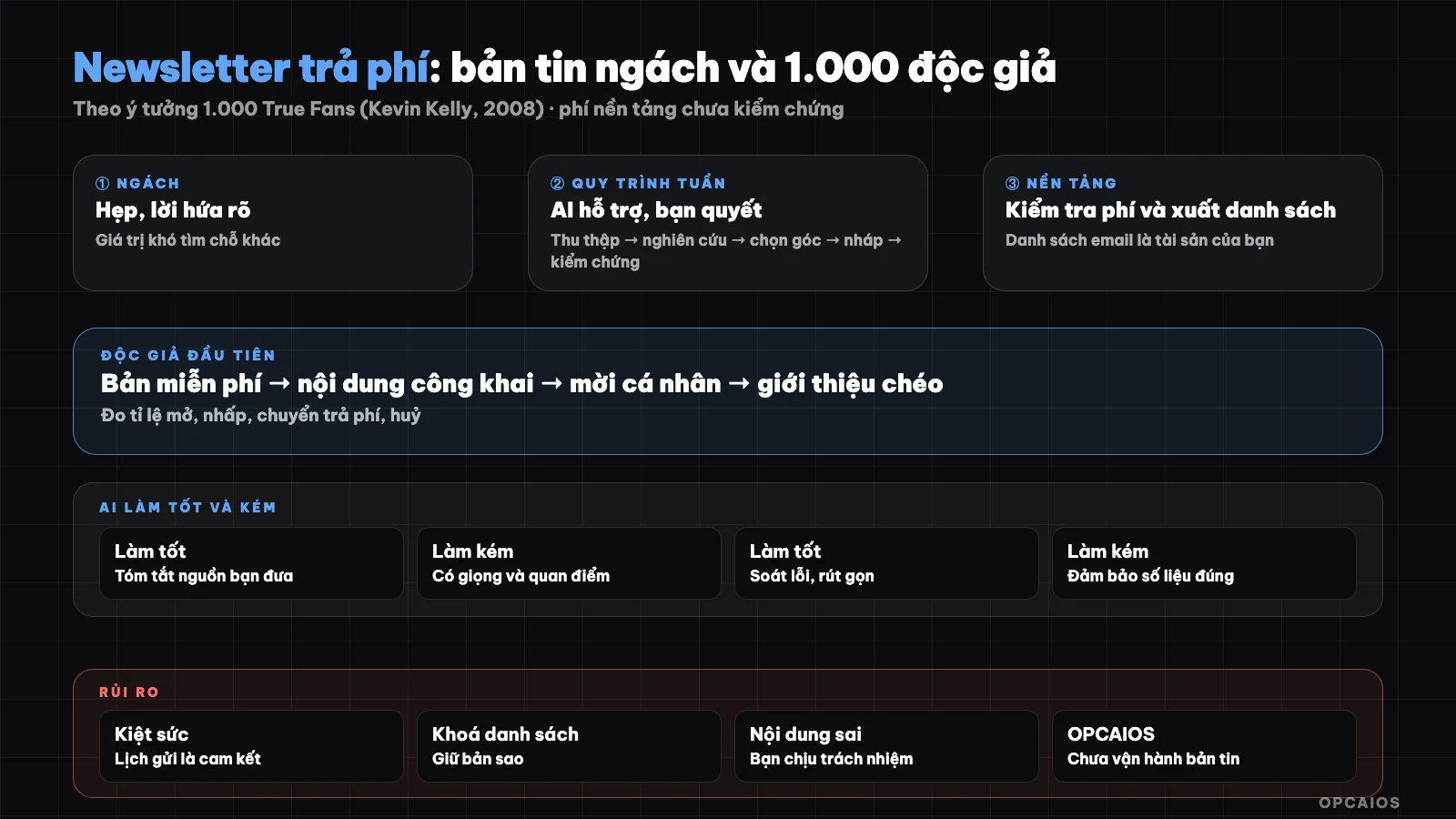
Narrow niche, clear promise, steady process, AI support and you stay accountable. Diagram: OPCAIOS.
Step 1: How to Pick a Niche and Promise?
Niche and promise are your first two decisions: a paid newsletter survives on value hard to find elsewhere, like curated summaries, analysis, private data, templates, early warnings or on-the-ground experience. If everything you write is in a free Google search, few will pay. Four things to pin down:
- Narrow niche: "AI for solo bookkeepers" beats "tech news".
- Clear promise: "Every Tuesday: 3 big changes and what to do this week."
- Specific readers: who reads, and what they save by reading.
- Your edge: experience, access, perspective.
Sample scenario, not a real newsletter: a 15-minute weekly read for 200 bookkeepers, priced $5 monthly, if 5% (10 people) pay then revenue is $50 monthly, before platform fees.
Step 2: What Does a Weekly Writing Process with AI Support Look Like?
A weekly writing process is a chain of seven repeating tasks, where AI does research and drafts while you keep judgment. Here's what I suggest, each week:
- Collect: save articles, news, reader questions in one place (for example Obsidian).
- Research with AI: ask ChatGPT or Claude to summarize sources you provide, find what differs between them.
- Pick angle: you decide what matters and why; that's the part readers pay for.
- Draft: AI drafts from your notes and angle; you rewrite in your voice.
- Verify: open sources for every number, name, date; cite sources in the post.
- Edit: cut, one main idea, one action.
- Send and measure: open rate, click rate, replies, cancels.
Automate the repetitive part (save sources, schedule, send reports) using n8n, but don't automate judgment. Sample scenario: each issue takes 4 hours, AI helps cut about 1 hour at the research and draft steps.
AI's Real Role
| Does Well | Does Poorly |
|---|---|
| Summarize sources you provide | Find "truth" with no source |
| Suggest headlines, outlines | Have its own voice and views |
| Check errors, trim text | Know what matters to your readers |
| Translate, adapt to channel | Ensure data is right |
Readers pay for your judgment; if the newsletter reads like generic AI, they cancel. Label clearly when AI plays a large role in content.
Step 3: Which platform and what fees?
A newsletter platform is where you store your email list and collect subscription payments. According to Substack's paid tier page (read October 25, 2026), Substack takes 10% of paid subscription revenue, with card processing fees deducted separately. According to beehiiv's pricing page (read October 25, 2026), beehiiv does not take a percentage of paid subscription revenue, but Stripe's standard fee of 2.9% plus $0.30 per transaction still applies, and paid tiers are priced by subscriber count. Example calculation: a $10 monthly tier on Substack costs $1 in platform fees, not counting card fees.
| Platform | Details (read from official pages October 25, 2026) |
|---|---|
| Substack | 10% of paid subscription revenue; card processing fees deducted separately |
| beehiiv | 0% of paid subscription revenue; Stripe 2.9% + $0.30 still apply; paid tiers scale with subscriber count |
| Ghost, or self-hosted | More control; you handle tech and payments yourself; we have not read their pricing page |
| Fees and terms change; check again. Look for: subscriber list export capability, payment support in Vietnam, referral tools, list ownership rights. Your email list is your asset; don't let it get locked into one platform. |
Steps 4 and 5: Getting your first readers and creating a paid tier
Your first readers usually come from direct relationships, and a paid tier needs clear value distinct from the free version. Example scenario: 50 initial people from personal networks, after 8 weeks you have 300 free subscribers, and a 3% conversion rate gives you 9 paid subscribers. Things to do:
- First, use the free tier as the entry point: make it good enough that people want to keep reading, paired with public content (blog posts, social media) leading to the signup form (automated sales funnel).
- Next, invite people personally, introduce newsletters in your niche to each other, and ask subscribers what they need.
- Then, set clear value for your paid tier: deep dives, templates, data, community, resource library. Test a few price points; OPCAIOS won't suggest specific amounts because it depends on your niche and market.
- Finally, keep them with consistency and clear policy: refunds, easy cancellation, explicit about what's included.
Note: conversion rates from free to paid readers are usually low, and we have no universal number; measure your own.
Tracking progress
| Metric | What it means |
|---|---|
| Free subscriber count and growth rate | Appeal |
| Open rate, click rate, reply rate | Reader interest |
| Free-to-paid conversion rate | Paid tier value |
| Monthly churn rate | Retention |
| Revenue minus platform fees and taxes | Real profit |
| Reaching 1,000 subscribers (paid or free) should be a milestone, not a guarantee of success. |
Risks
- Burnout: a regular send schedule is a long-term commitment.
- Platform dependency: keep a backup of your list.
- Bad content: AI can make things up; you're responsible.
- Copyright: don't copy other people's work verbatim.
- Email and data regulations: you need consent, and clear unsubscribe links (What is email marketing?).
- Tax and business registration: see Legal checklist.
OPCAIOS experience
OPCAIOS writes a blog and runs an email process, but we don't operate a paid newsletter and have no data on conversion or revenue. What we apply from making content: clear sources, fact-check before publishing, don't let AI post on its own, and measure by reader action, not by article count. Substack and beehiiv fees were read from their official pages on October 25, 2026; Ghost's fees have not been verified.
Frequently asked questions
How many subscribers do you need to live off a newsletter?
It depends on price, conversion rate, and your expenses; 1,000 is an example number, not a formula.
Can AI write the newsletter for me?
It can help with research and drafts, but paid readers are paying for your judgment.
Which platform should I use?
Check fees, list export, payments; don't let your list get locked in.
How long before you get your first subscriber?
We have no data; usually takes weeks of consistent sending.
Where do I start?
Pick a narrow niche, write 4 issues in a row for free, see the response. Check out OPCAIOS's AI application training.
Source: Kevin Kelly's 2008 essay "1,000 True Fans"; Substack's paid tier page and beehiiv's pricing page, read October 25, 2026 (Ghost's pricing page not read). No OPCAIOS revenue data. Experience is OPCAIOS's.
Translated from Vietnamese with AI. Read the original.
Want to apply this in your business?
Book a free 30-minute call (Vietnam time, in English or Vietnamese).