


What is vibe coding?
Vibe coding is tools that let you describe a software product in natural language and then have AI write, run, and fix code for you (see What is vibe code?). The five most mentioned tools for newcomers are Cursor, Bolt, Lovable, Replit, and v0. Important to know before choosing: all five charge by usage limits (tokens, credits, or usage levels), not by number of applications; so actual cost depends on how you work, and the "Top 5" in this post is a comparison list, not a quality ranking, because we haven't tried all five tools ourselves. Below is a pricing table read from each tool's official pricing page on 24/10/2026, selection criteria, risks when having AI write code, and OPCAIOS experience.
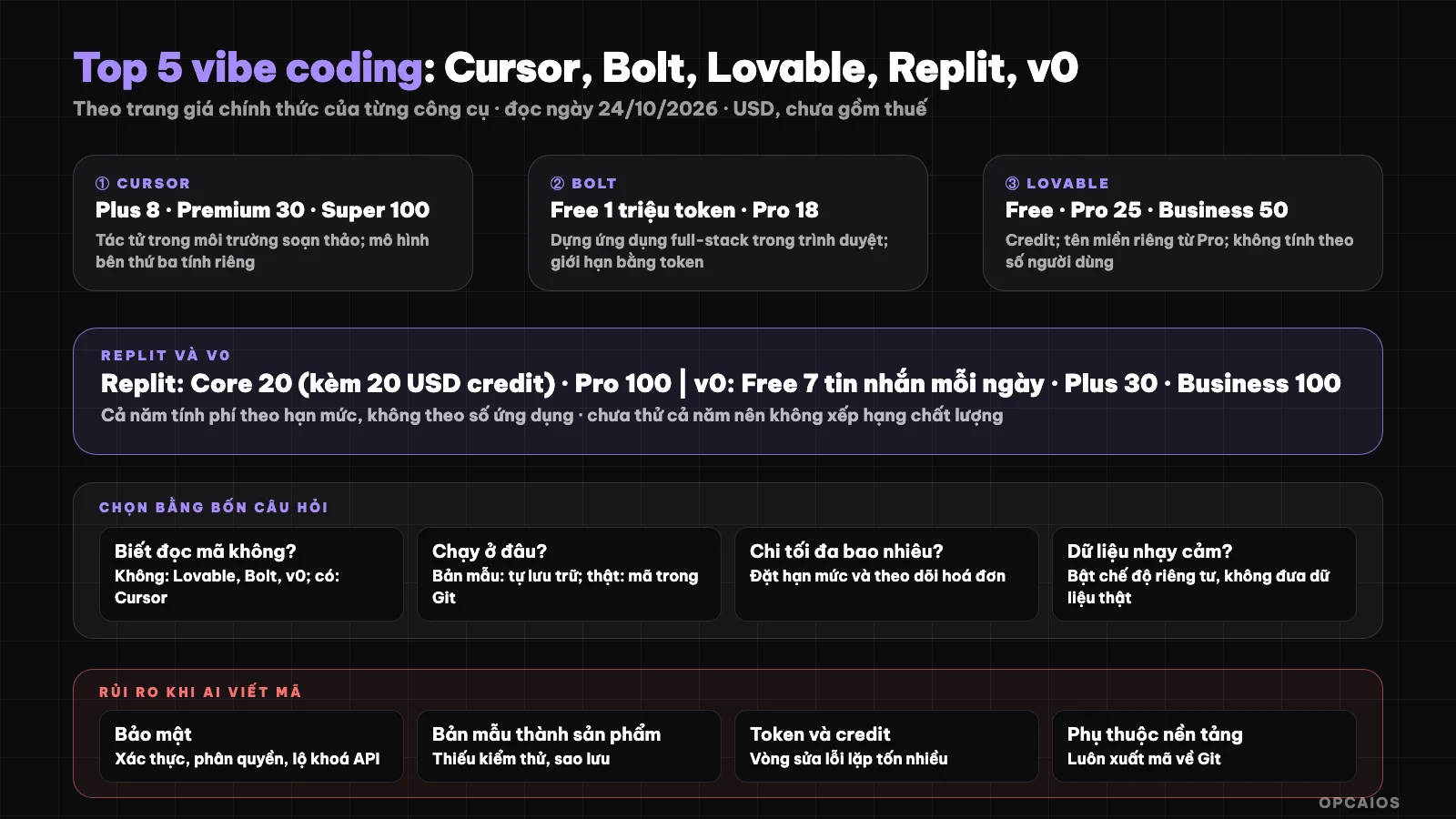
Five tools, five ways to count usage limits: pick by what you need to do, not by reputation. Diagram: OPCAIOS.
How much do five vibe coding tools cost and how do they count usage limits?
Price in USD excluding tax, read from each tool's official pricing page on 24/10/2026; may change.
| Tool | Free plan | Typical paid plan | Usage limit method |
|---|---|---|---|
| Cursor | Yes, limited AI usage | Plus $8, Premium $30, Super $100, Ultra $200 per month; third-party models charged separately | Shared pool, multiples compared to Plus, refreshes weekly |
| Bolt | 1 million tokens per month, max 300k per day | Pro $18 per month (annual payment), 10 million tokens | Tokens |
| Lovable | Yes: daily credit gift, 5 lovable.app domains, publish by invite | Pro $25 per month (100 credits), Business $50 per month | Credits; counted by credit, not by number of users |
| Replit | Free mode (per pricing page) | Core $20 per month ($18 if annual) with $20 credit; Pro $100 per month ($90 if annual) | Credit for powerful models, parallel agents in Pro plan |
| v0 (by Vercel) | Yes: 7 messages per day, $5 credit once | Plus $30 per person per month ($30 credit, $2 credit login daily), Business $100 | Credits; deploy to Vercel, sync GitHub |
Details for each tool see What is Cursor?, What is Bolt?. Note when reading the table: we haven't fully read the FAQ about Lovable and Replit credits, so we don't state usage per task; some pages (Replit, v0) show plan names different from what we used when asking, so the table uses exact names from the page.
Which tool suits whom?
- Cursor: someone who knows a bit of programming or works with developers, wants to edit code in an editor environment with agents.
- Bolt: someone who wants to build full-stack prototypes right in the browser, no installation.
- Lovable: someone making non-technical products, wants to create applications by prompt, work in teams (not charged by number of users).
- Replit: someone who wants an all-in-one environment (write code, run, store) with agents, can run multiple agents in parallel on higher plans.
- v0: someone making React interfaces and Vercel ecosystem, wants to push to Vercel fast (note Vercel's Hobby plan is only for non-commercial projects, see What is Vercel?).
This is description based on pricing pages and documentation we read, not a quality assessment of output.
How to choose: four questions
- Do you know how to read code? If not, pick code-hiding tools (Lovable, Bolt, v0); if yes, Cursor or command-line agents like Claude Code give you more control.
- Where will your product run? Self-hosted tools are convenient for prototypes; real products should have code in a Git repo and infrastructure you control (see What is VPS?, What is Cloudflare Pages?).
- What's your max cost per month? Set a spending limit and watch invoices: tools that charge by usage easily go over budget.
- Is your data sensitive? Turn on privacy mode if yes (see privacy section in What is Cursor?) and don't put real customer data in trials.
Risks of Letting AI Write Code
- Security: authentication, permissions, code injection prevention, API key exposure; request and review it yourself.
- Template to product: quickly generated code often lacks testing, error handling, backups.
- Token and credit costs: repeated debugging cycles consume a lot; break down requests.
- Platform dependency: always export code to your Git repository.
- Legal: read the terms about code ownership and data.
OPCAIOS Experience
We don't use all five of these tools as our main tool: our process is built on command-line programming agents and Antigravity working directly on Git repositories, then deploying to private servers with unbroken build steps and checks before going live. So the table above is a comparison of pricing and positioning from official sites, not our test results; we don't claim any tool produces better output. What we're sure of: whatever tool you use, keep code in a Git repository, have someone review changes, and don't put secrets in prompts.
Frequently Asked Questions
Which vibe coding tool has the best free tier?
OPCAIOS doesn't rank them because we haven't compared output quality, but we can compare free tiers by official pricing pages read on 24/10/2026. Cursor has a free plan with limited AI use. Bolt gives 1 million tokens per month, max 300 thousand per day. Lovable gives daily credits and 5 lovable.app domains. v0 gives 7 messages per day and $5 credit once. Replit has a Free plan per pricing page. The fairest way to test is to submit the same request—say, building a simple booking page—to each free tier and compare the results and usage limits. Only then decide whether to pay.
What tool should someone who doesn't know how to code choose?
People who don't know how to code usually fit tools that hide code like Lovable, Bolt, or v0, since they let you build apps with prompts without reading code. Lovable charges by credits, not users, so it's good for team work; Bolt runs in the browser, no installation needed. For example, Lovable's Pro plan costs $25 per month (100 credits) and Bolt's Pro plan $18 per month when paid yearly (10 million tokens), per pricing pages read on 24/10/2026. However, AI-generated code may lack authentication, permissions, or error handling. So you need to check security, keep code in a Git repository, and don't put real customer data in tests before bringing real users in.
What does it really cost?
Real cost ranges from $0 on free plans to a few hundred dollars per month on high plans, depending on usage. Per pricing pages read on 24/10/2026, typical paid plans are Cursor Plus $8, Bolt Pro $18, Replit Core $20, Lovable Pro $25, and Cursor Premium $30 per month, with the highest in the table being Cursor Ultra $200. Third-party model costs may apply, like on Cursor. Since all five tools charge by limits, not by app count, one loop of repeated fixes can burn a lot of tokens or credits. Three things keep costs under control: set a monthly spending cap, break down requests, and track invoices weekly.
Should I run real products on these platforms?
For prototypes, yes; for real products, keep code in your own repository and have testing and backup processes.
Does vibe coding replace programmers?
Vibe coding doesn't fully replace programmers; this approach helps build prototypes fast, but security, testing, and operations still need expertise. For example, a prototype built on Bolt or Lovable in a few hours can still lack testing, error handling, and backups. First, users need to understand authentication and permissions to know if AI-written code is safe. Second, real products should have code in a Git repository and infrastructure you control. Finally, someone should review changes before going live. This is also how OPCAIOS works with programming agents: code stays in Git, reviewed, and no secrets in prompts. Want to learn to use AI code safely? See OPCAIOS AI Application Training.
Source: official pricing pages of Cursor (read in browser), Bolt, Lovable (read in browser), Replit, v0, read on 24/10/2026; Lovable and Replit credit FAQs not fully read; prices exclude tax, may change. The "fits who" section is OPCAIOS description based on pricing pages, not testing. Experience is OPCAIOS.
Translated from Vietnamese with AI. Read the original.
Want to apply this in your business?
Book a free 30-minute call (Vietnam time, in English or Vietnamese).