



Selling Results Instead of Hours: How to Quote $2,000
Selling results means pricing your service based on the value the customer receives and a clear scope of commitment, rather than the hours you spend. The headline says "customers won't haggle," but that's not guaranteed: they can still ask for a price, compare options, ask for less, or say no. The $2,000 figure is just an illustration, not a rate you should apply. What the post offers is a framework to give quotes with solid ground, so the conversation shifts from "how many hours" to "what result, and how do we verify it."
The honest part has three points. First, OPCAIOS has no customer who paid $2,000 to report. Second, all calculation examples are hypothetical. Third, there's no guarantee about business results. The post goes through 7 steps, which you can do in Excel or Google Sheets and Notion: calculate value, package the service, scope and acceptance criteria, three anchor packages, one-page quote, handle objections, deposit and payment terms, plus risks.
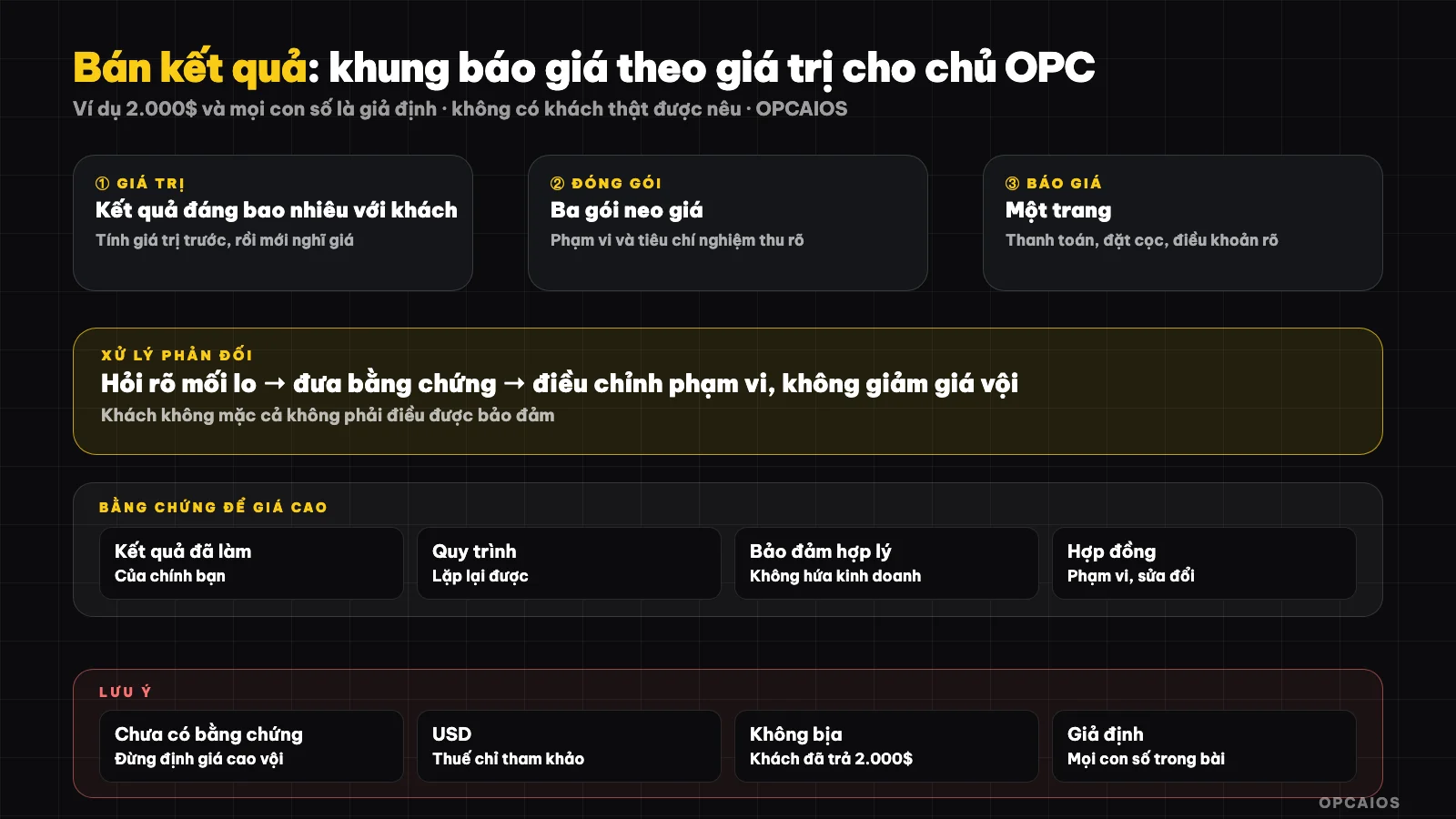
Quoting by value starts from your customer's result, not your hours. Diagram: OPCAIOS.
How is selling effort different from selling results?
Selling effort means pricing by hours worked, while selling results means pricing by the value the customer gets and the scope you commit to. The most important difference lies in your talk with the customer (1) and how you handle saved hours (2). On point (1), selling effort leads to "can you cut the hours?", while selling results leads to "is this result worth it?". For solo owners using AI, the last point matters: when AI cuts time from several days to a few hours, billing by the hour means cutting your own income, but billing by results turns saved hours into profit margin. For example, a process that once took 3 days now takes 4 hours thanks to Claude and n8n, but the value the customer gets stays the same. Still, selling results doesn't mean selling uncontrolled promises; your risk is committing to a result you can't fully control.
Table comparing five criteria
| Criteria | Selling effort | Selling results |
|---|---|---|
| Price basis | Hours, days | Value customer receives, scope of commitment |
| Customer compares with | Other people's hourly rates | Their cost of the problem, other options |
| The conversation | "Can you cut the hours?" | "Is this result worth it?" |
| Your risk | The faster you work, the less you earn | Committing to results you can't fully control |
| Using AI | Cutting hours means losing revenue | Cutting hours means higher profit margin |
Step 1: How to estimate the result value for your client?
Result value is the money or time per month that your client's problem is costing them, multiplied by the portion you solve. Before setting a price, ask your client and calculate it yourself using their actual numbers, not made-up figures.
Example calculation (hypothetical, not a real client)
First, suppose a small business has 2 staff members, each spending 5 hours per week doing manual reconciliation in Excel, with labor costs around $5 per hour (a hypothetical figure for 2026). That's roughly 40 hours per month, or about $200 per month and $2,400 per year. If automation cuts the time in half, the value is around $1,200 per year. In this case, a $2,000 price doesn't make sense, and an honest seller should say so directly rather than push it.
Next, if the process involves revenue or costly mistakes, a higher price may be justified. Quick check rule: if your price is much larger than the estimated value over one to two years, lower the scope or price. If the client sees the value as many times larger than the price, that's where you can sell a higher-tier package. Lesson: price must match the real value for each client, and $2,000 is not a fixed benchmark.
Example calculation (hypothetical, not a real client)
Suppose a small business has two staff members, each spending 5 hours per week doing manual reconciliation, with labor costs around $5 per hour (a hypothetical figure for illustration). That's roughly 10 hours per week, or about 40 hours per month, around $200 per month, around $2,400 per year. If automation cuts half that time (also a hypothetical), the value is around $1,200 per year. In this case, a $2,000 price doesn't make sense, and an honest seller should say so directly rather than push it. Conversely, if the process involves revenue, costly mistakes, or saves time for more people, a higher price may be justified. Lesson: price must match the real value for each client; $2,000 is not a fixed benchmark.
Quick check rule: if your price is much larger than the estimated value over one to two years, lower the scope or price; if the client sees the value as many times larger than the price, that's where you can sell a higher-tier package.
Step 2: Package it as a product with a name and scope—what is it?
Packaging a service means turning work into a product with a package name, deliverables, timeline, number of revision rounds, and a list of what's excluded. Outcome-based pricing needs something clear for the client to buy, and packaging provides exactly that. See What is a Productized Service to learn how to package step by step. A good package can be described in one sentence, for example: "Within 10 business days, set up process X to do Y, deliver documentation and instructions in Notion."
Hypothetical example: a package called "Automated Reconciliation" with a 10-day timeline, 2 revision rounds, illustrative price $2,000, excluding further training and post-delivery support. Having the package name and limits written out helps clients compare with other packages without asking for every detail. By contrast, saying "make a website to order" turns the conversation back to hours, because the client doesn't know what they're buying. Finally, write the package in Google Docs before showing it to the client.
Step 3: What do scope and acceptance criteria include?
Scope and acceptance criteria are the text that protects both sides, spelling out what you deliver and how to measure success. Write it as 5 items in text form. Item 1 is the specific result, for example a process that runs for cases A, B, C. Item 2 is what's not included, like systems outside the list, extra training, post-delivery support. Item 3 is measurable acceptance criteria: test with a sample dataset both sides agree on, pass how many cases out of the total.
Item 4 is the number of revision rounds and how to handle change requests via separate quote. Item 5 is conditions needed from the client: system access, sample data, a point of contact, response timeline. Hypothetical example: the reconciliation process succeeds when 47 out of 50 sample orders match correctly, within 10 business days. Acceptance criteria should be something you control, meaning the system runs as described, not business outcomes you don't control like revenue growth or order increase.
Step 4: How to anchor prices with three packages?
Price anchoring with three packages is a way to give customers three comparison points instead of a single number to negotiate. For example structure, prices are illustrative assumptions: Basic package $800 for one process and brief documentation, Standard package $2,000 for 2 to 3 processes with testing and instructions, Premium package $4,500 for multiple processes, integration, training and post-delivery support. The revision rounds are 1, 2 and 3 respectively.
First, the middle package is the one you want to sell, the high package makes the middle package easy to compare, the low package is for customers trying it out. This is a common presentation technique, not a guarantee customers will choose the middle package. Every package must be doable at actual cost including labor hours, tools, taxes and time finding customers, otherwise you are selling at a loss. For example, if the $800 package takes 20 hours of work and 10 hours finding customers, recalculate your hourly income before putting it in a quote.
Step 5: What does a one-page quote include?
A one-page quote is a document that helps customers decide without guessing, consisting of 6 parts: (1) the customer's problem restated in the customer's own words; (2) the results you commit to deliver; (3) three packages with scope, price and timeline; (4) acceptance criteria; (5) payment terms and quote validity; (6) next steps such as confirmation, deposit, start date.
Don't hide terms and conditions at the end and don't create false time pressure like "today only". Send the quote after a needs discovery session, don't send prices before understanding the problem. For example, a quote can be drafted in Google Docs or Notion, exported to PDF then sent via email or Zalo, with a validity of 7 days. In practice, one short page is usually easier to read than a 20-page proposal, but this is a practical observation, OPCAIOS does not have measurement data yet.
Step 6: Handling objections
| Objection | Honest answer |
|---|---|
| "Too expensive" | Go back to the value calculated together; suggest a smaller package instead of lowering the price yourself |
| "Can you give me a discount?" | Reduce scope instead of reducing price, or clearly state the price does not change |
| "Someone else is cheaper" | Ask what their package includes, compare at the same scope |
| "I need to think about it" | Accept, schedule a follow-up, don't push |
| "Do you guarantee results?" | Guarantee according to acceptance criteria; don't guarantee business results |
If you lower the price, get something specific in return (earlier payment, smaller scope). Lowering price unconditionally teaches customers that your price is negotiable.
Step 7: Payment and deposit
Common approach: collect a partial deposit before starting, the remainder upon acceptance or by milestone. State clearly in writing: deposit ratio, payment milestones, refund conditions (if any), what happens when customers are slow to respond or cancel midway. There is no verified standard ratio; choose a level that keeps you from big risk if the customer disappears, yet the customer still finds it reasonable.
Reasonable guarantees
You should guarantee what you control: deliver the right scope, deliver on time, fix errors on your side within the stated timeframe, hand over documentation. You should not guarantee: "increase revenue X%", "save Y hours" if it depends on how the customer operates. If you want to offer a refund guarantee, state the specific conditions in writing.
Risks
| Risk | How to handle |
|---|---|
| Pricing high without evidence | Start with a few small-scope projects, record measurable results, raise prices gradually as you get real evidence |
| Customer misunderstands results | Write measurable acceptance criteria, don't use vague promises |
| Scope creeps | Contract states out-of-scope items, separate quote for extras |
| No contract | Use a contract or electronic agreement, ask a lawyer about a suitable template |
| Payment in USD | Taxes, foreign exchange, invoices and other banking rules differ; ask an accountant, this is reference only |
| Dependent on a few customers | Expand customer sources, see automated sales funnel for OPC |
On taxes when receiving USD: how to report, business registration and documents depend on your legal status and your customer's; this post does not advise on taxes. See also legal checklist for solopreneurs and ask a tax expert.
OPCAIOS experience
OPCAIOS does not disclose revenue and does not have verified customers paying $2,000 to use as an example. What we apply is the principle: clear scope, clear acceptance criteria and use automation for repetitive parts, as mentioned in the post about packaging services. The framework in this post is a reference guide for you to try and measure yourself. On the relationship between cost and value, see also cost of AI tools replacing 3 staff members.
Frequently Asked Questions
Does value-based pricing guarantee customers won't negotiate?
No. It just keeps the conversation focused on results and scope; customers can still negotiate or walk away.
Is $2,000 the right price to set?
No. That's an illustrative figure. Your price should come from the real value for each customer and your real costs.
If I don't have past clients yet, should I set high prices?
Be careful. Start with a small scope, gather measurable proof, then raise prices when you have a basis.
Should I offer refunds or guarantee results?
Only guarantee what you control (deliver the scope correctly, verify against criteria). Don't promise business results. If you offer refunds, put the terms in writing.
How does AI help with pricing?
AI helps draft quotes, calculate scenarios, prepare responses to objections, but the price decision and commitments are yours. To learn how to package and run services with AI, check out OPCAIOS's AI application training course.
Source: value-based pricing framework is common business knowledge, not based on any specific web source; all figures and examples are assumptions, not real clients; taxes, contracts, and USD payments are unverified, for reference only, not advice. Experience is from OPCAIOS.
Translated from Vietnamese with AI. Read the original.
Want to apply this in your business?
Book a free 30-minute call (Vietnam time, in English or Vietnamese).