


What is UTM?
UTM parameters are values attached to the end of a link to tell analytics tools which source, channel, and campaign a visit comes from. According to the Google Analytics 4 guide (read on 25/10/2026), you should always use three parameters: utm_source, utm_medium, and utm_campaign. The guide also recommends adding utm_id and utm_source_platform because missing parameters cause "(not set)" values in reports. This post explains what UTM is, each parameter, naming conventions, common mistakes, privacy, and OPCAIOS's experience.
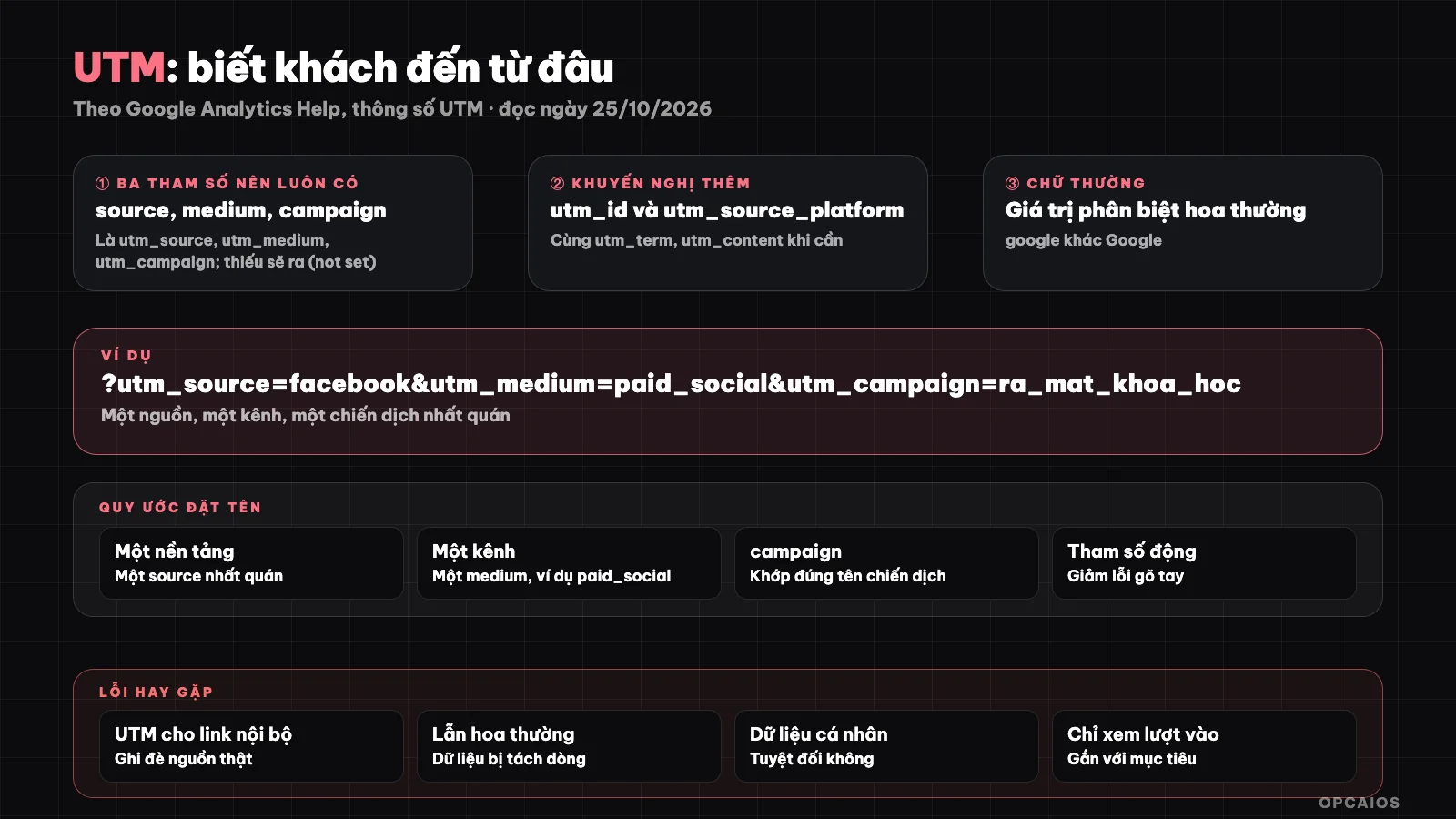
One link, three required labels: source, channel, campaign. Diagram: OPCAIOS.
What is UTM and what is it for?
UTM is a set of name-value pairs added to a URL, for example ?utm_source=facebook&utm_medium=paid_social&utm_campaign=ra_mat_khoa_hoc. When a user clicks the link, the analytics tool reads these labels to record which campaign the visit belongs to, helping you compare the effectiveness of each channel.
Without UTM, many visits from social media, email, or messaging get lumped into "direct" or "referral" broadly. UTM is especially necessary for channels where you send the link yourself: email, posts, messages, QR codes, ads. It's the foundation for measuring campaign effectiveness. See email marketing and growth hacking.
UTM parameters
According to the GA4 guide, parameters include utm_id (campaign ID), utm_source (referral source), utm_medium (channel type), utm_campaign (campaign or promotion name), utm_source_platform (traffic source platform), utm_term (paid keyword), and utm_content (differentiating ad variants).
| Parameter | Role | Example |
|---|---|---|
utm_source (should always be present) |
Source | facebook, newsletter |
utm_medium (should always be present) |
Channel type | paid_social, email |
utm_campaign (should always be present) |
Campaign | ra_mat_khoa_hoc |
utm_id |
Campaign ID | c2026_10 |
utm_term |
Paid keyword | khoa_hoc_ai |
utm_content |
Differentiate variants | banner_a, banner_b |
The guide also mentions utm_creative_format and utm_marketing_tactic, but GA4 currently does not report these two parameters.
Naming conventions for clean reporting
According to GA4, UTM values are case-sensitive: google is different from Google, SpringSale is different from Spring_Sale. The recommended standard is lowercase. You should have a naming convention table shared by everyone to ensure consistency.
- One source, one value: each platform gets one consistent source, sub-platforms get their own values (for example
fbfor Facebook andinstafor Instagram per the guide's example). - One channel, one medium, like
paid_social. utm_campaignmatches the actual campaign name.- Lowercase, no diacritics, connected with underscores to avoid duplicates (OPCAIOS's recommended practice, in addition to using lowercase).
- Use dynamic parameters if your ad platform supports them to reduce typos.
Common mistakes and misunderstandings
The biggest mistake is adding UTM to internal links within your website, which loses the original source of the session and overwrites it with internal labels. UTM is only for links coming from outside into your site.
- Mixing uppercase and lowercase: data gets split into multiple rows.
- Missing required parameters: reports show "(not set)".
- Inconsistent naming between team members: can't compare data.
- Putting personal data in UTM (email, names): absolutely not, because URLs can be saved and shared. See data security.
- Only looking at visits: tie it to goals like signups, bookings, purchases.
You can see overall traffic and search reports in Google Search Console; the two sources answer different questions.
OPCAIOS's experience
Our website's source code has a tracking event endpoint that reads UTM parameters and our dashboards use them to attribute customers by source, effectiveness, and funnel. We checked for the existence of these components in the source code on 25/10/2026.
Limitations: this post does not provide actual visit or conversion numbers from our site. And our naming convention is internal practice, not yet tested on large datasets.
Frequently Asked Questions
Is UTM mandatory?
No, but if you don't add it, many visits from channels where you send links yourself become hard to trace back to their source.
Does UTM make links long and ugly?
Yes. Use a link shortener tool or QR code for public links; the UTM parameters themselves are still preserved.
Should I use UTM for links within my website?
No: it can overwrite the actual source of the session. Use event tracking for internal actions instead.
How are utm_source and utm_medium different?
Source is the specific referrer (facebook, newsletter); medium is the channel type (paid_social, email).
Where should I start?
Set up a naming convention table for sources, channels, campaigns in lowercase, then add them to all outgoing links. Need help with measurement? See AI application training service.
Source: Google Analytics Help, UTM parameter guide (support.google.com/analytics), accessed 25/10/2026. The no-hyphen naming convention is OPCAIOS practice. Website tracking component verified by OPCAIOS in source code on 25/10/2026. Experience is from OPCAIOS.
Translated from Vietnamese with AI. Read the original.
Want to apply this in your business?
Book a free 30-minute call (Vietnam time, in English or Vietnamese).