


What is Growth Hacking?
Growth hacking is how you grow a business through a continuous cycle of experiments: come up with many ideas, test them quickly at low cost, measure the results, keep what works and drop what doesn't, before you pour in lots of resources. According to Sean Ellis, the term was born in 2010 and he defined a growth hacker as "someone whose north star is growth". This article, updated in 2026, is based on Ellis's original piece and Andrew Chen's work, checked against Wikipedia, and has four parts:
- The five-step experiment process and Dave McClure's AARRR framework.
- Famous examples like Hotmail, Dropbox and Airbnb.
- Conditions where you should use growth hacking.
- Risks of chasing "growth hacks".
For example, a startup with 500 new sign-ups a month should pick one main metric first, then test any hacks.
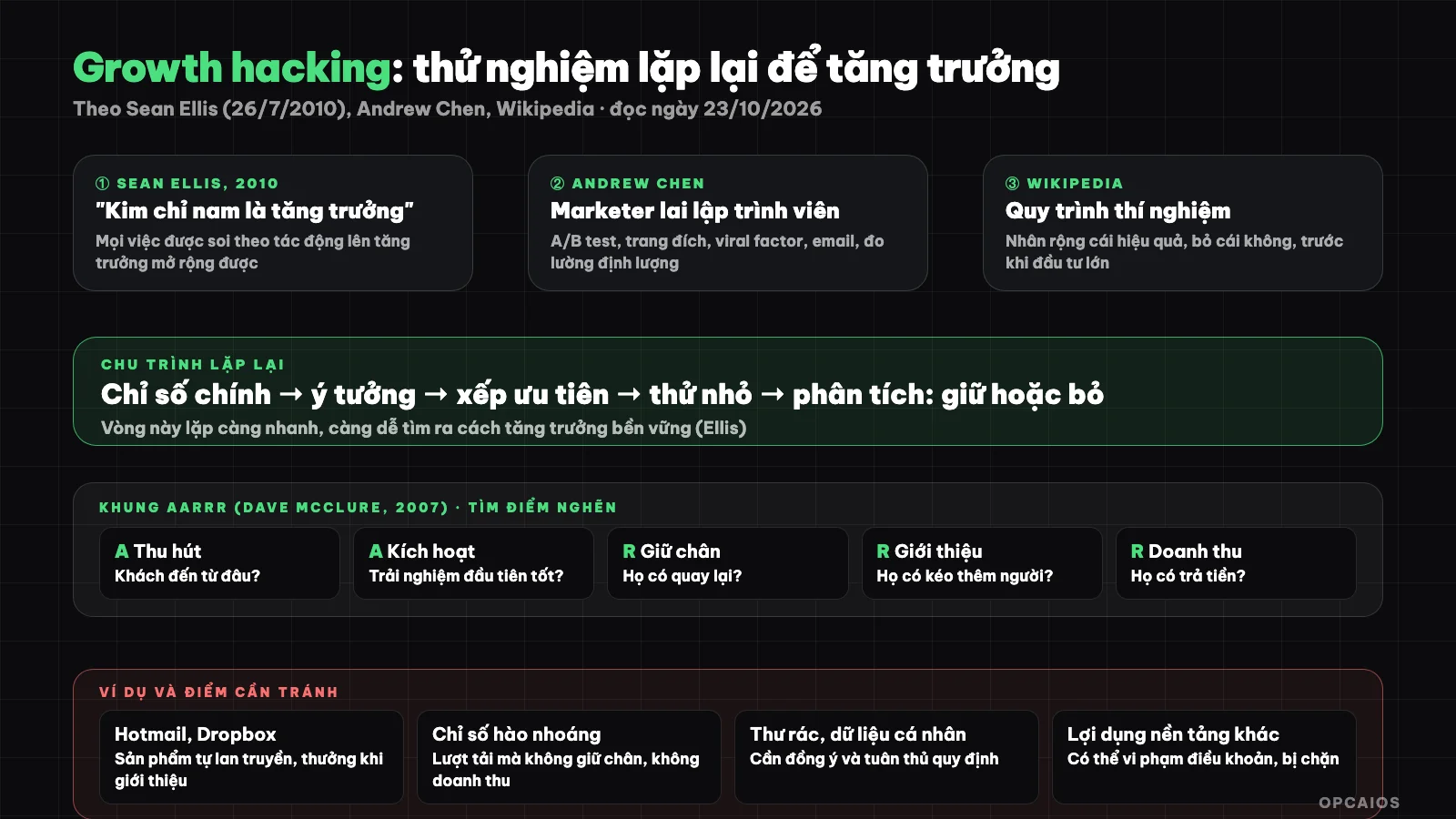
The repeating experiment cycle, measured by the AARRR framework, is the core; the "hacks" are just the result. Diagram: OPCAIOS.
What is Growth Hacking?
Growth hacking is a branch of marketing that focuses on fast growth, working as a process and a set of cross-disciplinary skills. According to Wikipedia, the goal is to regularly run experiments, which may include A/B tests, to improve the customer journey, scale ideas that work and drop ideas that don't before investing heavily. The method started with early-stage startups that needed fast growth on a tight budget, then spread to bigger companies. The original definition comes from Sean Ellis's post "Find a Growth Hacker for Your Startup" (dated 26/7/2010 on his blog; Wikipedia lists June, so I'm using the blog date): "a growth hacker is someone whose north star is growth. Everything they do is scrutinised for its possible impact on scalable growth". Ellis suggested that when a startup was ready to scale, hire a growth hacker instead of a VP Marketing with a generic skill set.
How is a Growth Hacker Different from a Traditional Marketer?
The difference is that they combine marketing skills with engineering and data. Andrew Chen made the term popular with his post "Growth Hacker is the new VP Marketing": according to him, a growth hacker is "a hybrid between a marketer and a programmer", who takes the traditional question "how do we get customers for the product?" and answers it with A/B tests, landing pages, viral factor, email deliverability and Open Graph; plus the discipline of direct marketing: quantitative measurement, spreadsheet modelling and lots of database queries.
| Criterion | Traditional Marketing | Growth Hacking |
|---|---|---|
| Main goal | Brand awareness, campaigns | Measurable growth (users, revenue, retention) |
| How to do it | Big plans, long campaigns | Many small experiments, fast iteration |
| Skills | Communication, creativity, management | Data, experimentation, engineering, product |
| Relationship with product | Separate from product | Growth built into the product |
| Measured by | Reach | Metrics tied to business results |
According to Wikipedia, a growth hacker embeds growth potential (attracting, onboarding new users, making money, retention, virality) into the product itself; a growth hacking team includes a marketer, a programmer, an engineer and a product manager.
What are the Steps in a Growth Hacking Process?
The growth hacking process is a loop, and according to Sean Ellis, the faster this loop runs, the easier it is to find scalable ways to grow. The original post describes a growth hacker needing discipline in three things: prioritise ideas, test ideas, then analyse enough to know which factors to keep and which to cut. Based on a reading dated 23/10/2026, you can break this down into five steps:
- Pick one main metric: a number that describes real growth, like active users per week, not a vanity metric.
- Gather ideas: from data, customer feedback, the product team and proven techniques from other companies.
- Prioritise: score by expected impact, confidence and ease to implement, then do the best one first.
- Test small: A/B test, a new landing page or trial email; keep costs low.
- Analyse and decide: keep, scale or drop, then go back to step 2.
Chen adds that if a startup hasn't hit product/market fit yet, a growth hacker can make sure virality is baked into the product core; after that, they help "level up" what's already working.
What is the AARRR framework (pirate metrics) used for?
AARRR is a five-stage framework by Dave McClure to measure the customer journey, presented in 2007. Compiled sources read on October 23, 2026 say its purpose is to avoid vanity metrics and focus on numbers tied to business results. The name "pirate" comes from how you read the initial letters. The five stages are:
- Acquisition: where do customers come from? Measure visits by source and cost per signup.
- Activation: do customers have a good first experience? Measure signup completion rate and main feature usage rate.
- Retention: do customers come back? Measure weekly return rate and churn rate.
- Referral: do customers refer others? Measure number of referrals per user.
- Revenue: do customers pay? Measure conversion to paid and revenue per customer.
Finally, use the framework to find bottlenecks. For example, if acquisition is good but activation is poor, pouring more Google or Meta ads just wastes money.
What are some famous growth hacking examples?
Wikipedia lists three examples most often mentioned, with a note that these "hacks" are just the result of repeated iteration:
- Hotmail: each email sent included the line "PS I Love You" with a link for the recipient to sign up for free email. This is an early example: the product markets itself when used.
- Dropbox: give users extra storage when they refer friends, turning users into distribution channels.
- Airbnb and Craigslist: Chen describes how Airbnb built a "Post to Craigslist" feature letting users post their listings to Craigslist, though according to him there was no public API for Craigslist so they had to study how the site works carefully. He says this is something a traditional marketer would find hard to think of, and it needs optimization after integration: measure completion rate when sharing and conversion rate when customers come from Craigslist. We don't assess whether this is valid under third-party platform terms; this is a historical example of thinking, not advice to copy.
Additionally, Wikipedia cites Fast Company on Twitter's "Suggested Users" list: the real trick is to build marketing into the product instead of building large marketing infrastructure. Chen also mentions "the law of very bad click rates": every marketing strategy eventually leads to lower click rates, so whoever enters a new channel first has an advantage from novelty and less competition.
When should you apply growth hacking?
Apply growth hacking when the product already has real people who need it and the team has metrics to measure. According to Sean Ellis, a growth hacker thrives after the product proves product-market fit along with effective conversion and monetization processes; then the next important thing is finding ways to scale growth repeatedly and sustainably. Without these conditions, all growth efforts are wastefully expensive.
To check product-market fit, many teams use the "Sean Ellis test". Step 1, ask users how they would feel if they could no longer use the product, with three choices: very disappointed, somewhat disappointed, not disappointed. Step 2, by Ellis's rule of thumb, if at least 40% of qualifying users answer "very disappointed" then the product likely fits the market in that group. For example, surveying 100 users means you need at least 40 people choosing "very disappointed". This information comes from compiled articles (secondary sources, read October 23, 2026) and sources that don't agree on publication year; treat this as a signal, not a verdict.
OPCAIOS's experience
OPCAIOS built its own tools to measure and test growth for its website instead of just guessing: allocate customer sources and revenue by channel, landing pages with A/B testing capability, weekly marketing reports, and SEO and GEO scores for each post before publishing. These are measurement tools; we don't disclose any growth numbers from them in this post. The principle drawn from Ellis's work is right: pick a number to improve, test small, read the results then scale up; and with AI-written content, always have someone review before publishing (see What is vibe marketing?).
Risks and ethics of growth hacking
The biggest risk of growth hacking is turning the process into "tricks". The core part, according to Wikipedia, is the iterative process, and growth hacking is not always free (read on 23/10/2026). Beyond that, there are four pitfalls to avoid, especially for businesses running ads through Google or Meta:
- Vanity metrics: counting downloads or signups without seeing whether users come back or pay.
- Spam and personal data: sending bulk messages or collecting data without customer consent damages your brand and may violate personal data protection regulations; ask a legal expert about the rules where you do business.
- Exploiting other platforms: integrations like Airbnb with Craigslist may breach that platform's terms, and the platform can change rules or block you anytime.
- Growth without retention: if your product isn't truly needed, pulling in more customers just exposes the problem faster.
How does AI change growth hacking?
AI reduces the cost of ideation, drafting, and prototyping, so you can run more experiments. But the decision phase (choosing metrics, reading results, keeping or dropping) still falls to people. If you want to connect steps into an automated workflow, see n8n, Make, and Zapier; if you need customer and pipeline management, see What is HubSpot?. With AI-generated content, follow the principle that someone reviews it and every number has a source.
Frequently asked questions
What is growth hacking?
It's a way to grow a business through continuous experiment cycles: try fast, try cheap, measure results, keep what works, and drop what doesn't. The term was coined by Sean Ellis in 2010.
Who came up with the term growth hacking?
Sean Ellis used the phrase "growth hacker" in a blog post on 26/7/2010. Andrew Chen later popularized it widely with his piece "Growth Hacker is the new VP Marketing".
How is growth hacking different from traditional marketing?
Growth hacking ties marketing to engineering, data, and product, running many small experiments and measuring by growth metrics, rather than big campaigns measured by reach.
What is AARRR?
It's a framework of five stages in the customer journey: Acquisition, Activation, Retention, Referral, Revenue, presented by Dave McClure in 2007, used to find growth bottlenecks.
When should you start growth hacking?
You should start growth hacking when your product has real users who need it (product-market fit) and your team can measure the customer journey. If you haven't met these conditions yet, then, according to Sean Ellis, any growth effort is wasteful, so the first job is to fix the product. Next, pick one main metric, such as activated users per week, then run small experiments on a low budget. Then read the results using the AARRR framework to see which stage is the bottleneck. The source read on 23/10/2026 does not mention a minimum revenue or user threshold to start. To learn how to apply AI to your growth process, see OPCAIOS's AI application training course.
Source: Sean Ellis's piece "Find a Growth Hacker for Your Startup" (startup-marketing.com blog, 26/7/2010) and Andrew Chen's "Growth Hacker is the new VP Marketing" (andrewchen.com), read directly on 23/10/2026; Wikipedia "Growth hacking" (definition, examples Hotmail, Dropbox, Airbnb, Twitter); information on Dave McClure's AARRR framework (2007) and "Sean Ellis test" taken from summary articles, secondary sources. Experience with measurement tools is from OPCAIOS, without growth figures attached. Not legal advice.
Translated from Vietnamese with AI. Read the original.
Want to apply this in your business?
Book a free 30-minute call (Vietnam time, in English or Vietnamese).