


What is a video outlier?
A video outlier is a video with view count many times higher than the daily average of the channel that posted it. For example, a channel that usually gets around 5,000 views per video suddenly has one hit 60,000. The key point is comparison to that channel itself, not to other large channels: a 60,000-view video on a small channel tells you much more about the idea and opening than a million-view video on a channel that already gets millions per video. This post does not promise that learning from outliers will make your video blow up; the platform algorithm is not public, and OPCAIOS has no growth results to report yet. The post will cover how to calculate the outlier ratio, the limits of the number, how to sample hooks and structure instead of copying, AI analysis with sources cited, platform terms you need to read, and what OPCAIOS has built in the internal Dream 100 module.
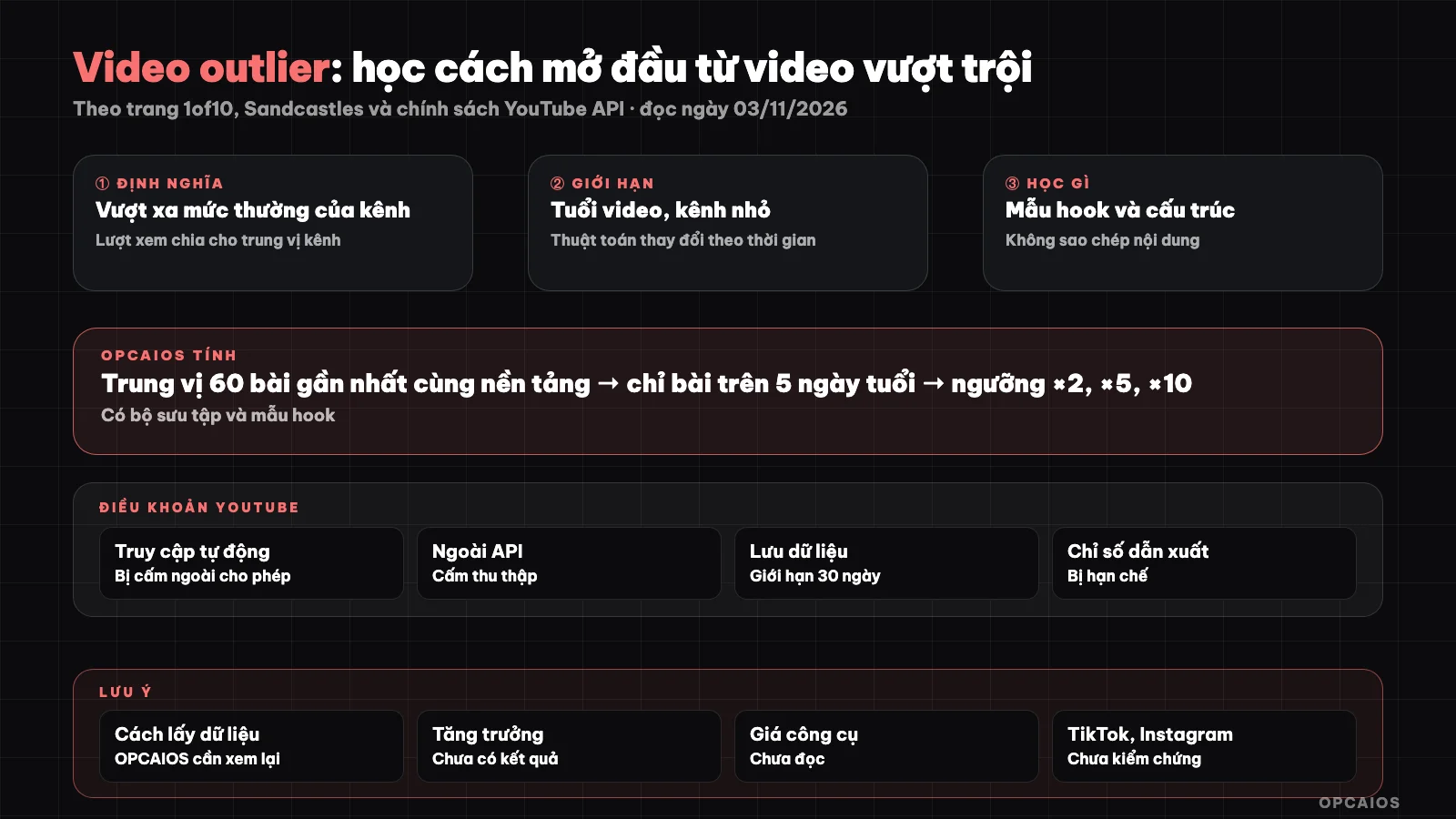
From channel views to outlier ratio, hook sample and your own script. Diagram: OPCAIOS.
Why is a video outlier worth studying more than the most-viewed video?
A video outlier is worth studying more than the most-viewed video because the outlier isolates the effect of idea and opening away from channel size. A large channel has high views on nearly every video, so looking at the "most viewed" list of that channel mostly tells you the channel is large. By contrast, when it's the same channel, same audience, same posting frequency but one video jumps the daily average five or ten times over, something is likely different about the topic, title, thumbnail, or first few seconds. That is a signal to learn from. Content research tools also use this idea: the 1of10 homepage (read on 03/11/2026) describes an outlier as a video performing 10 to 100 times better than the channel average, while the Sandcastles homepage (read on 03/11/2026) describes finding short video outliers on Instagram, TikTok, and YouTube Shorts, but does not publish a specific formula. We have not read the pricing pages of both tools so we do not list the price.
How do you calculate the outlier ratio?
The outlier ratio is a video's view count divided by the channel's usual daily view level, and median is the most stable way to measure usual level for someone working alone. Use median instead of mean because one or two viral videos will pull the mean way up, hiding other outliers. The steps:
- Take 30 to 60 most recent videos from the channel, separate short videos and long videos because the two formats have very different view levels.
- Remove videos that are too new (for example under 5 days old) from the baseline calculation, since they have not gathered enough views yet.
- Calculate the median view count of the rest: that is the channel's baseline.
- Divide each video's view count by the baseline.
- Set thresholds, for example ×2 is above normal, ×5 is an outlier, ×10 is a super outlier.
Example assumption: channel has median 4,000 views, video A reaches 22,000, ratio ×5.5. The platform does not show view count (like photo posts on Instagram) then you can use like count instead, but do not mix the two types of numbers.
| Ratio | Suggested way to read |
|---|---|
| Under ×2 | Within normal range |
| ×2 to under ×5 | Worth looking at title and opening again |
| ×5 to under ×10 | Clear outlier, should analyze closely |
| From ×10 | Rare, check factors outside content |
What are the limits of the outlier ratio?
The outlier ratio is a signal to ask questions, not proof of cause. The main limits:
- Video age: old videos have more time to gather views; videos a few days old may not show full potential yet. Note the posting date together.
- Small channel: a channel with few videos or a baseline of a few hundred views needs just one share to become ×10. Set a minimum number of videos and views before trusting the number.
- Algorithm and outside factors: a video may be pushed because of a trend, another large channel shared it, paid ads, or changes to the platform's recommendation that you do not see.
- Baseline shift: if a channel is growing or shrinking, an old video compared to the current baseline may be inflated or deflated.
- Format confusion: comparing short video to the long video baseline will give a meaningless ratio.
So look at a group of outliers with shared traits instead of one single video.
Extract Hook Pattern and Structure from Outliers Instead of Copying Exactly?
Extracting a hook pattern means finding the mechanism that holds viewers in the first few seconds, then applying that mechanism to your own subject and experience, without taking back the exact words, images, or production method. A simple process:
- Gather 10 to 20 outliers from three to five channels in the same niche.
- For each video, write down the opening sentence, hook type (question, number, counterintuitive claim, before and after, promised result), topic angle, format (talking to camera, screen recording, text on image).
- Count which hook types repeat most in the outlier group compared to regular videos from the same channel.
- Write a template as a fill-in-the-blank frame, for example: "I tried [specific thing] for [time period], here's what surprised me".
- Fill the frame with your real experience; if you don't have real experience, don't use that frame.
This approach respects the original creator and also works better, because audiences recognize copies. If you want to turn one long video into multiple pieces of your own content, see turn a YouTube video into 10 posts.
How Do I Analyze Outliers With AI and Still Have Sources?
Analyzing outliers with AI is only trustworthy when the AI works on data you've saved and answers with code or video links as proof for each claim. An LLM asked generally "why did this video go viral" will guess; given the title, description, transcript of the opening, thumbnail image, and outlier ratio of 20 videos, then asked to group hook types and note which video belongs to which group, the result can be checked. Three rules to keep:
- Each claim must point to at least one specific video; claims without proof should be dropped.
- Separate the "observation" part (video opens with a question) from the "hypothesis" part (question increases retention).
- Have someone read it again before you use it, because the model may misread text on the image or assign the wrong group.
If you use AI through the MCP protocol, you should give AI read-only access to research data.
What Does YouTube's Terms Say About Data Collection and Computing Metrics?
YouTube's Terms of Service and YouTube API Developer Policy set clear limits on data collection and creating custom metrics, so you need to read them before building your own outlier tool (this is not legal advice). According to YouTube's Terms of Service, Permissions and Restrictions section (read 03/11/2026), users may not access the service by automated means like bots or scraping tools, except for public search engines following robots.txt or when YouTube gives written permission. According to YouTube API Developer Policy (read 03/11/2026), section III.E.6 forbids collecting YouTube data outside the API; section III.E.4 limits storage time for many types of data not authorized by the channel owner to 30 days then must delete or refresh; section III.E.4.h does not allow using API data to create new derived metrics or scores, and if you display your own metrics next to API data you must clearly state they are not YouTube's numbers; section III.E.2 restricts aggregating data from multiple different content owners. An "outlier score" calculated from view counts across multiple competitor channels touches exactly these points. For TikTok and Instagram, read each platform's own terms; we have not verified them in this post. The safest way for a solo creator is to watch by hand on the platform, take notes in your own words, or use a third-party tool after reading their terms.
OPCAIOS's Experience
OPCAIOS has a Dream 100 module in the internal management area to track content creators and competitors in the AI for small business niche (see What is Dream 100). The upgrade on 10/27/2026 added the following sections, read from code and project notes:
- Outlier points: baseline is the median of views (or likes if the platform doesn't show views) from the 60 most recent posts on the same platform and format, only counting posts over 5 days old when there are at least 5 such posts; thresholds of ×2, ×5, ×10; recalculated periodically.
- Collection: AI reads cover images, titles and descriptions to tag format, building style, image type, prioritizing the highest outliers.
- Hook template: statistics on hook types within the outlier group and has AI draft a template framework, with real hooks from posts ×3 and above as comparison examples.
- A set of read-only MCP tools for AI agents to look up channels, outliers, collections and hook statistics.
What needs to be said plainly: the module currently reads public data from YouTube using an open-source command-line tool, not through the official API. After reviewing the terms in that section on 11/3/2026, we found this approach needs reconsideration and we don't recommend you follow it. We have no growth results from learning by outliers to publish, we don't have our own channels tracked in the module at the time of upgrade, and AI tags still need human review.
Frequently Asked Questions
What ratio counts as a video outlier?
There's no standard threshold. The 1of10 homepage describes outliers as videos exceeding a channel's average by 10 to 100 times; many users use lower thresholds like ×3 or ×5 to have enough samples to learn from. The threshold should depend on your niche: small niche with few videos, then ×3 is already noteworthy; crowded niche with many large channels, then use ×5 or higher. More important than the threshold is calculating the baseline correctly: median, same format, exclude videos that are too new.
Can you calculate outliers for new channels with few videos?
You can, but the numbers are less reliable. With under about 5 to 10 sufficiently aged videos, the median fluctuates sharply and a single share also creates a high ratio. You should note "small sample" next to the number, prioritize learning from channels with at least several dozen videos, and look at groups of outliers with common traits rather than a single video. For your own channel, if the baseline is low, the first goal is consistency, not chasing outliers.
Is learning hooks from competitors' outliers plagiarism?
Learning the mechanism is not plagiarism, but copying words, images, music or specific production techniques can violate copyright and damage your credibility (not legal advice). The safe way: write down the hook type as a blank template, fill it in with your own experience, data and examples, don't reuse the original footage or wording. If you really borrowed an idea from someone specific, naming them is the respectful way to do it and usually gets positive audience response.
Should I write my own tool to collect YouTube data to find outliers?
We don't recommend doing that before reading the terms carefully. YouTube's Terms of Service prohibit automated access outside permitted cases, and YouTube API's Developer Policy prohibits data collection outside the API, restricts data retention time and limits creating derived scores from API data. More reasonable options: manually watch and take notes, use third-party tools after reading their terms and data policies, or only analyze channels you own through official analytics tools.
Can AI write opening scripts from hook templates by itself?
AI can draft them, but drafts only work well when you feed in real experience, real data and your voice. The practical way: pick a hook framework you've extracted, give AI the topic, what you've done, real results, then ask for three opening options under 15 seconds; you pick, edit and verify every claim before shooting. Don't let AI make up numbers to make the hook sound stronger. If you want to learn how to build a content research process with controlled AI, see OPCAIOS's AI application training course.
Source: YouTube Terms of Service, Permission and Restrictions sections; YouTube API Developer Policy, sections III.E.2, III.E.4, III.E.6; 1of10.com and sandcastles.ai homepages (read 11/3/2026); TikTok and Instagram terms not yet verified, tool pricing pages not yet read; thresholds ×2, ×5, ×10 are OPCAIOS's classification, not an industry standard. Experience is OPCAIOS's.
Translated from Vietnamese with AI. Read the original.
Want to apply this in your business?
Book a free 30-minute call (Vietnam time, in English or Vietnamese).