


What is Dream 100?
Dream 100 is a strategy of selecting a short list of people, businesses, or channels that matter most to you, then tracking and creating value for them consistently over time instead of spreading effort across thousands of prospects. The original idea is tied to Chet Holmes in "The Ultimate Sales Machine" (Portfolio, 2007), where Dream 100 is a group of best-fit customers; Russell Brunson later used the same name in "Traffic Secrets" (2020) for influencers and platforms that own the audience you want to reach. This post does not claim that "100" is the standard number, nor does it promise that partners will respond; we have no data on successful partnership rates. The post will cover how to select a list, track content using AI, deliver value before asking, reach out respectfully, measure, and what OPCAIOS is actually doing with an internal Dream 100 module.
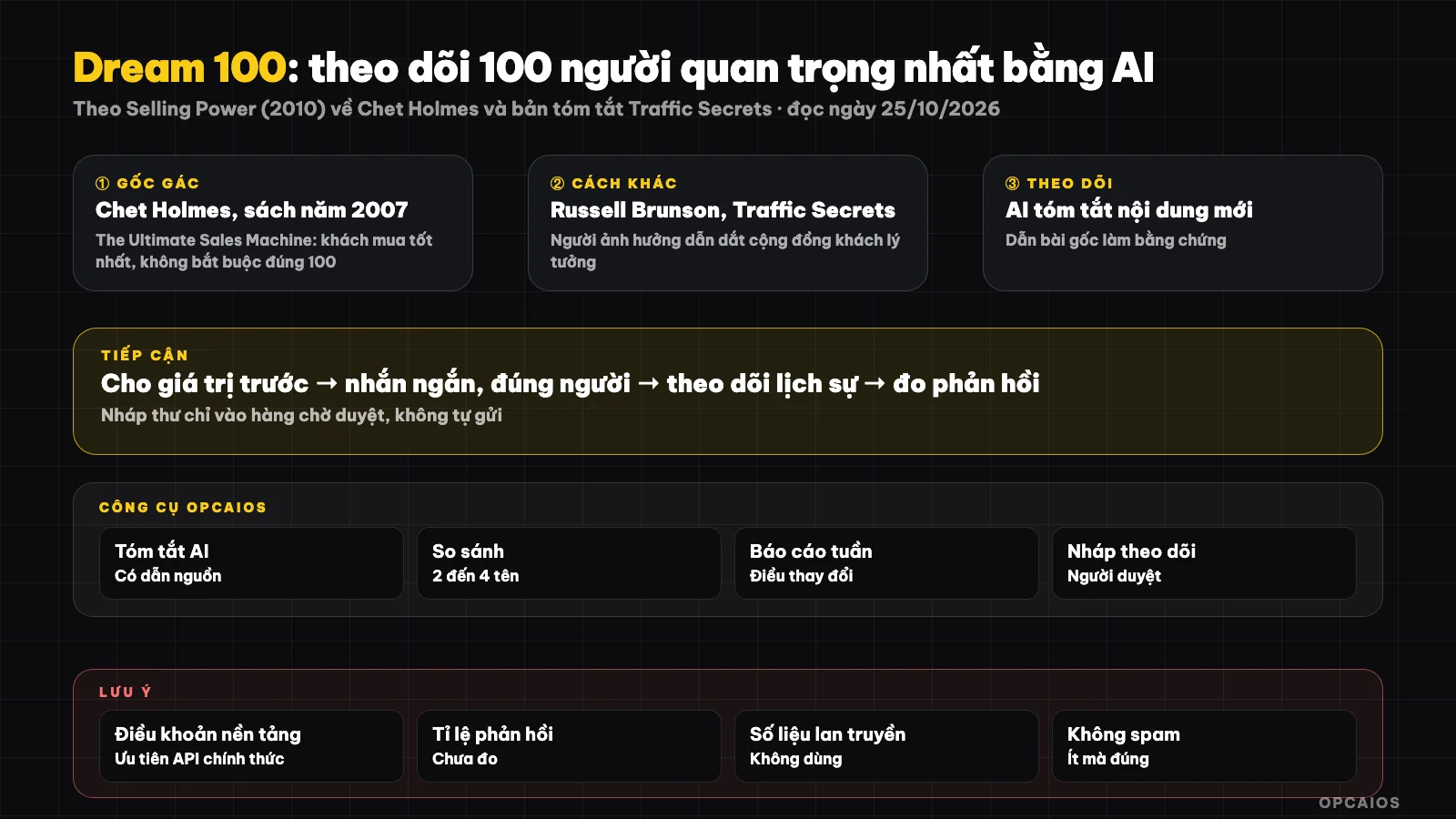
Dream 100 loop: select, track, deliver value, outreach with review, measure. Diagram: OPCAIOS.
Where does Dream 100 come from and how do the two interpretations differ?
Dream 100 has two common interpretations, and solo workers should know which one they are using. According to the article "The List That Will Change Your Life" on Selling Power (Heather Baldwin, 2010, read on 25/10/2026), Chet Holmes believed that in each market there is a small group of best customers who spend more, buy faster, and buy more often than the rest; businesses should pursue this group persistently, and the list does not have to be exactly 100 names. The second interpretation comes from Russell Brunson in "Traffic Secrets" (2020): Dream 100 is influencers, brands, podcasts, channels that own the audience your ideal customer already follows. One side is a customer list, the other is a distribution partner list. With a one-person company, the two lists usually blend: a few big aspirational customers, a few content makers in the same niche, a few supporting partners.
How to select a Dream 100 list correctly?
Selecting a Dream 100 list starts with your ideal customer, not with the most famous person. The right question is: who is my customer reading, listening to, buying from, trusting. Suggested steps:
- Write one sentence describing your ideal customer (industry, size, main problem).
- List where that customer gathers: YouTube channels, newsletters, groups, events, businesses offering supporting services.
- Assign a role to each name: prospect, influencer, partner, competitor to learn from.
- Rank them (for example A, B, C) by audience fit, not by follower count.
- Start small: 20 to 30 names cared for well is better than 100 names forgotten.
If you already have a B2B lead-finding system, Dream 100 is the priority tier at the top.
How does tracking Dream 100 content with AI help?
Tracking content with AI helps one person monitor dozens of channels without having to watch every video or read every post. The tracking has three layers: save what each channel posts (title, date, views if the platform is public), summarize topics and what the audience cares about, and compare weekly changes to see which posts stand out. AI does well at summarizing and categorizing when given saved data, with a request to trace back to the original post as proof; AI does poorly when it has to guess. Important conditions are getting valid data: prioritize official APIs or public sources that the platform's terms allow, read the terms before using third-party collection tools, do not log in with fake accounts, do not mass-download beyond limits. For platforms that do not allow data collection, just save the name and link and review by hand. For how to connect the steps, see tracking competitors with Firecrawl and n8n.
Why must you deliver value before asking for anything?
Delivering value first is the core of Dream 100, because people on the list receive many partnership requests and only remember those who helped them. Value here must be concrete and small, not vague praise. Examples:
- Comment with substance under their posts, add an idea or a source.
- Share their post with your own note, credit the source clearly.
- Send a tip to fix a small mistake (broken link, old data) discreetly.
- Introduce a fitting customer to them when you have a chance.
Once you have a few real interactions, a partnership proposal has context. The part about tracking with AI is useful mainly here: knowing what they just posted, what they care about, so the value you deliver comes at the right time.
How to Approach Dream 100 in a Respectful Way Without Becoming Spam?
Respectful outreach means each message is written for one person, has a specific reason, and respects it if they don't reply. A good message usually includes: who you are in one sentence, what you noticed about their work, a small ask that's easy to agree to, and an easy way to decline. Rules to keep:
- Don't send batches of the same template, don't buy email lists.
- Use their public work contact channels (business email, contact form).
- Follow up at most one to two times, spaced days to weeks apart, then stop.
- If you use AI to draft, a real person reads, edits, and sends it themselves.
- Comply with commercial email and personal data regulations where you and they are located (not legal advice).
How to write non-spam outreach is discussed in more detail in cold outreach without spam; note that OPCAIOS hasn't run large-scale cold outreach yet.
What Metrics Should I Use to Measure Dream 100 Effectiveness?
Measuring Dream 100 should measure your actions and real responses, not feelings. Suggested metrics:
| Metric | What it means |
|---|---|
| Number of names tracked by tier | Is the list being maintained consistently |
| Number of times you gave value per week | Are you giving first |
| Response rate per outreach attempt | Is the offer right person, right time |
| Number of real conversations, collaborations | Final result |
| Time from first contact to collaboration | Relationship cycle |
Log each touch with a simple CRM so you don't duplicate. An automated weekly report using n8n can pull these numbers every Monday.
OPCAIOS Experience
OPCAIOS has a Dream 100 module in internal administration, used mainly to track content creators, competitors, and potential partners in the AI for small business niche. What the module does, read from code and project notes:
- A recurring task re-reads public content from channels; channels with rising posts are re-read more often. With some social networks, we only save basic information because there's no way to get data appropriately.
- AI summarizes each name based on saved content (description, transcripts, notable comments) and links back to the original post as evidence.
- There's a page comparing two to four names side by side by 30-day metrics, and a weekly report flagging new trends versus the previous week.
- AI drafts follow-up messages for contacts due, but drafts only go to an approval queue; the system never sends itself, the owner edits and sends it themselves.
What we haven't done or haven't measured: no metrics yet on response rate or collaborations from Dream 100, haven't fully merged the two parallel outreach management flows that exist, and summary quality depends on the AI model so still needs human review.
Frequently Asked Questions
Does Dream 100 require exactly 100 people?
No. The number 100 is just an easy-to-remember way to call it. The Selling Power article on Chet Holmes' idea shows the list can be shorter or longer depending on the market. For a one-person company, 20 to 30 names managed consistently is often more realistic than 100 names just sitting in a spreadsheet. What matters is that each name has a clear reason to be on the list, a priority rank, and a schedule for regular touchpoints.
How is Dream 100 different from a regular prospect list?
A regular prospect list is usually long and handled through a funnel: send, filter, close. Dream 100 is short, carefully chosen, and managed as relationships: watching what they do, giving value first, approaching them personally, being patient over many months. The way Russell Brunson sees it, Dream 100 also includes influencers and channels that reach audiences, not just people who will buy. The two lists can exist side by side.
Can AI automatically send messages to Dream 100?
Technically yes, but we don't recommend it. Bulk automated messages easily miss context, look like spam, and can violate platform terms or business email regulations. The safe way is to let AI handle the prep work: summarize new content from the recipient, suggest common ground, draft messages. A real person reads it over, adjusts the tone, checks facts, then sends it manually. At OPCAIOS, AI-drafted messages always sit in a review queue and the system never sends on its own.
Is it legal to collect data from social media to track people?
It depends on the platform, how you collect it, and the laws where you operate; this is not legal advice. A practical principle: prioritize official APIs and public data that the terms allow, read each platform's terms before using third-party scraping tools, stay within access limits, don't use fake accounts, don't harvest personal data about people following them. For platforms that don't allow it, just save the name, link, and check manually. See 5 Data Security Rules When Using AI.
How long before Dream 100 shows results?
We don't have data to promise a timeline. Dream 100 is a relationship strategy so it's usually slow: it takes many rounds of giving value before an offer has a chance of being accepted, and many names will never reply. The way to keep momentum is to measure your own actions each week (times you give value, times you reach out) alongside the results. If you want to learn how to build a tracking and drafting system with AI in a controlled way, see OPCAIOS's AI Application Training course.
Sources: Heather Baldwin, "The List That Will Change Your Life", Selling Power (2010), about Chet Holmes' Dream 100 idea in "The Ultimate Sales Machine" (Portfolio, 2007); summary of "Traffic Secrets" (Russell Brunson, 2020) on Shortform (accessed 25/10/2026); have not directly verified the content of both books, growth numbers circulating online about Dream 100 are not used because they cannot be verified. Experience is OPCAIOS's own.
Translated from Vietnamese with AI. Read the original.
Want to apply this in your business?
Book a free 30-minute call (Vietnam time, in English or Vietnamese).