


What is an AI Agent?
An AI Agent is a system that uses a language model to receive a goal, plan on its own, call tools (files, browsers, commands, APIs), check results and continue, instead of just answering a question. Five commonly mentioned tools are Claude Code, OpenClaw, Hermes Agent, Devin and Manus. One honest note: "do everything for you from A to Z" is how they're marketed; in reality these agents still need clear goals, limited permissions, human review at risky points and output verification, and we don't have general data on task completion rates. This post describes five tools based on official sources from Anthropic, Nous Research, Cognition and Wikipedia (read 24/10/2026, year 2026), pricing if available, risks already mentioned, how to choose and real experience from OPCAIOS when running agents on a server.
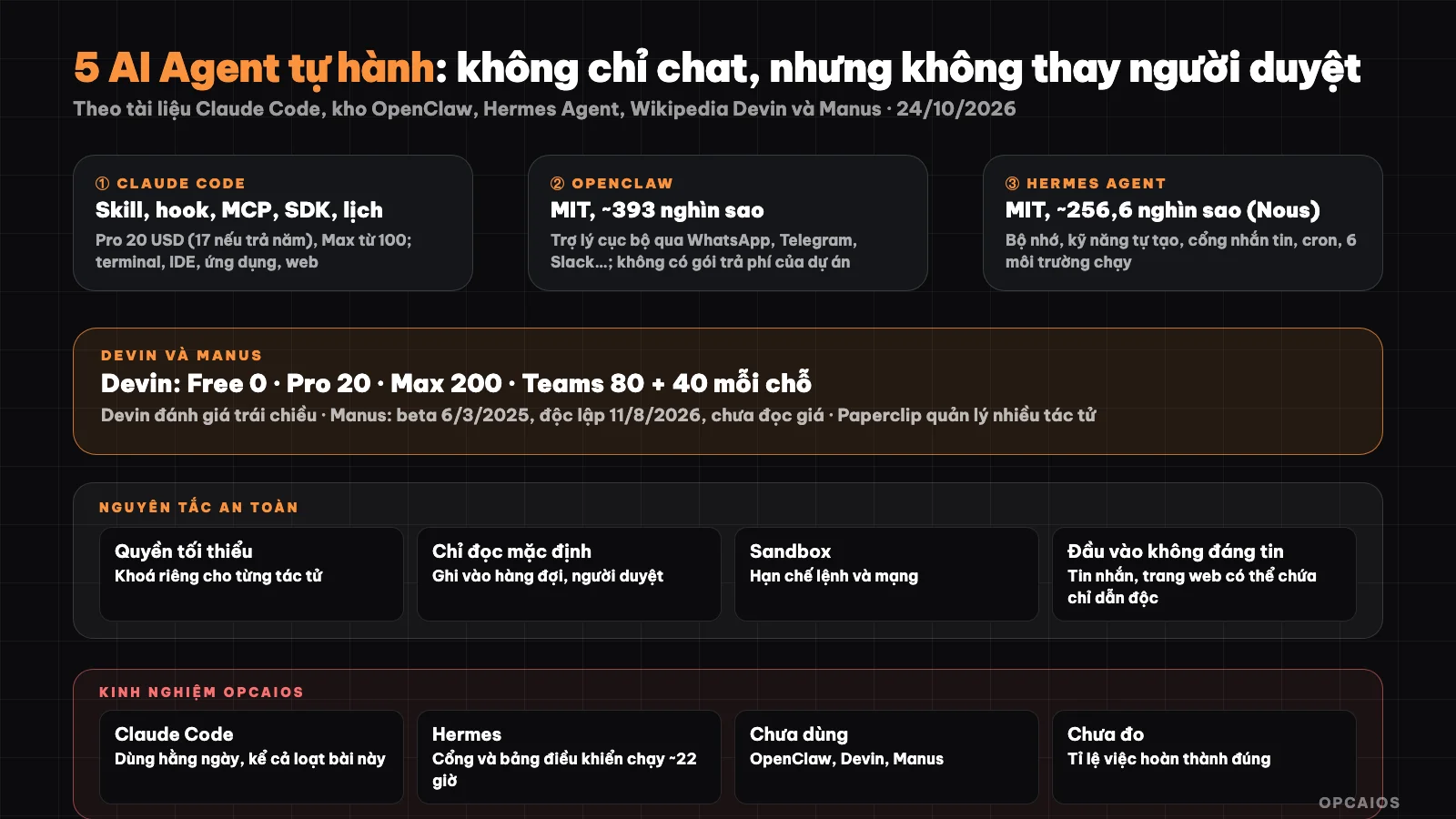
Five agents, one principle: minimum permission, human review, logs. Diagram: OPCAIOS.
Five Tools
1. Claude Code
According to Anthropic's official documentation (read on 24/10/2026), Claude Code is an agent-oriented programming tool that reads source code, edits files, runs commands, and integrates with development tools; the tool is available on terminal, IDE utilities, desktop applications, and browsers. For features, the documentation lists child agents running in parallel, hooks, skills, tool connections via MCP, headless mode (claude -p) for inserting into CI or scripts, SDK for building custom agents, and scheduled tasks running on the cloud or on-machine. For example, a small team can call claude -p in a CI script to run a repetitive job. A reasonable order for getting familiar is first using it on the terminal, next adding skills and MCP, and finally setting up scheduled tasks. Most surfaces require a Claude subscription or Console account. On pricing, according to Claude's pricing page, the Pro plan at $20 per month ($17 per month if paid yearly) includes Claude Code, while the Max plan starts at $100 per month. See also Skill anatomy in Claude Code.
2. OpenClaw
According to the GitHub repository, OpenClaw is an open-source AI assistant (MIT license, around 393 thousand stars when read on 24/10/2026) running on the user's machine and working through existing chat applications: WhatsApp, Telegram, Slack, Discord, Teams, Google Chat, Signal, iMessage. There is a local port serving as session, tool, and channel control center; local-first priority (state, memory, credentials live on the user's machine); extensible tools, skills, and plugins; a nonprofit organization managing the project and the project states there is no paid package, hosting service, or token. Project self-stated risks, in order of importance: first, treat incoming messages as untrusted input, second, tools run on the main server unless configured with sandbox, and finally, read the security guide before letting others use it or opening the port outward. Hypothetical example: if connecting OpenClaw to a public Telegram group, every message in the group must be treated as untrusted input, and the command-running tool should be placed in a sandbox.
3. Hermes Agent
According to the GitHub repository, Hermes Agent is an open-source agent from Nous Research (MIT license, around 256.6 thousand stars) self-described as a "self-improving agent" (read in 2026): self-manages memory, retrieves old conversations, creates skills after complex tasks and gradually fine-tunes (compatible with agentskills.io open skill standard); a messaging port connecting Telegram, Discord, Slack, WhatsApp, Signal, and command line; a cron scheduler running jobs unattended; six execution environments (local, Docker, SSH, Modal, Daytona, Vercel Sandbox); works with multiple model providers. The difference from OpenClaw is that Hermes Agent emphasizes self-creating and fine-tuning skills after complex tasks, together with a cron scheduler for running recurring jobs. Hermes Agent is also the agent that OPCAIOS is running on a private server (see the Experience section below). For example, a daily reporting job can be set up via cron and send results through Telegram. Besides, model cost and command execution permissions remain managed by the user.
4. Devin
According to Wikipedia (read on 24/10/2026), Devin is an AI-assisted software development tool from Cognition Labs, takes tasks in natural language, plans, writes code, finds documentation online, and adjusts based on feedback; Devin launched in March 2024. Wikipedia also records skeptical comments: some independent evaluators found Devin failing at an attempted Upwork project and questioned the accuracy of promotional videos. According to Devin's official pricing page: Free plan $0, Pro $20, Max $200 per month, Teams $80 per month plus $40 per developer; additional usage-based API pricing; the page does not state the number of compute units included with each plan and the current read has places where we must guess from the layout so please double-check.
5. Manus
According to Wikipedia, Manus is an autonomous agent proprietary to Butterfly Effect (founded 2022 by Xiao Hong, Singapore), launched in beta by invitation on 6/3/2025; in December 2025 Meta announced an acquisition, after which the deal was blocked by Chinese authorities (27/4/2026), Meta announced severing ties on 15/6 and on 11/8 Manus stated it would operate independently. Manus's pricing page was not readable when we tried, so we do not state pricing. Overall, this is an example showing how ownership status and policy of an agent company can change quickly. That reality leads to two things to do: first, do not keep important data only on one agent service; second, reread terms and pricing page before renewal. The timeframe from December 2025 to 11/8 in the timeline above shows this status can shift within months.
Quick Comparison
| Tool | Type | Runs on | Strengths per source | Watch out for |
|---|---|---|---|---|
| Claude Code | Programming agent | Your machine, cloud | Skills, hooks, MCP, SDK, scheduling | Command execution permissions, subscription costs |
| OpenClaw | Open-source personal assistant | Your machine | Multiple chat channels, local priority | Incoming messages unreliable, open ports |
| Hermes Agent | Self-improving open-source agent | Your machine, Docker, SSH, cloud | Memory, skills, cron, message ports | Permissions, model costs |
| Devin | Software engineer agent | Provider's cloud | Takes on jobs independently | Mixed reviews, usage-based pricing |
| Manus | General-purpose agent | Provider's cloud | Builds complete products from description | Ownership changes, price not yet public |
Want to manage multiple agents as a team: see What is Paperclip?; run multiple agents in terminal: What is Herdr?.
Principles for safe agent use
- Least privilege and separate keys for each agent (see How to build a 24/7 AI Agent system).
- Read-only by default; write to draft queue, then human review.
- Sandbox and network limits for command-running tools (see risks in What is Antigravity 2.0?).
- Set spending caps per agent.
- Treat all outside input as untrustworthy (messages, websites, files), as it may contain malicious instructions (prompt injection).
- Logs and kill switch always ready.
OPCAIOS Experience
We use Claude Code daily for tasks like writing posts, generating images, and deployment (this whole series was made with Claude Code through a custom skill), and run Hermes Agent on our own server: a check on 24 October 2026 showed Hermes's message port and dashboard running under a process manager, continuously for about 22 hours. We also run Paperclip to manage a default agent. We have not used OpenClaw, Devin, or Manus, so those three tools are described from public sources, not our experience. We have not measured the rate at which agents complete tasks correctly on their own, and we always keep a reviewer for public-facing content.
Frequently Asked Questions
What is an autonomous AI Agent?
A system using a language model to take a goal, plan itself, call tools, check results, and continue.
Can an agent do everything end-to-end by itself?
For clear, low-risk work, yes, mostly; for public-facing, financial, or hard-to-undo work, it needs human review. We don't have overall success rate data.
Which open-source agent is free?
OpenClaw and Hermes Agent are both MIT licensed, self-hosted; you still pay for model and server costs.
Is an agent dangerous?
Yes, agents carry risk because they run real commands and receive untrusted input like messages, websites, or files that may contain malicious instructions (prompt injection). The OpenClaw project itself notes the tool runs on the main server unless you set up a sandbox. So you need four layers of protection: least privilege and separate keys per agent, sandbox plus network limits, spending caps per agent, and human review before any public content. Example: an agent that can only read a project folder and write to a draft queue, even if injected with malicious commands, is harder to damage than one with delete permissions. Finally, always keep logs and a kill switch ready.
Which agent should I start with?
Start with an agent that fits the work you need, then expand gradually. For programming, Claude Code (Pro plan $20 per month per pricing page checked 24 October 2026) or similar is a sensible entry point. For a personal chat assistant, look at OpenClaw or Hermes Agent; both are MIT licensed open source, self-hosted, but you still pay model and server costs. For example, if your first task is writing posts or generating images on your personal computer, a programming agent running locally is enough. First, grant only read permissions; next, add write to draft queue; then let it run commands in a sandbox. To learn how to build safe agents, see OPCAIOS's AI application training course.
Source: code.claude.com (overview), claude.com/pricing, GitHub repos openclaw/openclaw and NousResearch/hermes-agent, devin.ai/pricing, Wikipedia on Devin and Manus, checked 24 October 2026; Manus pricing page not accessible. Stars and prices change fast; some Devin pricing items inferred from layout. Experience is OPCAIOS's per direct check.
Translated from Vietnamese with AI. Read the original.
Want to apply this in your business?
Book a free 30-minute call (Vietnam time, in English or Vietnamese).