


Installment Pricing for Solo Service Work: Payment Stages and Cash Flow
Installment pricing for solo service work is a way to break down a project's value into multiple payment stages tied to work milestones, typically a deposit when signing, a mid-term payment, and a final payment upon delivery, so the solo worker doesn't have to front all the effort and expense upfront. Cash flow goes with it: knowing which weeks money comes in, which weeks it goes out, and how many weeks remain before the fund runs dry. This post makes no promise that clients will pay on time, and it doesn't replace an accountant or lawyer: all content about taxes, invoices, and contracts is for reference only, not professional advice. All dollar amounts in this post are hypothetical examples. The post will cover why we split payments, how to write them into quotes and contracts, payment reminders, tracking receivables, forecasting cash flow 4 to 12 weeks ahead, contingency reserves, what to do when clients are late, and what OPCAIOS has built into the internal management dashboard.
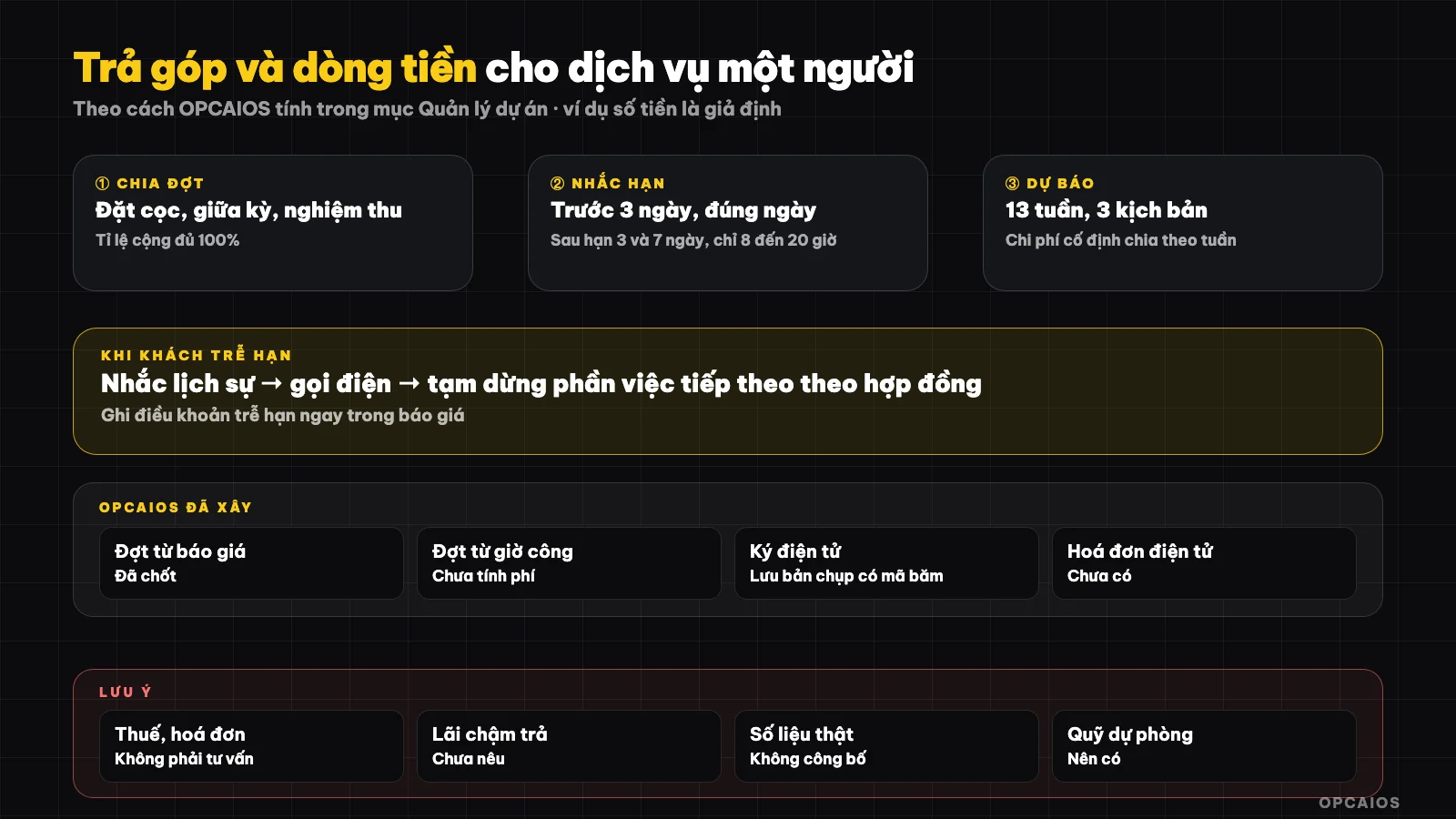
From finalized quote to payment stages, reminders, and weekly cash flow forecast. Diagram: OPCAIOS.
Why should solo service work split payments into stages?
Splitting payments is a way to shift cash flow risk from the solo worker to a clear agreement both sides can see. A freelancer or solo business owner taking on a project that runs six to ten weeks and collects payment only at delivery will face three risks at once: fronting time and tool costs, client changing direction halfway through, and a single payment being late, leaving them short on living expenses. Splitting payments solves all three. A deposit shows the client is serious and pays for setup work. A mid-term payment ties to a deliverable the client can review, so both sides spot misalignment early. A final payment ties to delivery criteria written in advance, so there's no more arguing over whether work is done. For clients, split payments are also easier to get approved in a budget than one large amount. If you're moving from selling hours to selling results, see also from selling effort to selling results: a 2000 USD quote.
What ratio should you split payments by?
The split ratio depends on how long the project is and how much cost you have to front upfront; there's no standard number. Three common patterns:
| Project type | Suggested split | Milestone tied to each stage |
|---|---|---|
| Short, 1 to 3 weeks | 50% deposit, 50% delivery | Signed quote; delivery meets criteria |
| Medium, 4 to 10 weeks | 40% deposit, 30% mid-term, 30% delivery | Signed; draft or demo review; delivery |
| Long, monthly | 30% deposit, rest split evenly by month | Signed; monthly progress report |
Example: a 30 million đồng automation system project, split 40/30/30, collecting 12 million when signed, 9 million when client approves the demo, 9 million when delivered. General rule: the deposit should cover the costs you have to pay upfront (tools, outsourcing), and the final payment shouldn't be too large, since final payments are the easiest to delay.
How should you write payment stages into quotes and contracts clearly?
Quotes and contracts should list each payment stage as its own line with amount, trigger event, deadline, and payment method, so no one has to guess. Items should include:
- Total value, whether or not it includes tax, and currency.
- Payment list: stage name, percentage, amount, trigger event (for example "client approves demo"), number of days to pay after the event.
- Delivery criteria written as checkable statements, with the number of revision rounds included in the price.
- Payment method: transfer, transfer note or stage code for reconciliation.
- What happens if late: pause work after how many days, any late fees or not (amount and basis should be checked with someone qualified in law).
- How scope outside the quote is priced, and when product ownership transfers (usually after final payment).
You can use AI to draft the terms, then have someone qualified review them, as in using AI to write contracts and standard terms for small services. On invoicing and tax for each stage, rules may change and depend on your business type; we haven't verified details so we don't cover it here—ask your accountant (not a tax advisor).
How to Remind Customers About Payment Deadlines Without Having to Chase Them Down?
The most effective payment reminders are scheduled in advance and sent regularly, because when done this way, the reminder is a process rather than a reproach. A reasonable reminder schedule for small service customers:
- Three days before the deadline: a brief message, including the amount, deadline, and payment link.
- On the deadline day: a one-line reminder.
- Three days after the deadline: ask if there are any issues, suggest a call if needed.
- Seven days after the deadline: restate the late payment terms you've agreed to, announce when you'll pause work.
Each reminder should include the most convenient payment method, for example a QR code transfer with unique content for each batch so you can reconcile automatically. How to link a QR code with automatic confirmation is described in collecting money via QR code transfers through SePay. Reminder messages can be sent via an email marketing tool or an n8n workflow, as long as you only send to batches that have been issued and are still awaiting collection.
What columns does tracking customer debt need?
Tracking debt means knowing, on any given day, how much each customer still owes, which invoices are overdue, and how long they've been overdue. A minimal table for someone working alone:
| Column | Meaning |
|---|---|
| Customer, project | Who owes, for what work |
| Batch, batch code | For reconciling transfers |
| Amount | Batch value |
| Payment deadline | When it should be paid |
| Status | Awaiting collection, collected, cancelled |
| Days overdue | Today minus payment deadline, if not yet collected |
| Last reminder | Avoid duplicate reminders |
Two numbers you should review weekly: total awaiting collection and total overdue. Add one more number if you break down batches from quotes: the portion of quoted value that has been finalized but not yet divided into any batch, because that's the money most easily forgotten.
How do I forecast cash flow 4 to 12 weeks ahead for a solo service business?
Cash flow forecasting by week is a running total of projected income minus projected expenses for each week ahead, so you see early which week your running balance turns negative. For a solo service business, 4 weeks is the minimum horizon to have time to adjust, 12 to 13 weeks (roughly a quarter) is enough to decide whether to take on more work or cut costs. The steps:
- List the batches awaiting collection by payment deadline; amounts already overdue roll into the current week but mark them separately.
- Add recurring income (maintenance packages, subscriptions) according to their cycle.
- Add unchosen opportunities, multiply by a probability you assess yourself, place them in the week you expect to close them.
- Subtract fixed monthly costs divided by week (take monthly cost times 12 divided by 52).
- Run a total and find the first week with a negative balance.
Run three scenarios: pessimistic (no new opportunities close, collect only part of overdue amounts), base (as in the table), and optimistic (high-probability opportunities count as closed). Example assumption: fixed costs of 13 million dong per month equals roughly 3 million per week; if the pessimistic scenario turns negative in week six, you know you have roughly five weeks left to collect on debt or close more work.
How much should I keep in reserves and what do I do when a customer is late?
Reserves are money set aside to cover fixed costs during weeks with no incoming payments, and it's your last layer of protection when customers are late. There's no standard amount; a practical way to think about it is to keep enough for fixed costs covering the longest number of weeks that your pessimistic forecast scenario turns negative, plus an additional buffer you choose yourself. When a payment becomes late, handle it in this order:
- Check your own side first: invoice, payment code, acceptance sent correctly?
- Call or message directly, ask why, propose a new payment schedule with a specific date and document it in writing.
- Pause the next part of the work exactly as stated in your contract terms, give the customer advance notice.
- Don't hand over ownership or admin access if the contract ties that to the final batch.
- For a large amount that drags on, ask someone with legal expertise before taking further action (not legal advice).
Don't take on new work just to "fill" an overdue amount if your forecast shows you don't have the capacity; cut costs first. See also 5 mistakes when building an OPC.
OPCAIOS's Experience
OPCAIOS built the quotation, payment installments, and cash flow forecasting features into the internal management dashboard in October 2026, when merging a separate project management application into the main admin portal. What's in the code:
- Quotations have line items, tax, discounts, AI-suggested line items with assumptions for the owner to edit, and customer e-signature on the customer portal; upon signing, the system saves a snapshot of the quotation content along with a hash for future verification.
- A finalized quotation can be split into installments by manually entered percentages (must add up to 100%) and day intervals between installments; each installment is a payment with its own code, QR code payment page, and automatic confirmation when the transfer matches.
- Installments can be created from unbilled hours using the project's hourly rate.
- Due date reminders run daily during business hours: customer email 3 days before, on the day, 3 and 7 days after the due date for issued installments, and internal notice to the owner.
- Cash flow forecast page shows 13 weeks including pending collections, recurring revenue, opportunities in CRM multiplied by probability, minus fixed costs divided by week, with three scenarios: pessimistic, moderate, optimistic.
What we haven't done: haven't connected e-invoicing, haven't set up bank reconciliation outside the QR code transfer flow. OPCAIOS does not disclose actual financial figures and has no results yet to share on on-time payment rates.
Frequently Asked Questions
What percentage deposit is reasonable for solo service work?
There's no standard ratio. The deposit installment should at least cover the costs you must spend before the customer sees the first result, such as tools, outsourcing, prep time. For short projects, many people use 50%; longer projects might be 30 to 40% then split the rest by milestones. New customers with no payment history are a reasonable reason to keep the deposit ratio higher. What matters is writing the milestones and due dates of each installment clearly in the quotation.
Should I charge a late payment fee?
You can write it into the contract if both sides agree, but the fee amount and legal basis should be checked with someone qualified, since regulations may differ by contract type and parties involved; this is not legal advice. In practice, with small service customers, clauses pausing work and withholding handover until full payment is collected usually work better than penalty fees. Whichever way you choose, remind the customer of the terms before applying them, don't apply them as a surprise.
Do I need accounting software for cash flow forecasting?
Not mandatory. A spreadsheet with columns for week, expected income, expected expenses, and running balance is enough to start. What matters is updating weekly and separating overdue amounts, recurring revenue, and unsettled opportunities. As projects grow, linking the sheet to your CRM and payment installment list helps reduce manual entry. Accounting software is still needed for books and tax; do that with your accountant.
What if the customer wants to pay all at the end of the project?
You can accept if the customer is reputable and the project is short, but understand you're lending the customer your full effort upfront. Ways to compromise: break the project into smaller phases, collect at each handover; offer a slight price cut for early payment; or keep a small deposit installment. If you accept end-of-project payment, put that amount in the pessimistic scenario of your cash flow forecast and check if your reserves are enough.
How safe is it to use AI to manage quotations and receivables?
AI does well at drafting: suggesting quotation line items, writing polite reminder emails, summarizing receivables by customer. Keep decisions with yourself: final price, terms, new payment schedule, when to pause work. Don't feed bank account numbers, full contracts, or customer personal data into AI tools whose data policy you haven't read. If you want to learn how to build quotation flows, reminder systems, and reporting with AI in a controlled way, see OPCAIOS's AI Application Training Course.
Source: OPCAIOS project source code and notes on quotations, payment installments, reminders, and cash flow forecasting (read 03/11/2026); regulations on invoices, tax, late payment interest are not verified and not stated specifically, all amounts are hypothetical examples, content is not financial, tax, or legal advice. Experience is OPCAIOS's.
Translated from Vietnamese with AI. Read the original.
Want to apply this in your business?
Book a free 30-minute call (Vietnam time, in English or Vietnamese).