



Turning Customer Praise into Content
What is turning customer praise into content? It's the process of asking customers or students for genuine reviews, getting clear permission about where and how to display them, then using the original review as a post, quote image, or case study. Customer praise is persuasive because readers trust people like themselves more than shop owners, and that's why fake praise, altered praise, or paid praise hidden from view causes serious damage when discovered. This post doesn't promise that praise will increase orders, it's not legal advice, and OPCAIOS hasn't published any customer testimonials on its website yet. The post covers the timing of requests, open-ended questions, how to ask permission, what not to do, guidance from the FTC (United States) as read from ftc.gov, Vietnamese regulations as reference, and how to turn praise into posts, quote images, and case studies with real numbers.
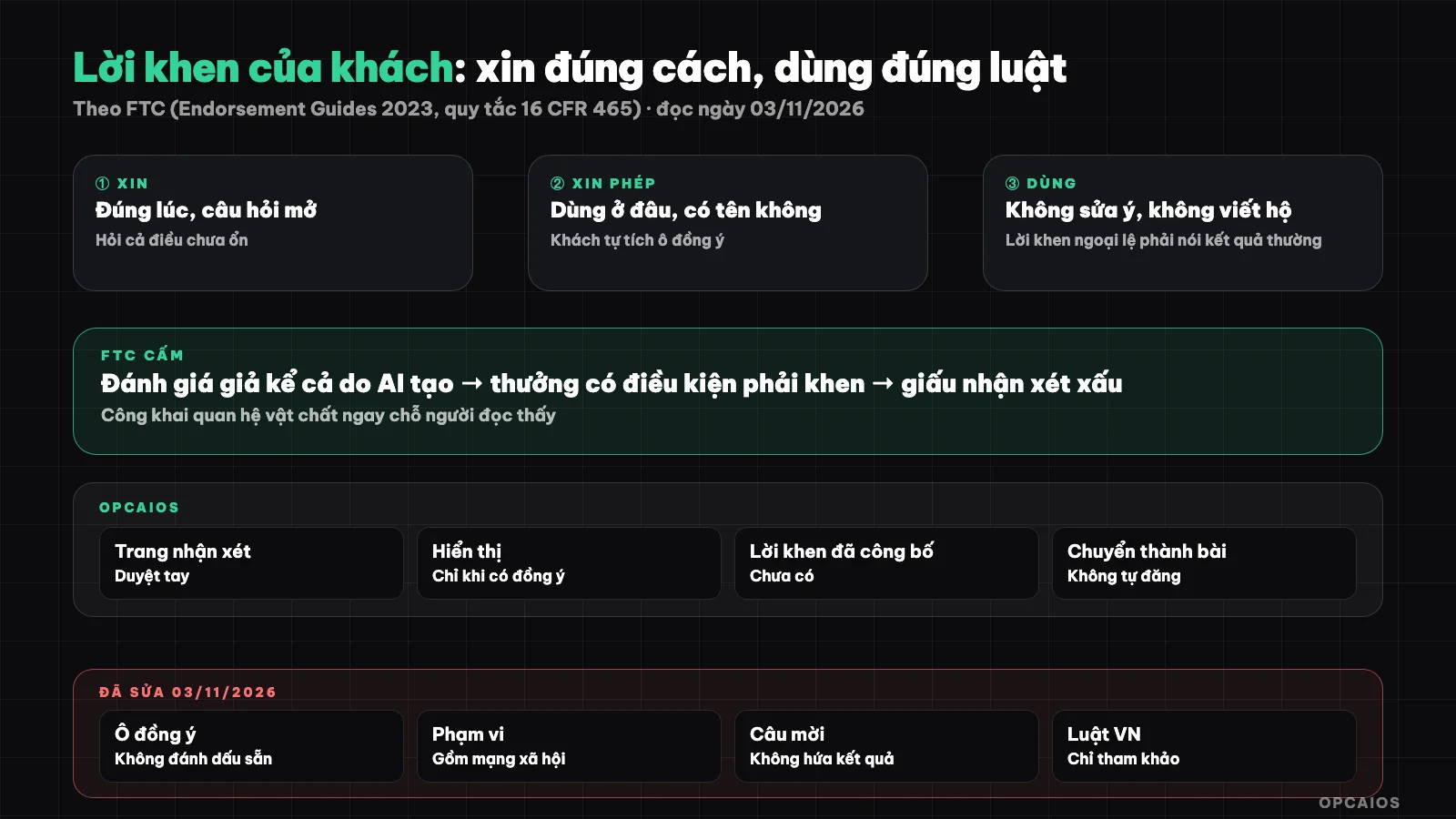
Ask at the right time, ask clear permission, preserve the intent, then use it. Diagram: OPCAIOS.
When should you ask customers for reviews?
The best time to ask for a review is right after a customer has achieved a visible result, while the experience is still fresh in their mind. For a course, that's a few days after a student completes and receives their certificate; for a service, it's after delivery or a few weeks after the customer uses the product; for a digital product, it's after the customer first uses it for real work. Three principles about timing:
- Ask once, remind at most once; don't send a chain of emails.
- Don't ask when a customer has an unresolved complaint.
- Ask all customers in the same group, not just people you think will praise you, so the picture isn't skewed.
The third principle matters more than it looks: FTC guidance considers asking only or displaying only positive reviews as potentially creating a false impression of customers' overall opinion.
What questions should you ask customers?
Good open-ended questions are ones that make customers tell a specific change, rather than just answer "good" or "satisfied." A short set of questions for solo workers:
- Before using the product or service, what difficulty were you facing?
- What made you decide to try it?
- After using it, what changed, and if there's a number, what is it?
- What do you think could be better or not quite right?
- What would you tell someone who's hesitating like you used to?
Question number 4 might seem counterintuitive, but it helps you improve the product and makes the review read more genuine. Don't lead the answer like "didn't you think the course was really great?". You can send questions via form, email, or message; a form is convenient because it saves the original text and time. See how to connect a form with automation in the post automating Tally form funnels and AI.
How should you ask permission from customers clearly?
Asking permission clearly is so customers choose for themselves, before posting, where their review will be used and what about them will be displayed. A single checkbox "allow use of review" isn't clear enough. Break it down into choices:
| Permission question | Options to have |
|---|---|
| Post where? | Website only / add social media / add paid ads |
| How to display the name? | Full name / name and first letter / anonymous |
| Use a photo? | Profile photo / no photo |
| Mention job or company? | Yes / no |
| How to withdraw? | An email or contact link to request removal |
The checkbox should be unchecked by default, so customers check it themselves. Keep a record of the date of permission and the scope agreed. When you want to use it somewhere new, like moving from website to ads, ask again. Name, photo, job are personal data; see more in 5 rules for protecting business data when using AI.
What absolutely not to do with testimonials?
The don'ts are all ways that make readers believe falsely about what customers really said and why they said it. Five prohibitions:
- Don't alter the meaning: only fix spelling errors if the customer agrees; shortening is not allowed if it changes the meaning, and you should show the customer the shortened version.
- Don't ghost-write: don't draft testimonials and then ask the customer to "sign off," don't use AI to write reviews under the customer's name.
- Don't fabricate: don't create testimonials from people who don't exist or haven't used the product.
- Don't hide paid-for testimonials: if the customer receives a gift, discount, or money to write a review, you must disclose it clearly, and the reward cannot depend on whether they praise or criticize.
- Don't hide bad reviews: don't delete them, don't push them down, don't threaten reviewers.
An example to clarify (hypothetical, not a real customer): a customer writes "The course helped me save time writing lessons, but the end part was a bit rushed." Shortening it to "The course helped me save time writing lessons" drops the criticism, so you should ask the customer first or keep it as is.
What does the FTC say about endorsements and fake reviews?
The FTC (U.S. Federal Trade Commission) has two main documents on testimonials: the Endorsement Guides (Endorsement Guides, revised 2023) and the Rule on Reviews and Testimonials by Consumers (16 CFR Part 465), released on 08/14/2024. According to the Q&A and announcements on ftc.gov as read on 11/03/2026, the main points are:
- Testimonials must reflect the genuine opinion of the person giving them.
- Material relationships that readers wouldn't expect, such as being paid, receiving a product gift, being a relative or employee, must be disclosed clearly where readers see it right away, not hidden in comments or links.
- If the results achieved by the person testifying are higher than typical and you don't have evidence that others have achieved the same, the ad must clearly state what typical results are.
- The 2024 rule bans fake testimonials, including those created by AI, from people who don't exist or have no real experience; bans rewards conditional on praising or criticizing; bans using threats to remove bad reviews; bans buying and selling fake followers, fake views.
- If the advertiser edits a customer's review, the customer has the right to demand that the edited version no longer be used.
These documents apply in the United States; for sellers in Vietnam, they are good reference standards for honesty, not legal advice.
What Vietnamese regulations should we refer to?
Vietnamese regulations relating to customer testimonials fall into two groups: advertising law and consumer protection law, and personal data law. On personal data, the Personal Data Protection Law No. 91/2025/QH15 takes effect from 01/01/2026 according to summaries by PwC and EY; we have not read the original text, so this section is for reference only. The practical consequence is: name, portrait photo, occupation of the customer are personal data, using them to promote requires clear consent for that specific purpose, and the customer needs a way to withdraw. On advertising, we have not compared specific provisions of the current advertising law in this post. The safe general principle is not to provide false information, not to exaggerate results, and with sectors having separate rules like functional food, healthcare, finance, education, then consult someone with legal expertise before posting. See also legal checklist for solopreneurs.
How do you turn testimonials into posts, quote images, and case studies?
Converting testimonials into content means putting the original meaning of the customer's review into a new format, within the scope the customer has agreed to. One genuine testimonial can be used in three forms, increasing in effort and persuasiveness:
- Social media post: one opening sentence for context, quote the review verbatim, name according to what the customer agreed to, thanks. Don't add results the customer didn't mention.
- Quote image: choose one short sentence but complete in meaning, place it on your brand background, with name and role. If the sentence is too long, ask the customer to pick a section, don't cut it yourself.
- Case study: tell the full story of before, during, after, with real numbers confirmed by the customer (e.g., hours saved, orders received), including what wasn't perfect. Send a draft to the customer to review before posting.
If you use AI to write captions, give clear instructions "don't add results, don't exaggerate" and read each one back. One testimonial can feed many channels; see how to reuse content in the post turn YouTube videos into 10 written pieces, and how to put testimonials on event pages in the post from the same batch automated webinars for solo workers.
OPCAIOS's Experience
OPCAIOS built a tool to collect and use reviews, read from the source code on 03/11/2026. There is a public review page with fields: display name, job (optional), product, star rating, content with a suggested prompt asking about what's not working, and email only for verification, not displayed. Reviews only appear on the Introduction and Pricing pages after manual approval and consent; the display block hides itself when there are no reviews. I checked both pages on 03/11/2026, and the review block had not appeared, meaning OPCAIOS had not published any customer praise. The system automatically sends an email requesting a review about 2 days after a student receives their certificate, skipping those who declined to receive messages. An approved review can become a Facebook draft post with a 1080 x 1080 quote image and a caption written by AI following commands without fabricating results; the post sits in the design stage and does not post automatically. When writing this, I found three things that weren't right and fixed them on 03/11/2026: the consent checkbox used to be pre-ticked, now customers must check it themselves; the consent text used to only mention display on the website while the tool can create Facebook posts, now it clearly states both OPCAIOS's website and social media; and the default comment prompt used to invite "similar results", now it only invites people to message for consultation, making no promises about results. At the time of fixing, the system had no reviews yet so no old records were affected.
Frequently Asked Questions
Can I use customer praise from Zalo messages as content?
Only if you've asked and the customer agrees, even if you hide their name. Private messages are sent to you, not meant to be posted publicly, and screenshots usually expose the name, profile picture, and phone number. The safe way is to message them back with thanks, ask if they agree to let you use it, where you'd use it, whether to include their name, then save their agreement. If the customer doesn't reply, consider it not agreed.
Is it okay to give gifts in exchange for reviews?
You can give thank-you gifts to everyone who submits a review, whether they praise or criticize, and you must clearly state on the review that the writer received a gift. You cannot set conditions like "5-star reviews only get a gift". The FTC's 2024 rule prohibits conditional rewards based on positive or negative content. For sellers in Vietnam, this is a reference standard; transparency about gifts is still the safest way to keep trust.
Can I fix spelling mistakes in reviews?
Fixing spelling, punctuation errors is generally acceptable if it doesn't change the meaning, but it's best to let the customer see the corrected version. You cannot replace words to sound stronger, cannot remove criticism, cannot merge reviews from two people. When you need to shorten it for a quote image, ask the customer to pick the sentence they want used. Keep the original to compare if the customer or readers ask about it later.
What if I have no customers yet, how do I create proof content?
If you have no customers, you have no praise, and you shouldn't create sample praise that looks real. Instead, show readers your process: what you do, test results from your own work, process screenshots, what you haven't achieved yet. You can do a few small projects for people you know with a clear agreement that you'll get a public review, then disclose the relationship when you post.
What does a case study need to be trustworthy?
A trustworthy case study needs background before the work, what was done, results with numbers confirmed by the customer, the measurement period, and what fell short. State clearly whether that result is typical or not. Send the draft to the customer for review, save their consent, and update or remove it if the customer asks. If you want to learn how to set up a process for requesting reviews, approving them, and creating honest AI content, see OPCAIOS's AI Application Training course.
Source: FTC, "FTC's Endorsement Guides: What People Are Asking" and the notice of 14/08/2024 about the rule banning fake reviews and testimonials, on ftc.gov (read 03/11/2026); effect of Law 91/2025/QH15 per PwC and EY's summary, haven't read the original text; haven't cross-checked Vietnamese advertising law provisions; examples in this post are hypothetical; not legal advice. Experience is OPCAIOS's.
Translated from Vietnamese with AI. Read the original.
Want to apply this in your business?
Book a free 30-minute call (Vietnam time, in English or Vietnamese).