



Transferring a business household to a company is registering a new enterprise based on an existing business household, then terminating the household's operations; this procedure is in Article 27 of Decree 168/2025/NĐ-CP. This post does not guarantee that the conversion is beneficial, does not calculate taxes for you, and is not legal advice. Table 5 signals are our practical criteria for solo workers, not regulations. Procedures, taxes, invoices, insurance according to documents read on 04/11/2026, marked where the original document could not be verified. The complete handover checklist is in the post.
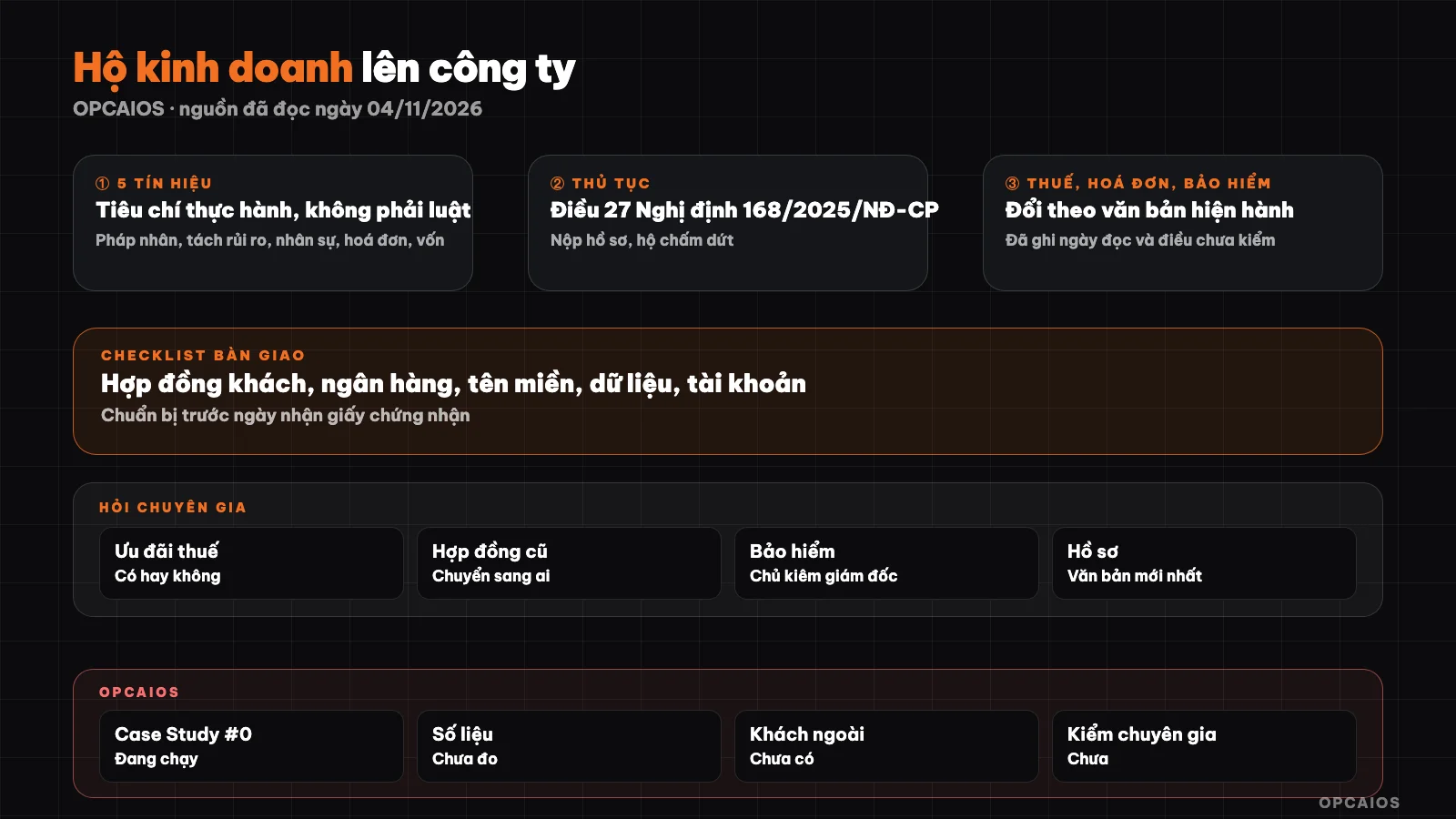
From consideration to handover: prepare before the business receives its certificate. Diagram: OPCAIOS.
When should you transfer a business household to a company?
Transfer when the practical reason to have a separate legal entity outweighs the increased costs and paperwork, not to "show off". We have not read any document requiring solo workers to transfer at a fixed revenue level; the table below is practical criteria, not regulations. How to use: count how many signals are happening. Three or more, then sit with an accountant to calculate specifics; one to two, then monitor each quarter; none, then stay as a household and keep good records.
| Signal | Question to ask yourself | If "yes" |
|---|---|---|
| 1. Customers demand legal entity | Do business customers require contracts and invoices under the company name? | Ask accountant about costs and timing |
| 2. Want to separate liability | How much are personal assets separated from the business? | Ask a lawyer, don't guess |
| 3. Have people working together | Hiring someone or having a long-term partner? | Ask about employment contracts and insurance |
| 4. Revenue and invoices increase | About to hit the threshold for electronic invoices? | Calculate two scenarios |
| 5. Need to sell or receive capital | Want to receive investment, sign major contracts, sell the business? | Ask lawyer about structure |
What changes and what stays the same when you transfer?
What changes is legal status and accompanying obligations; what stays the same is daily work and who does it. Under Article 27, documents are submitted to the provincial business registration authority, and the household cannot operate from the moment the business receives its certificate. That means from that day, contracts, invoices and money must be in the company's name. Article 27 also does not say contracts, accounts or assets of the household automatically transfer to the business, so you transfer and record them yourself.
- Registration location: household at the commune-level registration authority, enterprise at the provincial business registration authority (read Article 27).
- Taxes: household under Decree 68/2026/NĐ-CP, enterprise pays enterprise income tax (via synthesis post); benefits for households that transfer are unclear.
- Customers, domain, accounts: in personal or household name, you must transfer them yourself, your responsibility.
According to the documents read, what are the steps of the conversion procedure?
Under Article 27 of Decree 168/2025/NĐ-CP (issued 30/06/2025, effective 01/07/2025), the procedure has four steps. First, submit documents at the provincial business registration authority where the head office will be located. Second, documents include a copy of the business household registration certificate and papers under Article 24 by enterprise type (no copy of investment registration certificate needed); a single-member limited company does not need a member list, and if you provide personal ID number you don't need copies of legal papers. Third, within 2 business days from the date of issuing the certificate, the province sends information to the commune; the commune reports to the tax authority and changes the household status to "undergoing termination procedures". Fourth, when the tax authority reports that the household has finished tax obligations, within 3 business days the commune changes the household status to "has terminated operations".
Limitations: we read Article 24, Article 27 from hethongphapluat.com because vbpl.vn blocks automatic access. Decree 296/2026/NĐ-CP dated 23/07/2026 amends Decree 168; we could not verify whether Article 27 was amended. Processing time and fees also remain unverified.
Taxes, Invoices and Insurance: How Do They Change When Converting?
Three things worth asking an accountant about, and I'm not entirely sure about all of them. Our business household currently falls under Decree 68/2026/NĐ-CP (effective 05/03/2026), filing based on revenue instead of fixed tax; enterprises pay corporate income tax. On incentives, two sources sound different: according to LuatVietnam's citation, Article 15 Section 4 of the Corporate Income Tax Law 67/2025/QH15 exempts tax for 2 consecutive years from when the newly established enterprise from a business household has taxable income; while Article 7 Section 3 of Decree 20/2026/NĐ-CP (issued 15/01/2026) exempts 3 years for small and medium enterprises registering for the first time but excludes enterprises newly established through conversion of business form. I haven't found a document clearly stating which incentive an upgraded household can enjoy, so I'm not promising any benefit.
On invoices, according to the Economic-Finance Magazine citing Decree 68/2026, a household with VAT-taxable revenue of 1 billion đồng/year or more must use electronic invoices with codes or from cash registers; the regulations for enterprises like us I haven't read yet. On insurance, summaries of Social Insurance Law 41/2024/QH15 state that from 01/07/2025 business managers, including owner-directors not receiving salary, may fall under mandatory contribution; I haven't cross-checked the original document.
What Does a Handover Checklist Look Like When Converting a Business Household to a Company?
A handover checklist is a list of everything currently in your name or the household's name that the company needs to take over; it should be completed before the certificate of registration day since the household cannot operate from that day onwards. This is a template we drafted, not an official state form. Copy it, add on each line who it's under, who it's transferring to, deadline, and cross off each line when done.
HANDOVER CHECKLIST BUSINESS HOUSEHOLD -> COMPANY

A. Contracts and Customers
List customers with current contracts, including expiration dates
Long-term contracts: agree on amendment to change service provider
Notify customers of company name, tax ID, new payment account
Finalize accounts receivable and final invoices of the household, separate from the company's opening invoices
Change contract templates, quotes, terms to company name

B. Bank Accounts
Open company account with exact name on certificate of registration
List all accounts currently receiving household business payments
Ask accountant about notifying the tax authority of accounts
After receiving certificate of registration: do not receive new payments into old accounts
Update QR codes, transfer content, payment pages

C. Domain Names, Website, Email
Who is registered as domain owner; procedure to change owner with registrar
Domain admin email: not a mailbox only you know
Renewal: payment card, invoice under whose name; record DNS records

D. Data
Customer list, orders, project files: storage location, who has access
Full backup before transfer date
Remove permissions of people no longer working

E. Service Accounts and Software
List paid services (software, storage, advertising, payment gateways)
Each service: change invoice information to company or create new account
Enable two-factor authentication, save recovery codes; check admin for social media, maps, app stores

F. Taxes, Records, Employees
Keep household books, invoices, documents for time period accountant specifies
Ask accountant: household tax settlement, remaining obligations
Have staff: ask about labor contracts and insurance
Assets under personal name (equipment, trademarks): consult expert before transferring
Section D is almost done if you've already backed up 3-2-1.
What Are the Risks When Converting and Which Issues Should I Consult an Expert About?
The biggest risk is the gap after receiving the certificate: the household cannot operate but contracts, invoices, accounts are still under the old name. Next is wrong expectations about tax incentives; costs for records, filing, insurance may increase (haven't measured how much); old customers may not agree to sign again. See business household renting to OPC and legal checklist for business registration.
Ask an accountant or lawyer when:
- The household still has unpaid taxes, invoices or filings not completed and you're unsure what ending the household entails.
- You want to enjoy corporate income tax incentives.
- You have assets under personal name (equipment, trademarks, domain names) you want to contribute to the company.
- You're about to hire staff, or you as owner-director need to clarify insurance obligations.
- You have long-term contracts or work in regulated industries.
Related: separating personal and business money.
OPCAIOS Experience
OPCAIOS has not processed a business household conversion for anyone, has no verified case studies, and does not publish data. Table 5 signals and the checklist we prepared are based on texts we have read and have not yet been tested by external users.
Frequently Asked Questions
Once converted, can the business household still operate?
No. According to Article 27, Section 4 of Decree 168/2025/ND-CP, a business household cannot operate from the moment the enterprise receives its business registration certificate. The household transitions to "ceased operation" status after the tax authority confirms the household has fulfilled its tax obligations. Therefore, prepare contracts, invoices, and new accounts before receiving the registration certificate, and ask your accountant about any remaining tax obligations of the household.
Does an enterprise established from a business household get a corporate income tax exemption?
It cannot be confirmed yet. Law 67/2025/QH15 (Article 15, Section 4, according to the text we read) mentions a 2-year exemption for enterprises newly established from a business household; Decree 20/2026/ND-CP (Article 7, Section 3) mentions a 3-year exemption for small and medium enterprises registering for the first time but excludes cases of business form conversion. We have not found guidance that clearly states which category a household conversion falls into; ask the tax authority or your accountant.
Do contracts and existing customers automatically transfer to the company?
The section on Article 27 we read does not mention contracts or customers automatically transferring to the enterprise, so do not assume this will happen. The safer approach is to agree with each customer through an amendment or new contract in the company's name, and have a lawyer review long-term contracts. You can refer to a sample service contract for one person.
Should someone working alone just open a company instead?
There is no universal answer. Table 5 signals are practical criteria, not regulations: if customers do not yet require a legal entity, you have not hired anyone, and invoices are still simple, many people stay with a business household and maintain better records. If you have three or more signals, ask your accountant to compare the two options using your actual figures.
How long does the conversion take and how much does it cost?
We have not verified processing time and fees, so we do not provide numbers. The regulations we read only mention timelines between authorities: 2 working days for the provincial level to send information to the commune level, 3 days for the commune to update status after tax confirmation. Actual costs also include accounting, digital signatures, and invoices; ask for a quote.
Next Steps
To quickly discuss how to arrange the checklist for your situation, schedule a consultation. This is a discussion about work organization, not legal or tax advice.
Source: Article 24, Article 27 of Decree 168/2025/ND-CP (via hethongphapluat.com); Decree 296/2026/ND-CP (via KPMG Vietnam, LuatVietnam); Decree 68/2026/ND-CP (chinhphu.vn, Economic and Finance Magazine); Article 7 of Decree 20/2026/ND-CP (Can Tho Legal Portal); Law 67/2025/QH15 (cited via LuatVietnam, iHOADON); read on 04/11/2026. Not verified: original documents on vbpl.vn, whether Decree 296/2026 amended Article 27, tax incentives for business household conversion, regulations on invoices and insurance for enterprises, processing time and fees. This post is for reference only, not legal or tax advice; consult an accountant or lawyer before making a decision. The experience belongs to OPCAIOS.
Translated from Vietnamese with AI. Read the original.
Want to apply this in your business?
Book a free 30-minute call (Vietnam time, in English or Vietnamese).