


Household business and taxes for solo service and digital product sellers - what to note?
According to articles and advisory units I found on 25/10/2026, household businesses are transitioning away from fixed tax rates starting 1/1/2026 under Resolution 198/2025/QH15 and moving toward declaring based on actual revenue. Sources differ on the revenue threshold exempt from taxes (200 million, 500 million or 1 billion đồng), and I haven't read the original legal text. Therefore this article is a framework of questions and a checklist of things to prepare, not tax advice. Please confirm the figures with tax authorities or accountants before applying them.
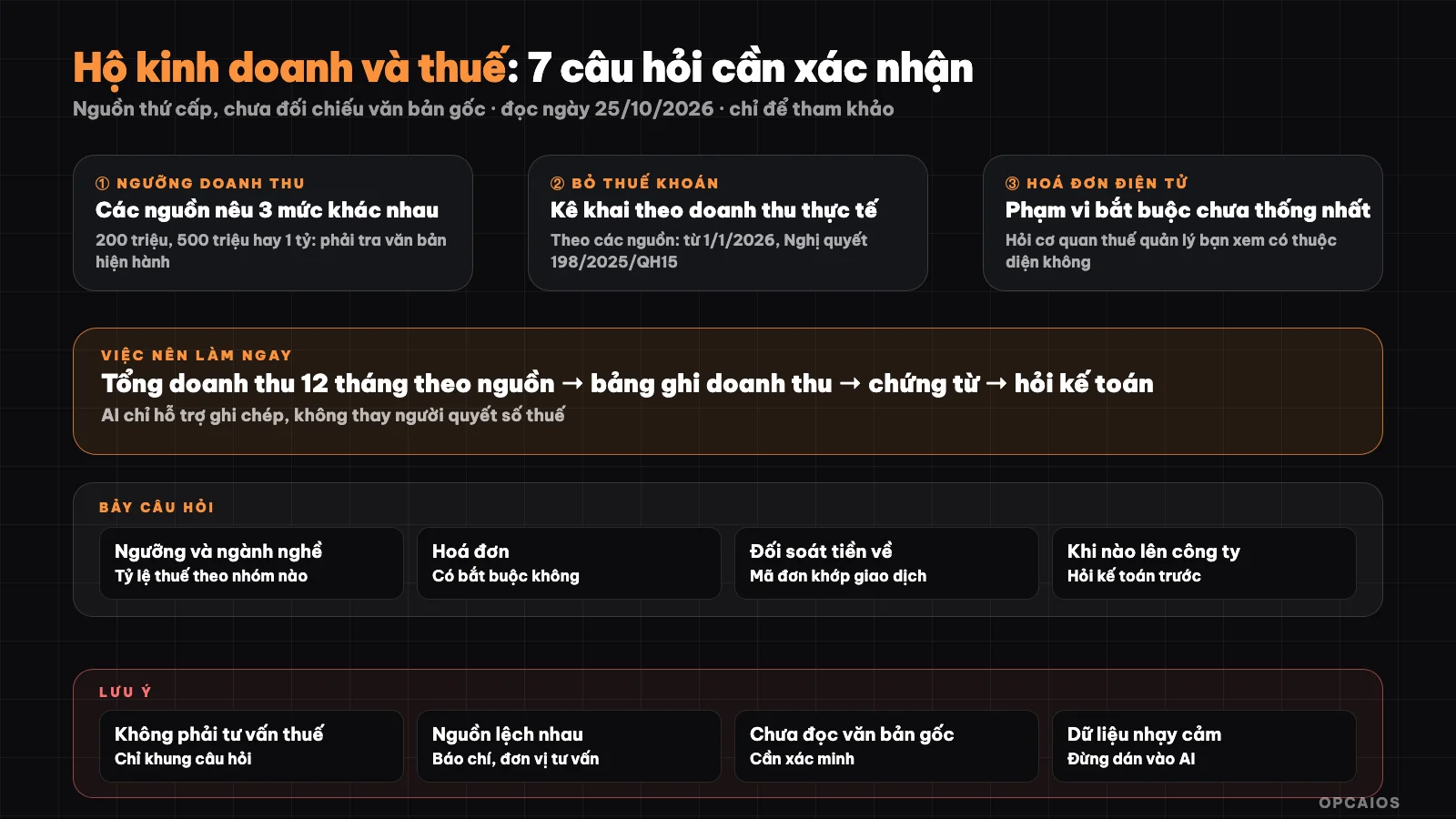
Seven questions to answer and confirm with tax authorities. Diagram: OPCAIOS.
Honest note before reading
This article synthesizes secondary information (press, accounting units, local government portals), not legal texts. Tax policy changes quickly and the sources I read contradict each other on important figures, so you should not use this article to file taxes.
What this article can do: help you know what to ask, what to keep and how to reconcile. On choosing a business structure, read more in legal checklist and business registration for solopreneurs.
Question 1: Where does my revenue sit compared to the tax-exempt threshold?
The sources I read give three different levels: 500 million, 1 billion and 200 million đồng per year. One source even has a headline stating 1 billion but the content says 500 million. I cannot choose the right level for you; please check the current text of the Personal Income Tax Law, the amended Value Added Tax Law and implementation guidelines.
What to do right away: calculate total revenue over 12 months from each source (bank transfers, cash, platforms), because whatever threshold applies is calculated on actual revenue not profit.
Question 2: Abolishing fixed tax rates means I have to do what differently?
According to secondary sources, household businesses no longer pay tax at a fixed rate but self-declare based on actual revenue. This brings a need to record revenue, keep documents and reconcile with money received in the account.
The practical consequence for solo workers is you need a place to record revenue that can be traced. For example if you sell digital products through QR code bank transfers, see collecting digital product payments via QR (SePay) about how to reconcile invoices with bank transactions.
Question 3: Do I have to use electronic invoices?
According to a local government page I read, from 1/6/2025 households and individuals in business fall under the requirement to use electronic invoices created from electronic cash registers under Decree 70/2025/NĐ-CP. An invoice provider says the mandatory threshold applies when revenue exceeds 1 billion, below which it's only encouraged.
These two sources don't agree on scope, so what to do is ask your managing tax authority: does your revenue and business sector fall under the mandatory category, and which invoice type to use.
Question 4: How is money received from customers recorded?
Each money receipt should match one order or contract, with a reference code, date and amount. If you sell via QR code, the payment reference helps automatic reconciliation; if you sell services in phases, record each payment separately.
| Task | How to keep it simple |
|---|---|
| Record revenue | One single table: date, customer, description, amount, invoice code |
| Documents | Approved contracts, quotes, transaction screenshots, invoices if any |
| Separate personal/business funds | Use a separate account for business receipts and payments if possible |
| Refunds | Record separately, with reason and supporting documents |
Question 5: What is my business sector classified as?
Tax rate and calculation method depend on business sector classification by tax authorities (services, retail, manufacturing...). Digital products, training, design or consulting may fall into different groups; I haven't read the official rate table so won't give figures.
Ask directly: "My activities include consulting, selling online courses and selling design services - which sector group do these fall under, and what rate applies?" and ask to have the answer documented in writing.
Question 6: When should I consider setting up a company?
Consider it when revenue and risks grow, when you need contracts with large enterprises, when you need to raise capital, or when you want to separate personal liability from business operations. This decision depends on taxes, accounting costs, and your plans—there is no universal threshold.
| Situation | Suggestion |
|---|---|
| Just starting, low revenue, working alone | A business household is usually enough but check with the tax authority |
| Business clients demand invoices and legal contracts | Consider a company |
| Want to hire staff, raise capital | Consider a company |
| Unsure | Consult an accountant or lawyer for one session before deciding |
Question 7: How far can I use AI for taxes?
AI helps draft revenue logs, remind you of deadlines, summarize texts you paste in, and list questions to ask your accountant. AI cannot replace a certified professional when deciding how much tax to pay, and it can make up laws or numbers.
Do not enter your tax ID, account numbers, or client files into AI services you haven't checked the terms for—see data security when using AI. For service contracts, see using AI to write contracts and sample terms.
OPCAIOS's experience
Operationally, we attach a reference code to each order on our website to match it against bank transactions, and keep order records in a backed-up database. That is the technical part supporting revenue recognition.
This post does not state OPCAIOS's tax status, legal form, or revenue, and is not an example to follow. The biggest limitation: we have not checked the original texts of the rules mentioned above. Every figure and date here needs to be verified again.
Frequently asked questions
Do business households have to pay tax if revenue is low?
It depends on the current non-taxable threshold, and the sources I read cite three different levels. Ask your tax authority.
Is selling online courses taxed differently from selling services?
It may differ in industry classification and tax rates. I have not verified the official rate table so you should ask an accountant.
Do I need a separate bank account for a business household?
I have not read the account rules in the original text; in practice, separating a business account makes reconciliation easier.
Can I use AI as an accountant?
Only to help with record-keeping and preparing questions. The numbers you declare must be checked by you or an accountant.
What should I prepare before meeting an accountant?
A 12-month revenue table, list of income sources, sample contracts, and questions about thresholds, invoices, and industry. Need help organizing the process? See AI application training services.
Sources (all secondary, searched 25/10/2026): hanoionline.vn, thuvienphapluat.vn (summary article, cannot access full text due to 403 error), sme.misa.vn, meinvoice.vn, Thanh Hoa's digital transformation page. Have not read Resolution 198/2025/QH15, Decree 70/2025/NĐ-CP, Personal Income Tax Law and VAT Law amendments in the original text; sources conflict on the 200 million / 500 million / 1 billion threshold. This post is for reference only, not tax or legal advice. The experience is OPCAIOS's.
Translated from Vietnamese with AI. Read the original.
Want to apply this in your business?
Book a free 30-minute call (Vietnam time, in English or Vietnamese).