


Service Contract for Solopreneur: 9 Base Clauses Plus 3 AI-Era Clauses
A service contract is an agreement where the service provider performs work for the service user and the service user pays for it, as defined in Article 513 of the 2015 Civil Code. This post covers 9 base clauses, 3 "AI-era" clauses, and a complete template to copy. This is a reference template; have a lawyer review it before use—it is not legal advice. The three AI-era clauses are our practice recommendations; from what we found, there are no case law or official guidelines yet on template clauses for this type of contract. We have not used this template with real clients.
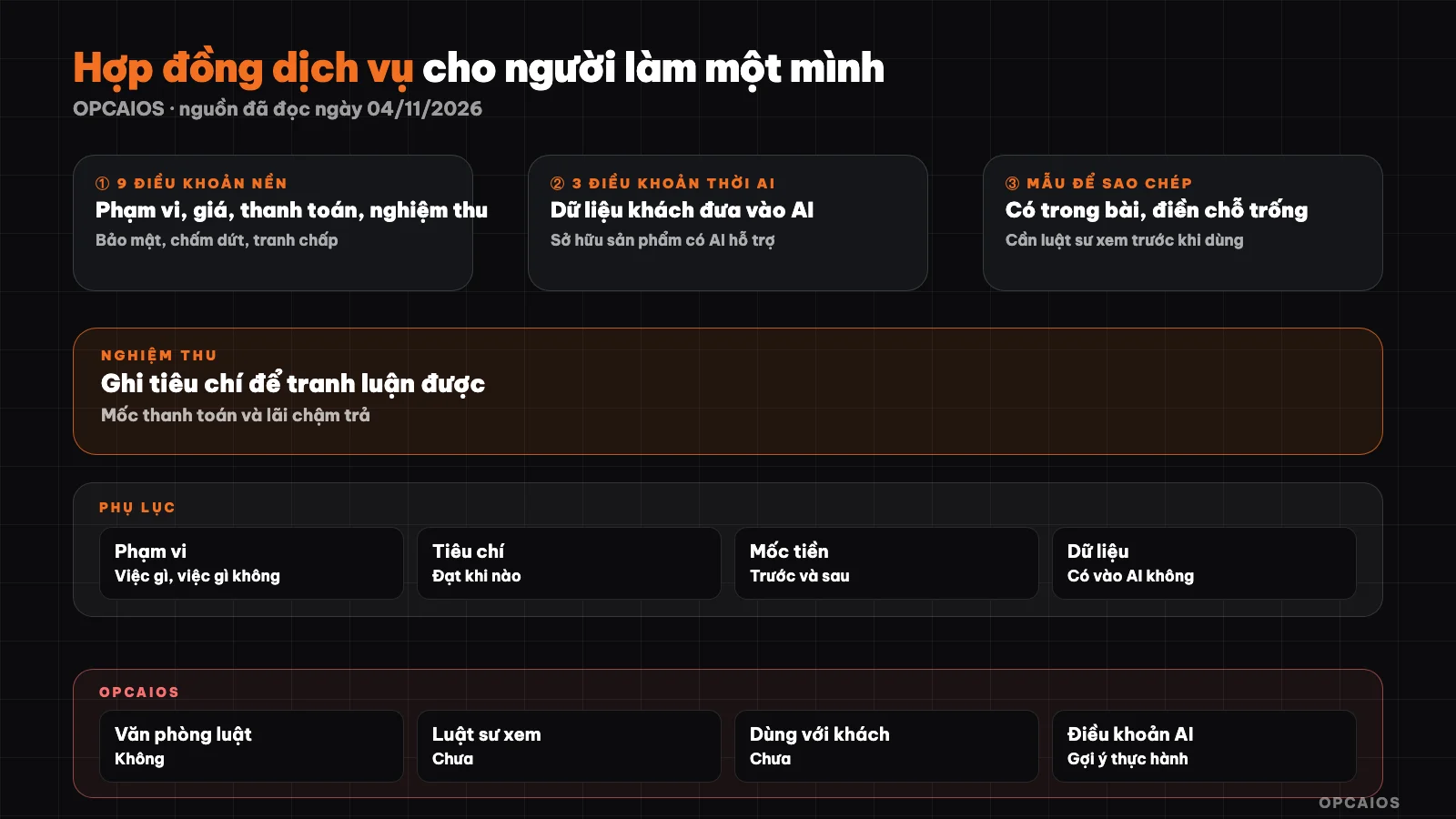
9 base clauses plus 3 AI-era clauses. Diagram: OPCAIOS.
Why does a solopreneur need a service contract?
You need one because the law provides only a few default rules, and they do not cover all your work. Under Article 519 of the Civil Code, if price is not agreed, the market price for the same type of service applies, payment due on completion. The law does not say how many revision rounds. On copyright: Article 39 of the Intellectual Property Law states that the party who enters into a contract with an author to create a work is the owner of the intellectual property rights, unless the two parties agree otherwise. If you want to keep the rights or only grant a license, you must write it down.
9 Clauses Every Service Contract Needs
Nine clauses form the minimum framework; in brackets are the laws I read (Civil Code is CC).
- Parties: name, tax ID or ID card number, signatory (Article 513 CC).
- Scope: what is included and not included in the contract (Article 514).
- Schedule, coordination: delivery milestones, information the client must provide (Articles 515, 518).
- Price, payment: installments, payment deadline, late payment interest (Articles 519, 357).
- Acceptance, revision: criteria, number of revision rounds (Articles 516, 517).
- Ownership rights: transfer or license, term (Articles 39, 45–48 Intellectual Property Law).
- Confidentiality: confidential information, duration (Article 517 paragraph 5 CC).
- Liability: penalties, damages, cap (Articles 418, 360 CC).
- Termination, dispute: notice period, venue (Articles 520, 521 CC).
Two things often missed. One: Article 46 of the Intellectual Property Law requires a copyright transfer contract to be in writing; Article 45 bans transfer of personal rights except the right to publish. Two: under Article 521 CC, if the contract term expires and you keep working and the client knows but does not object, the contract automatically continues.
3 AI-Era Clauses: Data, Ownership, Acceptance
These three clauses fill gaps left by old contracts; they are practice recommendations, not mandatory.
AI-1, Client Data Fed into AI. Record what type of data the client provides, which AI tools you may use, and that personal data does not go into tools outside that list. Legal basis: the Personal Data Protection Law 91/2025/QH15 (effective 01/01/2026) defines a processor as someone who acts at the controller's request through a contract (Article 2); Article 37 states the processor only receives data after an agreement or processing contract. Article 20 treats the use of platforms outside Vietnamese territory to process personal data collected in Vietnam as cross-border transfer; Article 38 exempts households from Articles 21, 22 (except in some cases) but does not mention Article 20. We have not read the implementing decree yet so we have not concluded; ask a lawyer.
AI-2, Ownership of AI-Assisted Products. Decree 134/2026/NĐ-CP (effective 09/04/2026) adds Article 5a to Decree 17/2023/NĐ-CP: copyright in a product using AI arises only when a human makes a significant and decisive contribution, takes responsibility for the content, and does not harm the rights of the input data. A product created entirely by AI generates no copyright. To claim rights, you must prove and truthfully disclose AI use—for example, with command history and drafts. Consequence: do not promise to "transfer all copyright" for parts AI created alone.
AI-3, Acceptance by Criteria. AI output can look right but be wrong in detail, so "client satisfaction" is not enough. Write measurable criteria into the appendix and note who checks the AI-generated part.
Scope and Acceptance Criteria: Write So Disputes Can Be Settled
Good scope includes a list of deliverables and a list of exclusions, each item with criteria answerable by yes or no. Example (hypothetical, not a real client): 4 blog posts, each 1,200 to 1,500 words, figures with source references, maximum 2 revision rounds within 7 days. Article 516 CC gives the client the right to demand work of the correct quality, quantity, and deadline as agreed, so the more specific the less argument.
Payment and Late Payment: Recording Amount, Milestones, Interest
Record the total amount, payment rate for each installment, triggering milestones and payment deadlines; there should be a first installment when signing (see installment pricing and cash flow for one-person services). Article 357 of the Civil Code allows interest calculation on late payment amounts, by agreement but not exceeding the rate in Article 468 clause 1 (20% per year). Article 418 allows agreement on penalty for breach. If both parties are merchants, the Commercial Law 36/2005/QH11 may apply, and Article 301 limits penalties to no more than 8% of the value of the breached obligation; ask a lawyer about valid penalty levels. On pricing based on results, see from selling effort to selling results.
Service Contract Template to Copy (reference template, need lawyer review before use)
Replace the [..] sections. Article 6 has two options, delete one.
SERVICE CONTRACT No. [..]/[year], dated [..], at [..]
PARTY A (service user): [name], Tax ID/ID [..], address [..], representative [..].
PARTY B (service provider): [name], Tax ID/ID [..], address [..], representative [..].

Article 1. Service. Party B performs for Party A: [description]. Acceptance criteria in Annex 1.
Article 2. Scope. Does not include: [..]. Work outside scope only done when both parties confirm in writing, with price and time.
Article 3. Schedule. Delivery milestone: [..]. Party A provides information and documents in Annex 1 within [..] days; if late, Party B's milestone shifts accordingly.
Article 4. Price, Payment. Total price [..] dong ([with/without] tax): installment 1 [..]% upon signing; installment 2 [..]% when [milestone]; final installment [..]% upon acceptance. Payment deadline: [..] days from notice, to account [..]. Late payment: interest [..]% per year, not exceeding the legal limit. [Penalty for breach [..] %, within legal limits.]
Article 5. Acceptance, Revision. Party A responds in writing within [..] business days; after [..] reminders with no response, deemed accepted. Revision maximum [..] rounds; additional rounds charged at [..].
Article 6. Intellectual Property. [Option A: when Party A pays in full, Party B assigns intellectual property rights in the delivered product, scope [..]; moral rights remain with the author.] [Option B: Party B retains rights, grants Party A use rights at [..], term [..], [exclusive/non-exclusive].] Party B's existing tools and templates remain Party B's property.
Article 7. Confidentiality. Each party keeps the other's confidential information during the contract and [..] years after, unless required by law.
Article 8. Liability. The breaching party compensates for actual, proven damages, maximum [..] dong. Force majeure exempts liability.
Article 9. Termination, Disputes. Either party may terminate if the other seriously breaches and fails to remedy within [..] days of notice. Party A may terminate for other reasons by giving [..] days notice and paying for completed work. Disputes: negotiation [..] days, then [Court/arbitration] at [..].
Article 10. Data and AI Tools. Party B only inputs Party A's data into the following AI tools: [list], does not input personal or confidential data into other tools. For personal data, Party A determines purpose and means; Party B only processes per Party A's request. Party A acknowledges the tools may process data abroad: [yes/no]. Party B reports data leaks within [..] hours and deletes or returns data within [..] days after termination.
Article 11. AI-Assisted Products. Party B discloses AI tools and processing steps in Annex 2, is responsible for checking, editing, and deciding final output. AI-generated portions lacking human creative contribution may not generate copyright; Party B only transfers or licenses rights Party B holds. Party B keeps command history and drafts [..] months.
Article 12. Acceptance by Criteria. Based on measurable criteria in Annex 1, not based on hours worked or times AI was used. Party B cross-checks all sources, citations, proper names generated by AI before delivery.

Annex 1: items, acceptance criteria, information Party A provides. Annex 2: AI tools, processing steps used.
Signature: PARTY A [..]      PARTY B [..]
When to Ask a Lawyer
Ask before signing if: contract value is large relative to your annual income; the client is a state agency or foreign entity; you handle large or sensitive amounts of personal data; the client demands exclusivity; or you are unsure whether you are signing as an individual or business operator.
OPCAIOS Experience
OPCAIOS is not a law firm. We have not had a lawyer review this template and have not used it with real clients, so we have no data on whether the template helps prevent disputes. The AI clauses are how we understand them after reading the laws cited, and may be wrong.
Frequently Asked Questions
Is a service contract required to be in writing?
We haven't reviewed the legal provisions on contract form, so I can't say for certain. One point I've read: copyright assignment contracts must be in writing. Written documents are still the best evidence in case of disputes.
Can this template be used by freelancers who haven't registered a business?
You can use it as a content framework. Whether you sign as an individual or as a business household, and what taxes apply, are separate questions. See legal checklist for business registration for solopreneurs and ask an accountant or lawyer.
Should I completely ban using AI in the contract?
Not necessarily. Many clients just need to know what you're using and where their data goes; Articles 10 and 11 in the template follow that direction. If a client bans it outright, add it to the contract and comply. See also 5 data security rules when using AI.
Does a product made with AI get copyright protection?
According to Article 5a mentioned above, only when a person makes significant, decisive contributions and meets the other conditions; a product created entirely by AI does not. Whether a specific product meets that threshold has no precedent to reference yet.
What if a client is late on payment?
Follow what's written in the clause: remind them in writing, charge late fees, hold the final deliverable if the contract allows. Keep acceptance records (see client portal for freelancers), because Article 519 of the Civil Code lets clients reduce payment if the service doesn't meet the agreement.
Next Steps
Copy the template in this post, fill in the [...] with your actual details, then have a lawyer review it before sending it to clients.
Sources: Civil Code 91/2015/QH13 (Articles 357, 360, 418, 468, 513 to 521; summary page, not yet cross-checked with original); Consolidated Intellectual Property Law 160/2026/VBHN-LQ-VPQH (Articles 39, 45 to 48) and Decree 17/2023/NĐ-CP including Article 5a added by Decree 134/2026/NĐ-CP (chinhphu.vn, read 04/11/2026); Personal Data Protection Law 91/2025/QH15 (Articles 2, 20, 37, 38) and Commerce Law 36/2005/QH11 (Article 301), via summary pages, amendments not yet checked. Not yet read: Decree 356/2025/NĐ-CP, artificial intelligence law, contract form provisions. This post is for reference only, not legal or tax advice; ask an accountant or lawyer before deciding. The experience is OPCAIOS's.
Translated from Vietnamese with AI. Read the original.
Want to apply this in your business?
Book a free 30-minute call (Vietnam time, in English or Vietnamese).