



Case study "increase income 5 times" from freelancer to automatic OPC owner looks like what, and is it trustworthy? I need to say this right away: this post does not tell a verified true story. OPCAIOS has no customer records or income figures for anyone who increased by exactly 5 times to publish, and we refuse to make up a character for the sake of it. Instead, the post presents an illustrative model with assumed numbers, clearly marked as assumptions, so you can see the math behind income growth when switching from selling hours to selling products and systems; plus a roadmap, the checkpoints to measure, and how to verify yourself whether income actually increased. If you see a "5 times" case study with no data source stated, that expectation should be questioned.
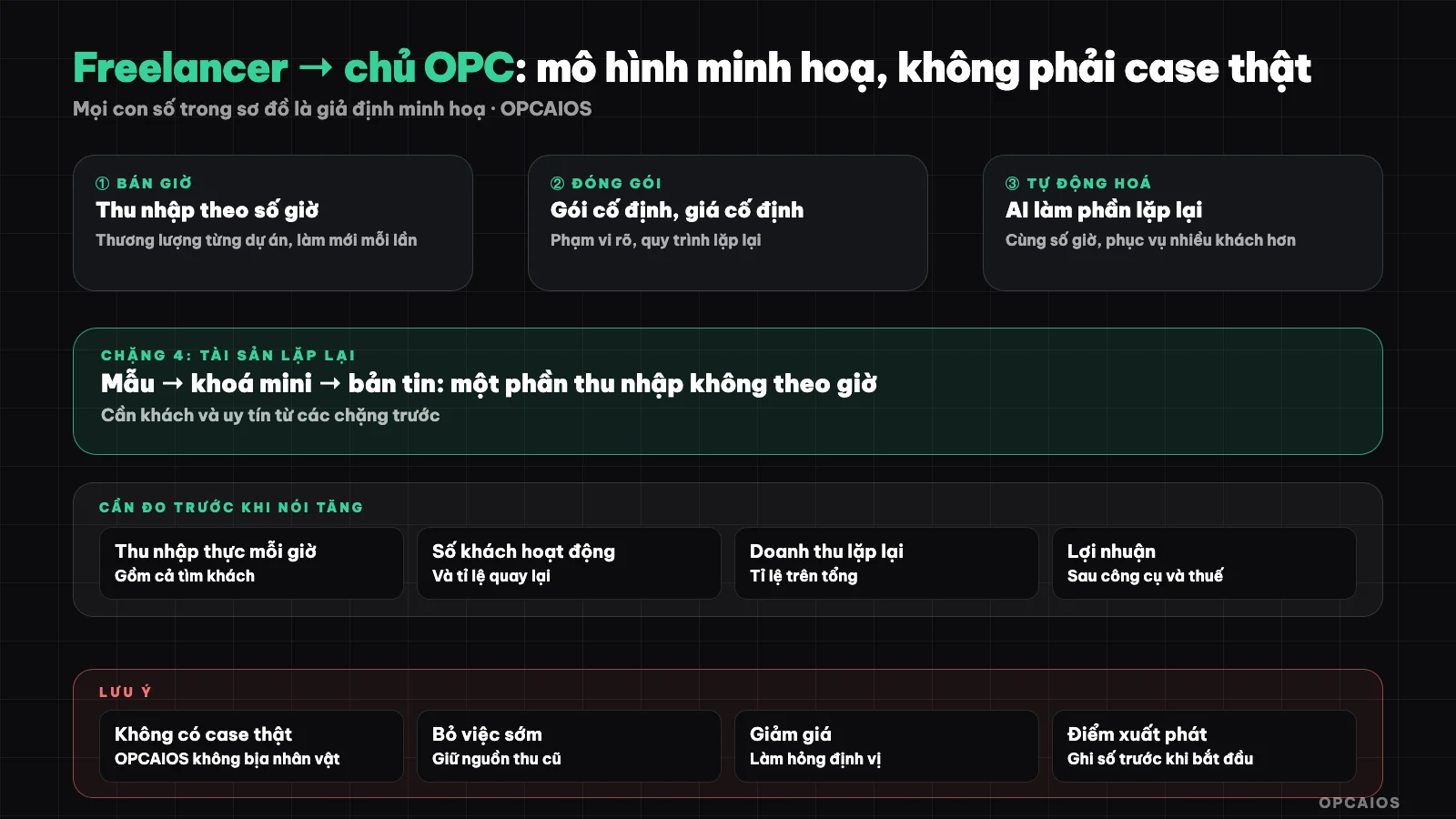
Four stages from selling hours to repeat product; all numbers in this post are illustrative assumptions. Diagram: OPCAIOS.
Why there is no "true 5 times case study," and what public data says
OPCAIOS has no true 5 times case study for four reasons. First, no customer agrees to publish income before and after. Second, personal income is sensitive data, so publication needs clear consent. Third, many "case studies" online are retold, rounded or made up to sell a course. Fourth, the 5 times factor depends on the starting point: growing from 10 million to 50 million is different from growing from 50 million to 250 million.
On the big picture, the State of Independence 2025 report from MBO Partners (read on 25/10/2026) says over 72 million Americans work independently, and 5.6 million in the independent expert group earn over 100,000 USD per year, up 19% from 2024 and 86% from 2020. This is a survey self-published by a company that provides services to independent workers; the page we read did not state sample size, and the figures are for the US market. This data only shows a high-income group exists, it does not prove any roadmap that increases 5 times.
Illustrative model (assumed numbers)
Suppose a freelance designer earns 12 million dong each month, working around 140 hours. This is not a real person.
| Stage | How to sell | Assumed monthly income | What changed |
|---|---|---|---|
| 0. Sell hours | Take jobs by project, by hour | 12 million | Income scales with hours |
| 1. Package | One fixed package, fixed price, fixed time | 18 million | Less negotiation, faster |
| 2. Automate | Templates, processes, AI does repeat work | 30 million | Same hours, more clients |
| 3. Repeat product | Templates, mini course, small subscription | 45 to 60 million | Part of income does not scale with hours |
This math shows 5 times only happens when price, productivity and repeat product all grow together, and it takes time, real customers. We do not claim anyone achieves it on this roadmap.
Four Stages of Transformation
Stage 1: Know What You Sell and To Whom
Knowing what you sell and to whom is the first step of the entire journey, because without clear positioning, packaging or automation will go off track. Write down 3 types of work you do best, which clients pay the best, and which work you hate. For example, a design freelancer might realize their clients are small shops that pay on time and request few revisions, while another group of clients pays low but demands much. Next, gradually drop the group of clients who pay low and demand much. Finally, record your actual hourly income right now as your starting point.
Stage 2: Package Your Service
Packaging your service means turning "made to order" into a package with fixed scope, timeline, price, and repeatable process (What is Productized Service?). Price based on results instead of hours. Example scenario: group work into one brand identity design package at fixed price (stage 1 in the table above). The approach has three steps. First, list the most repeated work from past projects. Next, clearly define what's included and not included, number of revisions, and delivery time. Finally, try selling that package to 1 or 2 existing clients before announcing it widely. These are illustrative numbers, not verified results from real people.
Stage 3: Automate the Repetitive Parts
Automating the repetitive parts means using AI and tools for research, drafting, reporting, and client care (AI system running on its own, n8n on VPS). The goal is to reduce hours per client, not drop quality. The order to do it: first, record each step of a project and measure minutes per step. Next, pick the step that takes the most time but requires little judgment, like drafting an initial version or sending a report. Finally, automate just that step and keep a person reviewing before delivering to the client. Only automate processes that already run well by hand.
Stage 4: Create Repeatable Assets
Repeatable assets are products sold many times with low marginal cost, like templates, tool kits, mini courses, or newsletters (7-Day Mini Course). This is income that doesn't grow linearly with hours, but needs existing clients and reputation from the earlier stages. Example: design templates sold to existing clients and followers, or a mini course recorded once then sold again. Sell it first to a few clients to check demand, then invest in making it. There's no guarantee anyone reaches this level, and the numbers only illustrate the calculation.
What Numbers Should You Measure to Know There's Real Progress?
To know income is really growing, a freelancer needs to measure 5 metrics over 90 days, recording them monthly in a spreadsheet. Example scenario: a freelancer takes in 12 million dong each month after 140 actual income hours, roughly 86 thousand dong per hour; if after stage 2 that becomes 130 thousand dong per hour, that's progress, but if revenue goes up and hours go up too, it's not. First, set the baseline from the past 3 months. Next, record the new number each month. Finally, compare after 90 days and only conclude when the number increases in at least two consecutive months.
| Metric | How to calculate |
|---|---|
| Actual hourly income | Revenue minus expenses, divided by actual hours worked (including finding clients, meetings, revisions) |
| Number of active clients | And rate of returning clients |
| Portion of repeatable revenue | Percentage of revenue not from new work |
| Time to deliver one package | Does it decrease over time |
| Profit after tool costs, taxes | Not just revenue |
Record the numbers before you start; without a starting point you can't prove "multiplied."
What Traps Make the Journey Fail?
There are 5 common traps on the path from freelancer to OPC owner, and each trap has its own way to avoid. See more 5 mistakes building OPC.
- Quit too soon: keep the old source of income until the new source is stable for many months, example scenario at least 3 consecutive months hitting targets.
- Lower price to get clients: this ruins positioning, because clients used to low price will struggle to accept higher price.
- Automate without a process: automating a messy process just makes it messy faster.
- Build product before you have clients: sell to 1 or 2 existing clients first, then invest in making it.
- Compare with others: other people might have ready-made audiences or luck, so comparing with your own measurements is more reliable.
OPCAIOS Experience
We do not have figures to assert any roadmap that increases income fivefold. What we have done: package services into clear categories, automate operational work with tools, and make the process public. Those steps help make work repeatable, but we do not publish income and do not treat it as evidence for a specific increase level.
Frequently Asked Questions
Is a fivefold income increase realistic?
A fivefold increase can happen in some cases, but it depends on starting point, market, and time; there is no guarantee. Public data only shows a high-income group exists: according to MBO Partners' State of Independence 2025 report (read 25/10/2026), 5.6 million independent workers in the US earn over $100,000 per year, up 19% from 2024. That is a self-reported survey by a company in the industry, not stating the increase of each individual. For example, someone increasing from 10 million to 50 million đồng per month has already achieved fivefold, while someone earning 50 million needs 250 million đồng per month to reach the same ratio. So set absolute goals in money, hours, and number of clients, not just in multiples.
Is the model in the article a real person?
No; it is assumed figures to illustrate the calculation.
Should I quit freelancing right away?
No; transition gradually and keep the old income source until the new one is stable.
How long does the transition take?
We do not have common figures; usually several months and it depends on the person.
Where do I start?
Start by measuring your current real income per hour, because without a starting point you cannot prove an increase. First, record revenue, expenses, and actual hours worked from the last 3 months, including time finding clients and revising work. Next, pick one service you repeat most and package it into a fixed-price package. Last, track 90 days using the measurement table in the article. Assumed example: a freelancer receiving 12 million đồng per month after 140 hours calculates to about 86 thousand đồng per hour income, a baseline to compare later. See OPCAIOS's AI application training course if you need guidance.
Source: MBO Partners, State of Independence 2025 (mbopartners.com, read 25/10/2026; self-reported survey, US figures); illustration model built by OPCAIOS, assumed figures, not data from real people; no verified case study. Experience is OPCAIOS's.
Translated from Vietnamese with AI. Read the original.
Want to apply this in your business?
Book a free 30-minute call (Vietnam time, in English or Vietnamese).