


Affiliate marketing B2B/SaaS software means you introduce a software to businesses using your own tracking link; when someone clicks your link and signs up or pays according to the terms, the provider pays you a commission. The title mentions "$1,000 first", but that is not guaranteed: many affiliates earn nothing, and every calculation in this post is an assumption for you to estimate yourself. Program terms cited in the post were read on 25/10/2026.
The post explains 6 parts: (1) how SaaS affiliate programs work, with HubSpot and Notion examples, including recurring or one-time commission, cookies, and payments; (2) how to choose a niche and a product you actually use; (3) how to write helpful content with AI support; (4) the obligation to disclose affiliate relationships; (5) how to measure using tracking links; (6) the risks. OPCAIOS has an internal partner program but has not yet sold B2B SaaS affiliates, so the post does not mention any achievements in this area.
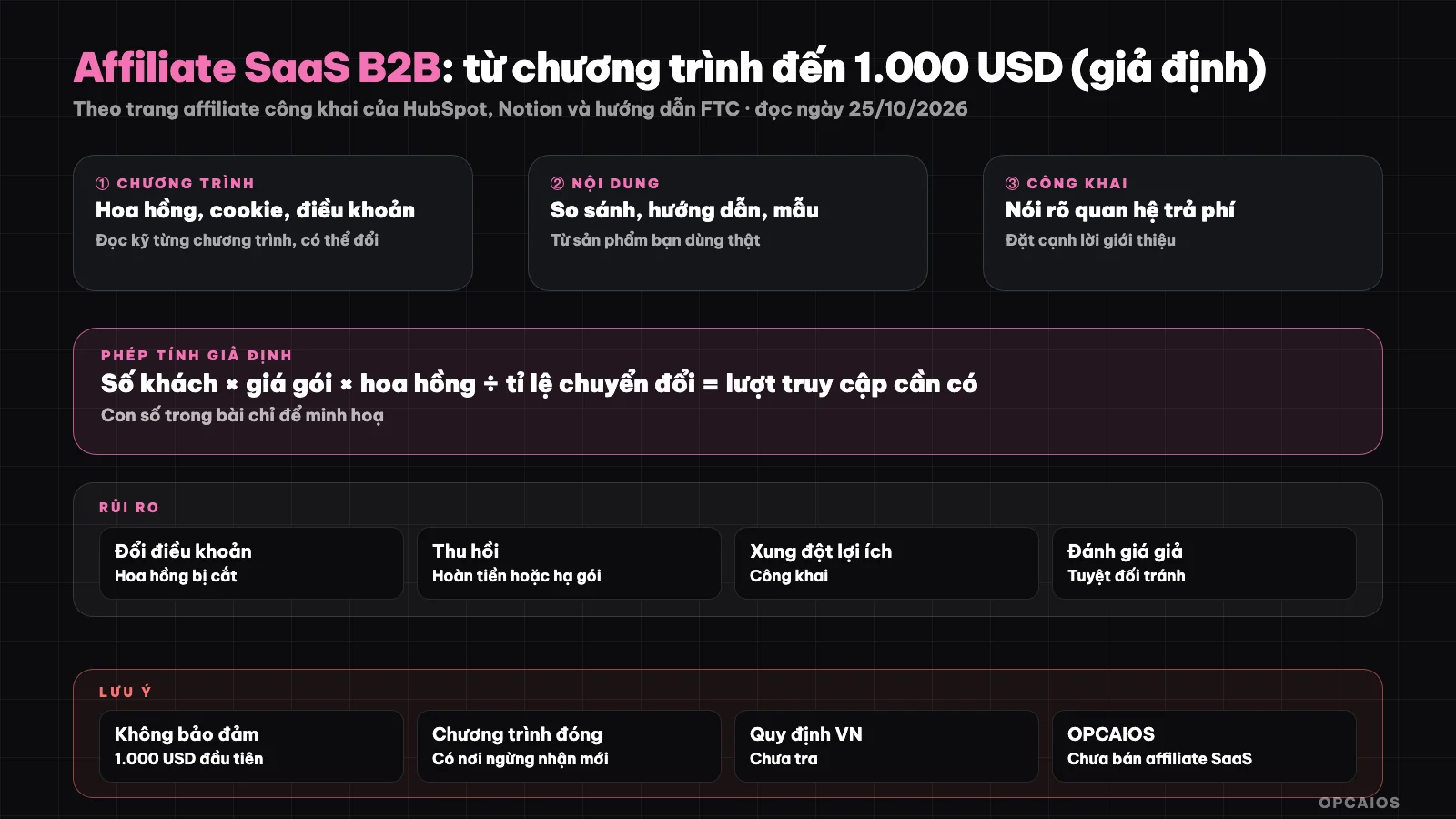
From choosing a product to measuring results, there is a disclosure step in the middle. Diagram: OPCAIOS.
How do SaaS affiliate programs work?
A SaaS affiliate program is a set of rules each provider sets for their promoters, and there are 4 points you must read carefully before writing a single line of content. Point 1 is the type of commission: one-time per customer, a percentage of first-year revenue, or recurring monthly. Point 2 is the cookie or recognition period, meaning how long after a customer clicks your link you still get credit. Point 3 is payment through which platform, minimum threshold, and how often you get paid. Point 4 is the terms: whether commissions are clawed back if the customer refunds or downgrades, whether self-promotion or paid keyword advertising is banned.
How do HubSpot and Notion pay affiliates differently?
According to the official affiliate pages of HubSpot and Notion (read on 25/10/2026), the two programs use two different models. First, HubSpot at Starter tier pays 30% recurring for up to one year, tracked for 180 days, minimum withdrawal of $10 via bank transfer or PayPal. Next, Notion pays up to $50 per activation, plus 20% of first-year revenue from each referral, tracked via PartnerStack, and currently does not accept new affiliates. Terms may have changed when you read this post, so check again.
Finally, from these two examples, you draw one important fact (1): a program can close to new members. Notion also tracks by last click, bans self-promotion, and may claw back if the customer refunds or downgrades to the free tier within 2 months. OPCAIOS could not access pages of other providers, for example a large SEO tool, so does not provide their numbers.
Comparison table of HubSpot and Notion
| HubSpot (affiliate page) | Notion (affiliate page) | |
|---|---|---|
| Commission | Starter tier: 30% recurring for up to one year; higher tiers have separate conditions | Up to $50 per activation, plus 20% of first-year revenue per referral; page does not say whether 20% is one-time or recurring |
| Recognition period | 180 days | Page does not state cookie period; customer must upgrade to paid plan within 180 days of clicking |
| Payment | Direct bank transfer or PayPal, minimum $10 to withdraw | Tracked via PartnerStack; page does not describe schedule or method |
| Key obligations | Need steady signup numbers over three months to tier up | Currently does not accept new affiliates; tracks by last click; bans self-promotion; may claw back if customer refunds or downgrades to free tier within 2 months; requires disclosure of paid relationship |
How do you calculate the assumption for $1,000?
The assumption calculation is a way to estimate how many customers you need to reach $1,000 in commission, using numbers you plug in yourself. Let's say software costs $40 per month, with an assumed 30% recurring commission over 12 months. First, each customer retained for the full 12 months gives you roughly 40 × 30% × 12 = $144. Next, to reach $1,000 you need around 7 customers retained for the full year. Then, if out of every 100 people clicking the link, 3 pay (this ratio is an assumption), 7 customers need roughly 230 quality clicks.
Finally, money comes in gradually month by month, not all at once; customers leave early or request refunds, so commission drops or gets clawed back. The calculation is only useful because it shows you the variables you need to measure: clicks, signup rate, retention rate, time from click to payment. If a program pays a higher one-time amount, the math changes entirely, like Notion's $50 per activation. Plug your chosen program's numbers into Google Sheets, don't use the numbers from this post.
How do you pick a niche and affiliate product?
A good affiliate niche is a tight group of readers with clear pain points, matched with software you've actually used. There are 5 principles. Principle 1: pick your readers first, software second; for example, small business owners who need customer management, or freelance accountants who need invoicing tools. Principle 2: only recommend what you've actually used, because you can write details the provider's description doesn't have, like which steps are confusing, what errors you hit, how long things take. Principle 3: check the terms first, including whether the program still accepts new members, like the Notion example.
Principle 4: prioritize products with a free trial or free tier, so readers can try before paying. Principle 5: don't bet everything on one provider, because commission can change anytime. For instance, if you write 10 posts about HubSpot and the program closes to new members, your whole plan stops. Write down the date you read the terms in Google Sheets, like 25/10/2026, so you know which terms have gone stale after 30 or 90 days.
What kind of content is useful when written with AI but based on real experience?
Content based on real experience is content you install yourself, use yourself, take screenshots of, and tell straight what works and what doesn't. Common types are comparisons of two or three tools for a specific situation, step-by-step guides for doing something, templates and checklists to go with them, and "how I set it up" posts. AI like Claude helps with outlining, first drafts, summarizing official documentation, building comparison tables, catching typos, and translating.
AI cannot replace the core part. Content written entirely by AI about a product you haven't used is fake review, both easy to get wrong and potentially breaking advertising rules. The process of turning existing content into many formats is at turn YouTube videos into 10 blog posts; how to pick a cheap niche is at 7 low-budget OPC business ideas.
How do you disclose affiliate relationships correctly?
Disclosing affiliate relationships means saying clearly you earn commission when you recommend a product, not optional. Per FTC (US) guidance for influencers, read on 25/10/2026, you must disclose "material relationships", including financial ones, and place the notice right next to the recommendation where it's hard to miss. Don't hide it on an about page, at the end of the post, or behind a "read more" button, and use plain language like "ad" or "sponsored". The OPCAIOS site doesn't specifically mention affiliate links so I won't confirm anything beyond general principles; the Notion program does require you to disclose paid relationships.
OPCAIOS has not verified ASA (UK) guidance and current advertising rules in Vietnam, so I won't quote specific terms; read the official text yourself or ask a lawyer (information only, not legal advice). Safe practice: put a clear line at the top like "This post has affiliate links: I earn commission if you sign up through this link", repeat it near each important link, and be honest about the product's weaknesses.
SEO/GEO and email
- SEO: target the real questions buyers actually type ("How are A and B different for a group of 5 people"), not generic keywords. See What are SEO and GEO.
- GEO: write clear definitions, comparison tables, a "not for whom" section so AI answer tools can pull citations.
- Email: gather readers into a list with consent (free template, checklist), then send a sequence of genuinely helpful guides, each email disclosing the relationship. See What is email marketing. Don't buy lists, don't send bulk to people who haven't agreed.
Measure with tracking links
Each post, each email, each channel uses its own link to know which source brings customers. You can use the affiliate program's own tracking parameters or a shortening tool with stats. OPCAIOS has a shortening system with stats in our admin tool; you don't have to use it, any shortening tool with stats works, as long as the final link is the correct affiliate link you were given. Minimum tracking table: date, source, clicks, sign-ups (from provider dashboard), approved commission, reversed commission. The deciding metric is approved commission, not clicks.
Risks to state plainly
| Risk | How to reduce |
|---|---|
| Provider changes terms or cuts commission | Don't depend on one program; save screenshots of terms with the date you read them |
| Commission reversed when customer refunds or downgrades | Count "approved commission", not pending commission |
| Program stops taking new affiliates | Check status before you write a whole series |
| Conflict of interest makes you over-praise | Disclose, mention weaknesses, write "not for whom" |
| Breaking terms (self-referral, brand keyword ads) | Read the terms; getting blocked means losing pending payouts too |
| Fake reviews, spam, wrong information | Don't do it; only write what you've tried |
| Low or zero income for many months | Treat this as an experiment with a fixed time budget |
OPCAIOS's experience
We have an internal affiliate program for our own products, but haven't sold B2B SaaS affiliates and have no commission numbers to share. What we actually have: a shortening system with stats, internal SEO/GEO tools, and an email sequence to measure customer source; this post is how to use them, not a story we've run. See also AI tools kit for the OPC model and 5 mistakes when building OPC.
Frequently Asked Questions
Am I guaranteed to make $1,000 in my first month?
No. The calculations in the article are assumptions; your results depend on your niche, content quality, program terms, and how long you stick with it.
Should I choose recurring commission or one-time commission?
Recurring commission works better when customers stay longer, while one-time commission works better when customers leave early. According to HubSpot's affiliate page (read 25/10/2026), the Starter tier pays 30% recurring for up to one year, while Notion pays up to $50 per activation plus 20% of first-year revenue. Read the terms carefully about the recurring period, clawbacks when refunds happen, and withdrawal thresholds—for example, HubSpot requires a minimum of $10. Example calculation: a $40/month product with 30% recurring for 12 months gives around $144 per customer who stays the full year, but only around $12 if they leave after 1 month. When calculating, use approved commission instead of pending commission, and try both scenarios in Google Sheets with 10 customers, 20 customers, and 50 customers to see which model fits your niche. If a program closes to new affiliates like Notion did as of the read date, choose another provider.
Do I have to disclose my affiliate links?
According to FTC guidelines we've read, you need to disclose the financial relationship prominently and clearly; Notion's terms also require this. We haven't verified regulations in Vietnam and ASA, so please read the official texts yourself.
Is it okay to use AI to write affiliate posts?
Using AI to draft and review is fine, but your content must be based on you actually using the product. Fake AI reviews harm your readers and hurt you.
I'm just starting out, what should I learn first?
Learn in 3 steps. First, pick a narrow niche and one software you've actually used. Next, read the affiliate program terms carefully and record the read date in Google Sheets. Finally, write a guide based on real experience, disclose your affiliate relationship, and measure using a unique tracking link. If you need hands-on guidance on content, email, and measurement, check out OPCAIOS's AI application training course.
Sources: HubSpot and Notion affiliate pages, FTC's public guidance for influencers (read 25/10/2026); unverified: Semrush affiliate page (couldn't access), ASA guidance, Vietnam advertising regulations, all conversion rates and earnings (assumptions only); experience is OPCAIOS's.
Translated from Vietnamese with AI. Read the original.
Want to apply this in your business?
Book a free 30-minute call (Vietnam time, in English or Vietnamese).