



What is a Low-Capital, High-Margin OPC Business Idea?
It's a model where one person can start with a small amount of capital because the main product is expertise, time, and software. AI helps reduce delivery time for each job, so margins (what's left after direct costs) can be high. Two honest caveats: this post doesn't give any specific revenue or margin numbers because there's no reliable common data, and "high margins" only work when you sell at a price matching the value, not the hours worked. A hypothetical example: an automation operations expert selling automation services via n8n by project price instead of $20 per hour will have higher margins because Claude cuts delivery from 10 hours down to 4. Below are seven ideas with a scoring checklist; first score the criteria, then pick an idea.
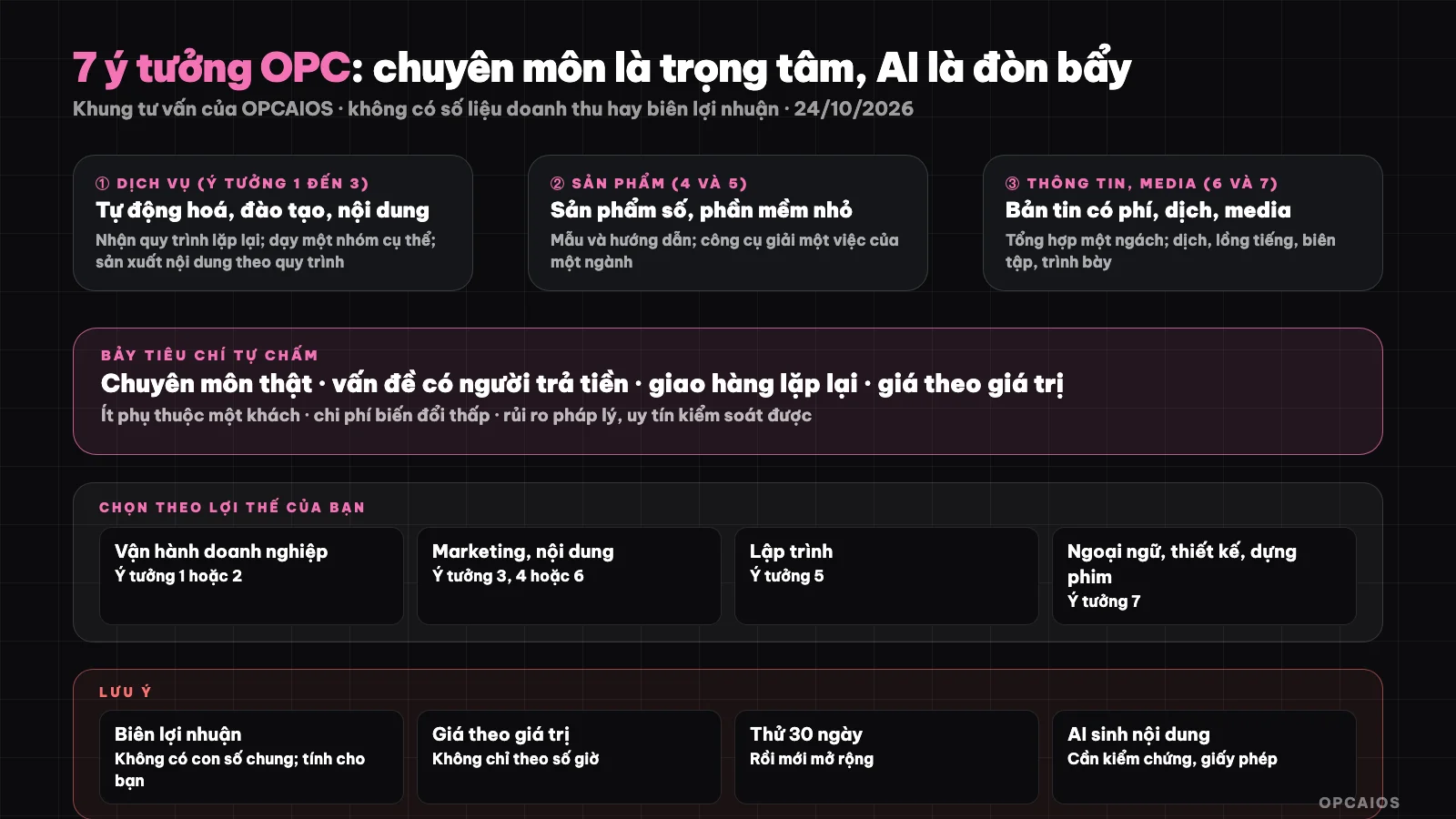
Seven directions for a one-person company: expertise as the core, AI as the lever. Diagram: OPCAIOS.
What Criteria to Score an OPC Idea?
The criteria are seven questions to help an OPC owner score an idea before spending time on it. The more "yes" answers an idea gets, the more worth trying. A hypothetical example: an idea scores 5 out of 7 criteria, missing proof that customers pay and a repeatable process, so you should try selling to 3 customers in 30 days before investing in tools like n8n or Claude from Anthropic.
- You have real expertise or advantage that you've proven (customers, products, results).
- The problem has someone willing to pay, verified through real conversations.
- Delivery is repeatable, with a process where AI can help.
- Price by value, not just by hours.
- Low dependence on one customer or one platform.
- Low variable costs: costs little when adding one more customer.
- Legal risk, reputation risk you can manage: especially for health, finance, legal fields.
Seven Ideas
The first group is three expertise-based services.
1. Service: Building automation systems for small businesses. Identify a repeating process of your client (receiving requests, quoting, reporting), build it using tools like n8n or Make. AI helps: survey the process, draft documents, write scripts, test. Risks: projects drag on because clients haven't clarified their process; maintenance after handover. First step: pick an industry you understand, build a sample process for yourself.
2. Training: AI applications for individuals and businesses. Teach a specific group how to use AI in their work. AI helps: write lesson plans, exercises, sample scenarios. Risks: content becomes outdated fast; competition with free content. First step: run a small training session with a group of friends you know, gather feedback.
3. Service: Content production for freelancers or small agencies. Take on multi-channel content production following a fixed process (see One-Person Marketing Department). AI helps: draft content, convert formats; you control the tone. Risks: generic content, depends on social platform changes. First step: try it with one client on a small scope.
Ideas 4 and 5: what are digital products and small software?
Digital products and small software are two ways to package expertise into repeatable sellable items, so they need distribution channels rather than more hours of work.
4. Digital products: templates, prompt bundles, guidebooks. Sell templates and guides to solve a specific problem. AI helps: draft, experiment, create illustrations. Risks: easy to copy, needs distribution channel; AI content needs verification. First step: make a free product to build an interest list first.
5. Small software solving a problem for one industry. A small tool that does one thing well (see What is Vibe code? and What is Vercel?). AI helps: write code, test, write documentation. Risks: customer support, security, maintenance; AI-generated code needs review. First step: build a prototype for a real client.
Example: a quote template bundle at $15 needs about 200 buyers to make $3,000, while small software at $50 a month needs fewer customers but costs more in support.
Ideas 6 and 7: paid newsletters and translation, media—what are they?
Paid niche newsletters and translation and media services are two ways to sell quality and credibility, because one mistake can cost you a customer.
6. Paid industry report or newsletter. Aggregate trustworthy information for a niche. AI helps: gather, summarize, draft; you verify and analyze. Risks: quality and credibility are everything; AI can make up sources. First step: publish free issues to test your audience.
7. Translation and media production for businesses. Translate documents, voice-over, edit short videos, design presentations (see What is Gamma? and What is ComfyUI?). AI helps: draft translations, generate visuals, produce at scale. Risks: copyright and model licenses, quality needs review. First step: take on a test project at a low rate to get a portfolio sample.
Example: publish 4 free issues in 30 days, charge only when you have at least 100 regular subscribers; if the newsletter costs $10 a month, 100 people means $1,000 a month.
How to Choose Among Seven Ideas
| If you have | Consider |
|---|---|
| Business operations experience, understand processes | Idea 1 or 2 |
| Marketing or content experience | Idea 3, 4, or 6 |
| Programming skills | Idea 5 |
| Foreign languages, design, video production | Idea 7 |
Pick one, try it in 30 days (see 30-day roadmap) before expanding.
OPCAIOS Experience
OPCAIOS is pursuing two directions from the list above: building AI automation systems for small businesses and training on AI applications, plus one experimental direction in content services. We do not disclose revenue or profit margins and do not use our own numbers as evidence for these seven ideas; we have not tried the other ideas so cannot assess their effectiveness. One thing we believe: high margins come from value-based pricing and repeatable delivery, not from using many AI tools.
Read more: Micro-Community Model; How to Package and Sell AI Prompts / n8n Templates; 7-Day Process to Create a Mini-Course Using AI from Your Own Experience.
Frequently Asked Questions
Which OPC idea needs the least capital?
Expertise-based services (automation, training, content) usually need the least capital, since costs are mainly time and software. Hypothetical example: an automation service using n8n needs a computer, a Claude Pro subscription at about $20 per month, and 10 hours of consulting per week—no storefront or warehouse needed. Specific tool costs with prices quoted on 24/10/2026 are in the post about tool costs.
What counts as high margin?
Margin is what's left after direct costs, and there's no reliable common figure for OPC models. The number depends on three factors: your selling price, tool costs like Claude or n8n, and time to deliver. Hypothetical example: if you sell a project for 10 million đồng and tool costs plus time work out to 2 million đồng, your margin is 80%; this is just an illustration of the math, not actual OPCAIOS figures. Calculate it yourself for your model.
Should I start with a digital product?
You could, but digital products need distribution channels, so many people start with a service to learn their customers first, then package it as a product. First, sell the service to 3 to 5 customers to see what they ask and what they pay for. Next, package the repetitive parts into templates or guides. Finally, build a free product to collect interested contacts before you sell a paid version.
Does AI make these ideas easier?
AI makes these ideas easier at the delivery stage, but competitors also move faster with Claude, ChatGPT, or Gemini. Hypothetical example: writing a lesson plan or draft translation used to take 3 hours, now it takes 15 minutes, but review still needs a person. So the edge comes from expertise, reputation, and distribution channels, not from using AI. If you want to learn how to deploy it, take OPCAIOS's AI application training course.
Source: the seven ideas and criteria set are OPCAIOS's consulting framework, not market research results; the post contains no revenue or margin figures; tool knowledge comes from OPCAIOS's related posts (read on 24/10/2026). The experience is OPCAIOS's.
Translated from Vietnamese with AI. Read the original.
Want to apply this in your business?
Book a free 30-minute call (Vietnam time, in English or Vietnamese).