


What is last30days?
last30days is an open-source skill for AI agents like Claude Code, Codex or Cursor: you type /last30days with a topic, the skill searches in parallel on Reddit, Hacker News, X, YouTube, TikTok, Polymarket, GitHub and the web over the last 30 days, scores by engagement, then synthesizes it into a summary with source citations. According to the GitHub API (read 04/11/2026), Matt Van Horn's mvanhorn/last30days-skill repository was created 23/01/2026, has around 66,500 stars, MIT license, written in Python, last code push 03/11/2026; the latest release is v3.31.0 (27/10/2026). This post explains what the skill does, which sources are free, which need API keys, how to install it, data risks and platform terms.
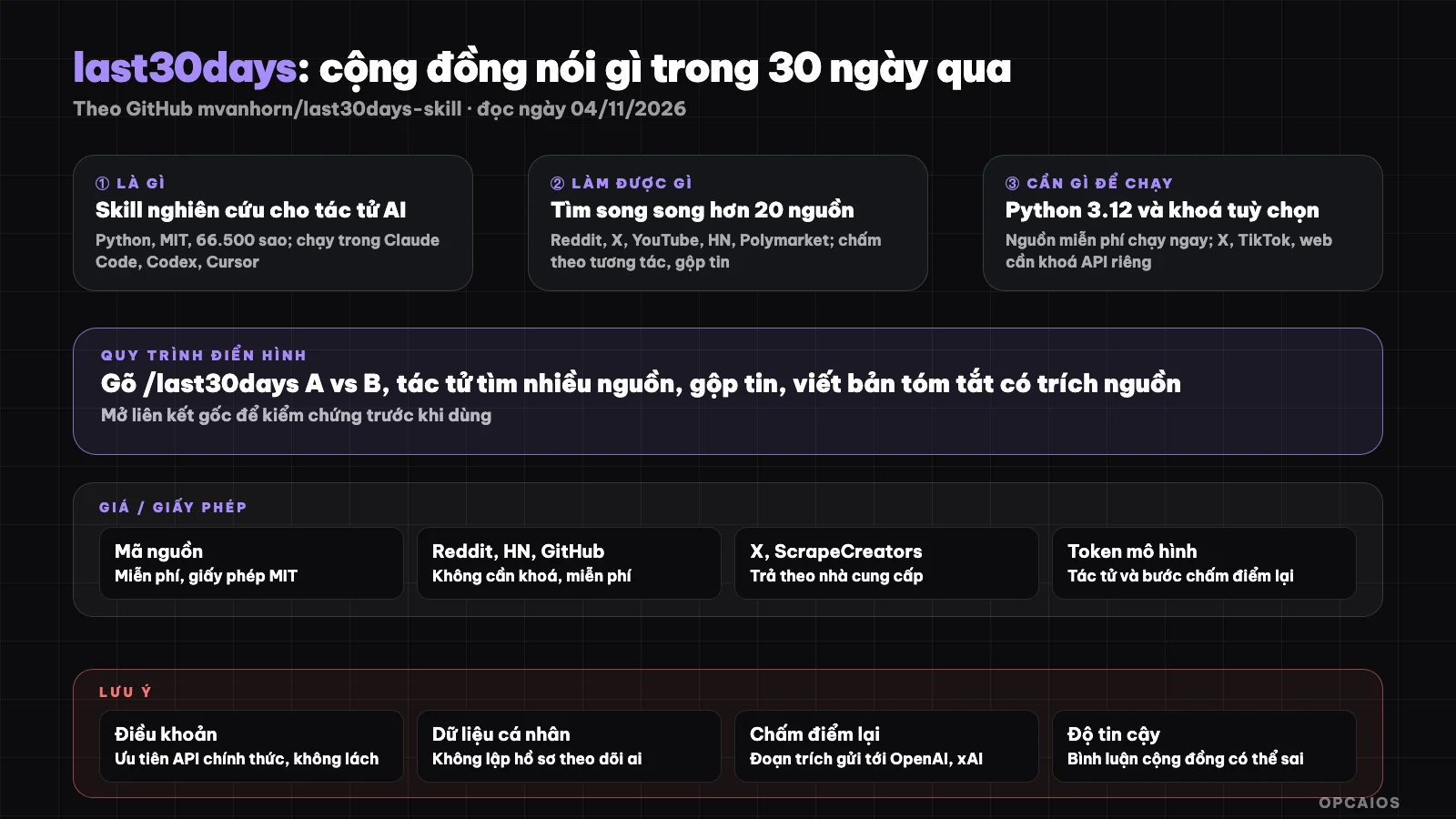
last30days collects community signals from the last 30 days into one summary. Diagram: OPCAIOS.
What is last30days and who made it?
last30days is an "agent-led search engine," as the README describes itself, ranking results by upvotes, likes and real money bets instead of by editors. The author is Matt Van Horn, according to his GitHub profile (read 04/11/2026) a co-founder of June and the company that later became Lyft.
Matt Van Horn writes in the README that he built this skill to keep up with the AI field, because the community on Reddit and X often knows new ways to use things before the model's training data updates. He then used it before sales calls, before meeting someone, before a trip, and before building a product to know what problems users are facing. The core idea: each platform is a closed garden with its own API and authentication, so no AI assistant can search all of them by itself; when you bring your API keys and browser session, the agent can search everything at once. The README says the skill once topped GitHub Trending; that's information the project published, we have not verified it. The result is synthesized text, not raw data, so you still need to read the original sources before using it for important decisions.
What are the main features of last30days?
last30days searches multiple sources in parallel, merges stories about the same topic, scores by engagement, relevance and freshness, then lets the agent write a summary. The table below summarizes what the README says, read 04/11/2026.
| Feature | Short description |
|---|---|
| Search by topic | People, companies, products, technologies or comparisons like "X vs Y" |
| Discovery mode | Ask "what's trending in AI agents" to get 5 to 10 topics ranked by momentum |
| Hiring signals | The --hiring-signals flag reads public job pages as evidence of where the company is headed |
| Over 20 sources | Reddit, HN, X, YouTube, TikTok, Instagram, LinkedIn, Bluesky, arXiv, Techmeme, Perplexity, local files |
| Export JSON | --emit=json for automation workflows |
| Store and track | --store saves to local SQLite, with scripts for watchlists and daily, weekly digests |
| Research library | Search stored summaries, create local HTML pages and Atom feeds |
The strongest point according to the README is depth: it gets YouTube transcripts, Reddit comments with upvote counts and Polymarket odds, not just headlines. If you make content or do market research, you will see this saves time; we have not measured the exact savings.
Pricing, API Keys, and Hidden Costs
last30days is free, MIT licensed per the GitHub API (read 04/11/2026). Reddit, Hacker News, Polymarket, and GitHub run immediately without configuration. Other sources require API keys or login sessions, and costs come from those providers.
| Source | What You Need | Cost per README (excludes tax, subject to change) |
|---|---|---|
| Reddit, HN, Polymarket, GitHub, StockTwits | Nothing | Free |
| arXiv, Techmeme | Free CLI, installed during initial setup | Free |
| X | X_BEARER_TOKEN from X API, or browser login session |
Per X developer project credits |
| YouTube | yt-dlp | Free |
| TikTok, Instagram, Threads, LinkedIn | ScrapeCreators key | README states 10,000 requests free, then pay-as-you-go |
| Web search | Brave Search key | README states 2,000 queries free per month |
| Perplexity | Perplexity key or OpenRouter | Pay-as-you-go |
We haven't read the pricing pages for ScrapeCreators, Brave, or X, so the figures above come from the README and remain unverified. There's also the token from the agent you use for synthesis, plus the token from your model provider if you enable re-scoring via OpenAI, xAI, or Google. No GPU needed.
How to Install last30days
Installing last30days on Claude Code (Anthropic) takes just two marketplace commands, per the README on GitHub (read 04/11/2026). Other agents use a shared Agent Skills installer. Pick one installation method per machine to avoid duplicate commands.
- First, install for Claude Code by typing these two commands in Claude Code:
/plugin marketplace add mvanhorn/last30days-skillthen/plugin install last30days. For Codex, Cursor, Copilot, Gemini CLI:
npx skills add mvanhorn/last30days-skill -g
- Next, if you want to see what the skill will read and write before running for real, use the preflight check command from the source code:
python3 skills/last30days/scripts/last30days.py --preflight
This command shows you the configuration source, the plan to use browser cookies, and which files will be written—without actually reading cookies or running research.
- Finally, run
/last30days <topic>for the first time; the setup wizard will ask which additional sources to enable. Your machine needs Python 3.12 or later. The default summary saves to the user's Documents/Last30Days folder.
Claude Desktop has a .mcpb package that installs as an MCP server; credentials are stored in your operating system's keychain.
Limits, Risks, and Platform Terms
The biggest risk with last30days is access: the skill can use login cookies from your browser session on X or other services, and call APIs to fetch data from TikTok, Instagram, LinkedIn through third parties. That usage pattern may touch each platform's terms.
I note four points, for reference only and not legal advice; I haven't compared them against each platform's original terms text. First, the service terms of X, TikTok, Instagram, LinkedIn typically restrict automated data collection; read the terms and prioritize official APIs, don't use the skill to circumvent access limits. Second, research about a specific person is personal data processing: Vietnam has personal data protection rules, Europe has GDPR, so use it only for legitimate purposes and don't build tracking profiles on anyone. Third, per the README's Data handling section, the skill runs on your machine and data only goes to the APIs you call; if you enable a scoring provider (OpenAI, xAI, OpenRouter, Google), the topic and excerpts will be sent there. Finally, the library's --publish feature defaults to public, so check before posting. Reddit comments or X posts can be wrong and unverified; the summary only reflects what the community says.
Compared to Perplexity, Agent Reach, and Regular Search
last30days differs from AI search tools in prioritizing community signals by engagement count, within a 30-day window. The table below is a general description, not a measurement.
| Option | Strengths | Limits |
|---|---|---|
| last30days | Many social sources, scored by engagement, runs in your agent | Needs API keys for many sources, carries term-of-service risk |
| Perplexity | Fast web search, includes sources, no install needed | Less depth into social comments |
| Agent Reach | Gives agents access to many platforms | Different purpose, doesn't synthesize by 30-day window |
| Manual Google search | Free, familiar | Time-consuming to open each tab |
When should you use last30days?
last30days works well when you need to know what the community is talking about on a topic in the recent month, especially AI topics, tech products, or brands. It doesn't work well when you need long-term historical data or official statistics.
| Situation | Recommendation |
|---|---|
| Find trending content ideas | Discovery mode, then verify sources again |
| Compare two tools before writing | /last30days A vs B |
| Prepare for a business partner meeting | Search by company name, avoid building personal profiles |
| Track a topic weekly | --store with watchlist |
| Need official statistics for a report | Use original sources, don't use summaries |
Example (hypothetical): an OPC person writes an article about an AI programming tool, runs /last30days Claude Code vs Codex, gets a comparison table with excerpts from Reddit and Hacker News, then opens each link to verify before citing in the post.
OPCAIOS's experience
We added last30days to the Repository list in the Tools section on opcaios.org after reading the README and checking that the repository is still maintained; we haven't tested it yet, so this section states the criteria we use to consider it, not an evaluation after using it. Our criteria: is the repository still maintained (yes, code pushed on 03/11/2026); license (MIT); hidden costs (ScrapeCreators lock, X API, Brave, model tokens); can it replace manual topic research for blogs and internal SEO/GEO tools; and the risk of terms violations when using browser session cookies. For the opcaios.org blog, we will only consider sources with official APIs or that don't require login first.
Read more: What is Skill?, What is Claude Code?, What is AI agent?.
Frequently Asked Questions
Is last30days free?
The last30days source code is free, MIT license via GitHub API (read 04/11/2026). Reddit with comments, Hacker News, Polymarket, GitHub, and StockTwits run immediately without a key; arXiv and Techmeme use the free CLI. Other sources cost money depending on the provider: X API charges per developer project credit, ScrapeCreators per README has 10,000 free requests then charges by usage, Brave Search has a monthly free limit. You also pay tokens for agents like Claude Code to synthesize. We have not read the official pricing pages of these providers.
Does last30days send my data anywhere?
According to the Data handling section in the README, the skill runs on your machine and data only goes to the search APIs you call, like Reddit or ScrapeCreators. If you set keys from scoring providers like OpenAI, xAI, OpenRouter or Google, the topics and content passages found will be sent to that provider; without a key, it uses a local scoring model. The README states there is no tracking or analytics. Also, the content found goes into the context of the model you are using, so the data policy of that model provider still applies.
Does using last30days violate Reddit, X, or TikTok's terms?
The answer depends on how you enable sources and each platform's terms; we have not cross-checked the original text and this is not legal advice. Using official APIs like X API with your own key is safer. Using browser session cookies or third-party scraping services may violate anti-scraping terms. Read the terms, keep frequency low, do not use to bypass blocks, and do not profile track individuals as you may run into personal data protection rules.
Can someone who does not know how to code use last30days?
You can if you already have Claude Code or Claude Desktop. On Claude Code you only need two commands to install from the marketplace; on Claude Desktop, download the .mcpb package, drag it into the Extensions section and paste the API key when asked, nothing is required everywhere. Your machine needs Python 3.12 or higher. The harder part for newcomers is getting API keys for X or ScrapeCreators and understanding their costs. Start with free sources like Reddit, Hacker News, GitHub to get familiar, then enable paid sources later when you really need them.
Where can I learn how to use research skills for work?
First, read the README and CONFIGURATION.md file in the mvanhorn/last30days-skill repo to see which sources need what keys. Next, read What is a Skill? and What is MCP? on the OPCAIOS blog to understand how skills differ from MCP servers. Finally, test a small topic with only free sources, compare the summary with the original links, then bring it into your weekly content workflow. If you want a structured roadmap for using AI agents for research and content, check out OPCAIOS's AI application training course.
Source: GitHub mvanhorn/last30days-skill (README, API, release v3.31.0, read 04/11/2026), Matt Van Horn's GitHub profile; no separate official website; not read/not verified: CONFIGURATION.md, ScrapeCreators pricing page, Brave Search, X API, Perplexity, original terms of the platforms, examples and user quotes in README; star count and pricing may change. Experience is from OPCAIOS.
Translated from Vietnamese with AI. Read the original.
Want to apply this in your business?
Book a free 30-minute call (Vietnam time, in English or Vietnamese).