


What is Lead Scoring?
Lead scoring is a way to assign each prospect a number, usually from 0 to 100, so the salesperson knows who to call first. Points come from two groups: how well the prospect fits your ideal customer profile (fit) and how recently they have engaged (engagement), and can be deducted when a prospect goes silent for a long time. For small businesses, lead scoring with a few simple rules is often enough and easier to explain than an AI model, because data is scarce, prospects are few, and salespeople need to know why someone is being called. This post does not promise that scores will increase closing rates; we have not measured that on our own data. The post shows how to build fit scores and behavior scores, set thresholds to pass to callers, reduce scores over time, when to use AI, and the risks of bias and personal data.
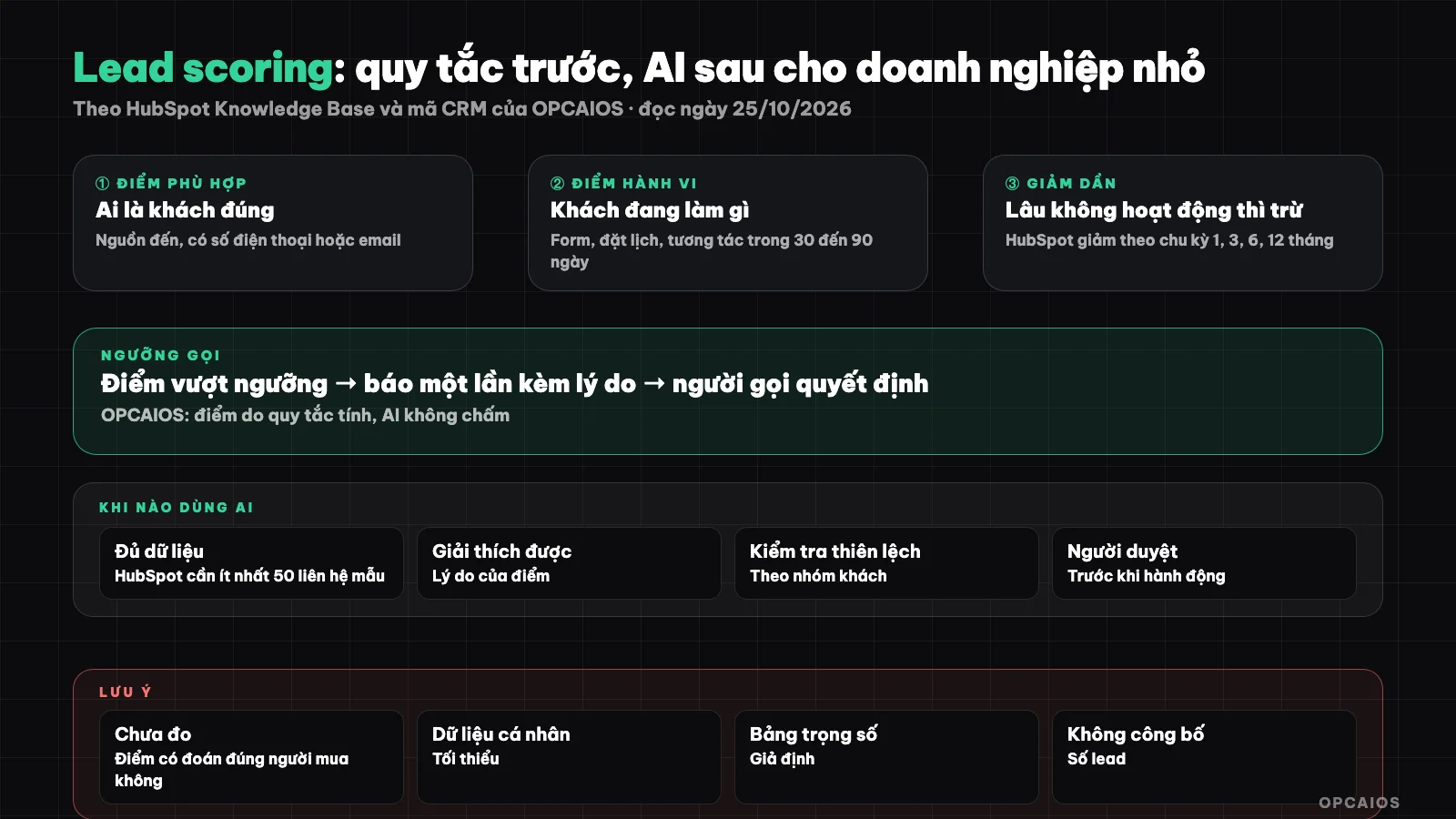
Rules first: fit score plus behavior score, with a cap and decay over time, then compare to call threshold. Diagram: OPCAIOS.
What does lead scoring include?
Lead scoring has three parts: fit score, behavior score, and time rules. HubSpot Knowledge Base (read 25/10/2026) separates two types of scores clearly: engagement score measures actions like visiting a page, signing up for a newsletter, clicking a button, opening an email; fit score measures attributes like job title, company size, revenue. HubSpot also lets you combine the two types into a combined score, ranking labels in a grid from A1 to C3, where the letter shows fit level and the number shows engagement level. This separation is useful for small businesses because the two questions are different: "is this the right customer for me" and "is this person interested right now". Combining them into one number is convenient for ranking, but you should keep the two parts separate to understand the reason.
Where should fit score come from?
Fit score should come from information that prospects themselves provide and that directly relates to buying. For small businesses selling services or courses, easy signals are:
- Source: prospects referred to you are usually more trustworthy than prospects from a manually imported list.
- Contact information: having a phone number counts more than having only an email, because you can call.
- Open opportunity: there is already a deal being consulted on or a quote has been sent.
- Industry or size traits: only if you really do sell differently to these groups.
Do not include unrelated attributes like age, gender, religion.
What should behavior score measure?
Behavior score should measure actions showing a prospect is researching a solution, each type weighted and with its own cap. A cap is the limit on how many points one type of behavior can contribute, so a habit like opening an email many times does not automatically push a prospect into the hot group. HubSpot calls a similar mechanism point group limits and total point limits. A sample scoring table for a small business might look like this (assumed, not real numbers):
| Behavior | Points each | Cap |
|---|---|---|
| Open email | 2 | 10 |
| Click link in email | 5 | 15 |
| Download document | 8 | 16 |
| Message via Zalo or Messenger | 8 | 16 |
| Sign up for event | 10 | 20 |
| Attend event | 15 | 30 |
See more about email measurement in the post What is email marketing and about shared inboxes in the post nurturing customers on Zalo OA and Messenger with AI.
How to set the threshold to pass to callers?
The threshold to pass to callers is the score level that when a prospect crosses it, the system alerts the salesperson and suggests what to do. A practical way has four steps:
- Choose an initial mark, for example 70 out of 100, then see how many prospects cross it in the first week.
- If the caller cannot keep up, raise the mark; if almost no one crosses it, lower the mark.
- Alert each prospect only once when they just cross the mark, to avoid repeated alerts that cause numbness.
- Include the reason and what to do, for example "attended event: call to ask what interested them most".
To combine scores into an automated funnel, see automated sales funnel for OPC.
Why Should Scores Decrease Over Time?
Scores should decrease over time because downloading a document three months ago no longer tells us about interest today. There are two common approaches. The first is to only count behaviors within a time window, for example the last 90 days; older behaviors naturally drop out of the score. The second is to subtract a fixed amount when the customer has no activity for a certain number of days. HubSpot Knowledge Base (read on 25/10/2026) describes further mechanisms for decreasing scores over cycles of 1, 3, 6, or 12 months, decreasing linearly from the initial score value and applying to old events as well. For small businesses, a time window plus a subtraction when silent is enough, because it's easy to explain to the salesperson: "the score dropped because no one has contacted this customer for two weeks and they haven't done anything." What matters is that the score must be recalculated regularly, not just when the customer first comes in.
When Should I Use AI to Score Leads?
You should use AI to score leads when you already have enough customers who converted and customers who didn't convert for the model to learn from, and when manual rules can no longer keep up. HubSpot notes that the AI-powered scoring feature requires the Marketing Hub Enterprise plan and a minimum of 50 sample contacts, of which 25 have converted and 25 have not (read on 25/10/2026). This number shows a common point: without outcome data, AI has nothing to learn from. Small businesses usually have a few dozen customers each month, so the reasonable order is:
- Start with transparent rules like the tables above.
- Record actual results: who bought, who declined, why.
- After a few months, compare scores with results to adjust weights by hand.
- Only try a model when you have enough samples, and still keep the reasoning readable.
AI is useful earlier for other tasks like summarizing customer history or drafting messages; see What is LLM.
What Should I Watch Out For Regarding Bias and Personal Data?
Bias in lead scoring is when the score favors or neglects a group of people for reasons unrelated to buying ability, such as adding points by region or by name type. Personal data is all the information you use to score: email, phone number, email open history, messages. Four principles to keep:
- Only use signals related to buying, not sensitive attributes.
- Show the salesperson the reason, so they can spot illogical scores.
- Respect people who declined to receive messages: exclude them from scoring and from automated sequences.
- Have a way to delete or anonymize when customers ask, and state the purpose clearly in your privacy policy.
In Vietnam, the Law on Protection of Personal Data (Law 91/2025/QH15, effective from 01/01/2026 according to summaries by PwC and EY) and Decree 356/2025/NĐ-CP are documents worth reading; this section is for reference only, not legal advice. See also 5 rules for protecting business data when using AI.
OPCAIOS's Experience
OPCAIOS scores leads in the internal CRM using rules, not AI to generate scores. The score has two parts that add up, limited to a range of 0 to 100. The basic part is based on source (referral highest, manual entry lowest), whether there is a phone number and email, whether there is an open opportunity or has reached the consultation stage, how many times our people have interacted, how many times the customer submitted a form or scheduled a meeting in the last 30 days, and subtracting points when there is no activity for 14 days. The behavior part is a maximum of 60 points, counted within 90 days (events within 180 days): opening and clicking emails in a sequence, downloading documents, commenting on a Page, messaging, signing up, attending or watching back events, submitting a form again; each type has its own cap. The default hot threshold is 70 and can be adjusted; a customer who exceeds the threshold but hasn't been contacted is only notified once, with the reason and one thing to do. A customer with only one email used doesn't get sent a notification; people who have stopped following or have already anonymized themselves are not scored. We have not yet measured whether the score correctly predicts who will buy, and we do not publish lead numbers.
Frequently Asked Questions
Do small businesses need lead scoring?
Yes, when the number of potential customers each week is more than the number of people you can call back. If you only get a few inquiries per week, just call everyone back, quickly and thoroughly, and that's enough. When the list starts to get long, lead scoring helps you prioritize: who just attended an event, who just asked about pricing, who has been silent for weeks. Start with a spreadsheet or CRM with a points column and a few rules—you don't need expensive software yet.
How many scoring rules should you have?
Around 5 to 10 rules is easy to manage. Each rule must answer the question "why does this action show the customer wants to buy". Too many rules make the score hard to explain and hard to adjust. You should set a cap for each type of behavior so that a habit like opening an email doesn't automatically push the score up. After each month, look back at which rules almost never trigger and drop the ones you don't need.
Is 70 points the standard threshold?
There is no standard number. 70 out of 100 is just a common starting point. The right threshold is the one where your caller can handle every customer above that score within the day or within the week. If you report too many, the caller will skip them and the score loses its value; if too few, good customers get delayed. Watch for a few weeks, compare the group that bought with the group that didn't, then adjust.
Should opening an email earn many points?
No. Email opens are measured by a tracking pixel, and some email apps or filters auto-load images, so opens might not be a real person reading. Clicking a link, replying to an email, sending a message, or booking a call are stronger signals. Give email opens low weight and a low cap, treat it as a secondary signal, and use a time window so old opens lose their value.
When should you switch to AI-powered scoring?
When you've already recorded enough real results (who bought, who didn't) for the model to learn from, and when manual rules can't keep up anymore. For example HubSpot requires at least 50 sample contacts for its AI scoring feature. Before that point, transparent rules usually work better. If you want to learn how to build a CRM, scoring, and automate customer care with AI, see OPCAIOS's AI application training course.
Source: HubSpot Knowledge Base, page "Understand the lead scoring tool" (read 25/10/2026); the weighting table in this post is an assumption; Salesforce documentation not yet verified and full text of Law 91/2025/QH15 and Decree 356/2025/NĐ-CP not yet cross-checked in this post; the effectiveness of scoring has not been measured by OPCAIOS. The experience is OPCAIOS's.
Translated from Vietnamese with AI. Read the original.
Want to apply this in your business?
Book a free 30-minute call (Vietnam time, in English or Vietnamese).