

What is RudderStack?
RudderStack is a customer data platform (CDP) for developers: it collects events from websites, applications, and SaaS services, transforms data, then pushes it to data warehouses and marketing, analytics tools. The core is the rudderlabs/rudder-server repository written in Go. According to GitHub (API, read on 04/11/2026), the repository was created on 19/07/2019, has around 4,500 stars, the most recent code push was on 03/11/2026, and uses the Elastic License 2.0 (ELv2), which is not an open source license by OSI definition. The pricing page rudderstack.com (read on 04/11/2026) has a Free plan at 0 USD for 250,000 events per month and a Growth plan starting at 265 USD per month. This post explains what RudderStack does, pricing, how to self-host, personal data risks, and when to choose it.
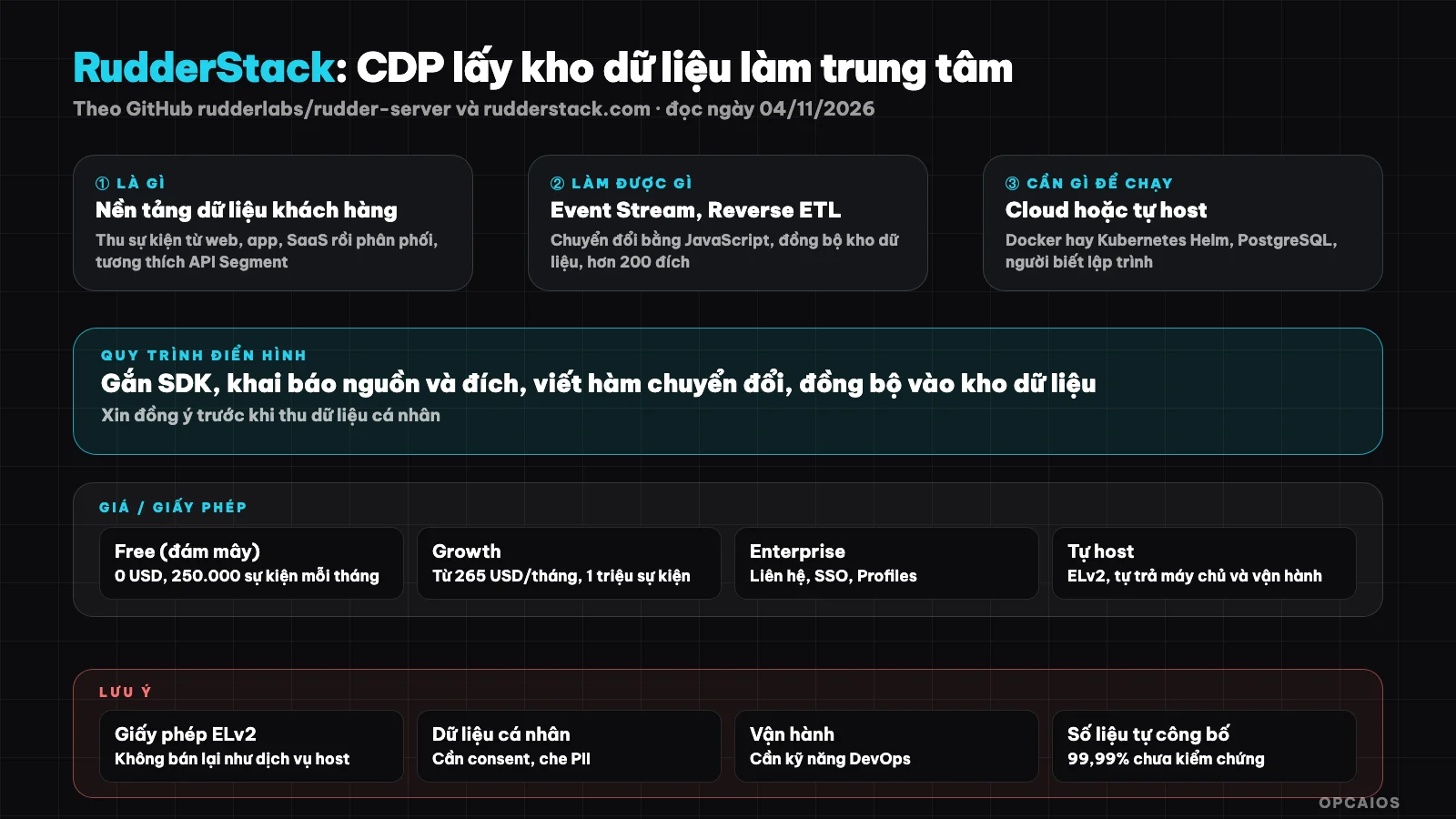
RudderStack sits between event sources and destination tools, with the data warehouse as the center. Diagram: OPCAIOS.
What is RudderStack and who developed it?
RudderStack is a product of RudderStack company (GitHub organization rudderlabs), which introduces itself as a CDP for developers and an alternative to Segment, focusing on privacy and security. The self-hosted version is rudder-server; the service version is RudderStack Cloud.
A CDP is a system that collects all customer interactions, such as page views, button clicks, signups, purchases, into one unified stream, then distributes that stream to where it's needed. Without a CDP, each tool (GA4, Facebook Ads, email software) has to attach its own piece of code to the website, and data easily drifts apart. RudderStack solves this by collecting once and sending to many places. According to the README on GitHub (read on 04/11/2026), RudderStack puts the data warehouse first as the primary destination, is compatible with Segment's API, and lets you write event transformation functions in JavaScript. The server part is written in Go, the interface in React, and depends only on PostgreSQL database according to the README. The README also mentions the company recently launched RudderAI, an AI agent layer for the customer data lifecycle; we haven't read the RudderAI page yet. If you're not familiar with measurement concepts, first read What is GA4.
What are RudderStack's main features?
RudderStack has four groups of work: collecting events (Event Stream), transforming data, syncing to data warehouse, and pushing back from warehouse to tools (Reverse ETL). The table below summarizes from the README and official pricing page (read on 04/11/2026).
| Feature | Short description |
|---|---|
| Event Stream | Over 16 source SDKs (web, mobile, server) and over 15 cloud event sources, according to pricing page |
| Segment compatibility | Can use Segment-style API, swap SDKs while events still go to old destinations |
| Transformation | Write JavaScript functions, paid plan adds Python, to clean or supplement events |
| Destinations | README lists over 90 destinations; pricing page lists over 200 cloud destinations and over 10 data warehouses |
| Data warehouse sync | Near real-time; Free plan syncs every 3 hours, Growth 30 minutes, Enterprise 5 minutes |
| Reverse ETL | Take data analyzed in warehouse and push back to marketing tools |
| Data governance | Tracking Plan, block events, mask personal data (PII), user deletion API |
| Profiles | Merge identities, 360-degree customer profiles; only in Enterprise plan |
The two numbers "90+" and "200+" differ because the README is older than the pricing page. Also the README states uptime of "at least 99.99%"; this is a number announced by the project, not independently verified.
How much does RudderStack cost and what is its license?
RudderStack uses a freemium model: the self-hosted version is free under ELv2, and the cloud version has a Free plan and paid plans based on event volume. The table below is from the pricing page at rudderstack.com (accessed 04/11/2026), excludes taxes, and may change.
| Plan | Stated Price | Main Limits |
|---|---|---|
| Free (cloud) | 0 USD | 250,000 events per month, 10 members, 5 transformations, warehouse sync every 3 hours |
| Growth (cloud) | From 265 USD/month | 1 million events per month, higher tiers increase the price, 15% discount if paid annually, 30-day trial |
| Enterprise | Contact sales | SSO, HIPAA, Profiles, 5-minute sync |
| Self-hosted rudder-server | 0 USD license cost | Under ELv2; you handle servers and operations yourself |
The ELv2 license allows use, modification, and distribution, but prohibits offering the software to third parties as a hosted or managed service where users access most features. In short: internal use is fine, reselling it as a CDP service is not. Hidden costs when self-hosting include continuously running servers, PostgreSQL, destination data warehouses (like BigQuery or Snowflake with their own fees), and the effort of operations and upgrades.
How do I install RudderStack and get started?
The README offers two paths: sign up for RudderStack Cloud Free to try quickly, or self-install using Docker, Kubernetes, or on your development machine. The README does not list specific install commands but links to the documentation. The general process is: first, choose how to run it; last, verify events are arriving:
- First, choose how to run: Cloud Free if you want to try right away, or self-host following Docker or Kubernetes guides at rudderstack.com/docs.
- Next, if self-hosting for production, use the Kubernetes Helm chart; the README strongly recommends this since Docker images are patched more frequently than the GitHub repository.
- Attach the RudderStack SDK to your website or application, declaring sources and destinations.
- Finally, send test events following the "sending test events" documentation to confirm data reaches the destination.
If you are new to containers, see What is Docker and What is VPS. We have not installed RudderStack; the steps above summarize the README. We also have not cross-checked the documentation to see what additional components the self-hosted version requires beyond PostgreSQL in practice.
Risks, security, and legal issues when using RudderStack
The main risk of RudderStack is personal data. A CDP collects identifiers, emails, and customer behavior into one stream, so a misconfiguration can send sensitive data to many third-party tools at once. This section is for reference only and is not legal advice.
First is consent. Before collecting events tied to a person, your website needs a consent mechanism suited to applicable law. In Europe that is GDPR; in Vietnam there are rules on personal data protection, but we have not compared the original text for the CDP case. The pricing page notes that RudderStack has basic consent integration across all plans and advanced features on paid plans, including PII masking and a user deletion API. Next is where data lives: self-hosting keeps data on your infrastructure, as the README emphasizes, but you also bear responsibility for server security, backups, and access control. Finally there is the license: ELv2 is not OSI open source, so if you are an agency planning to host RudderStack for many customers as a service, you need to read the license carefully or ask a lawyer.
One more thing: the README mentions some large companies using RudderStack. That is information the project has shared; we have not verified it.
RudderStack compared to other options
RudderStack suits teams with developers and a data warehouse, who want to control event flow without paying per volume like Segment. The table below is general description, not measurement.
| Tool | Type | Strengths | Things to Consider |
|---|---|---|---|
| RudderStack | CDP, ELv2 + cloud | Data warehouse-first, Segment-compatible | Requires technical skill to self-host |
| Segment (Twilio) | Cloud CDP, paid | Large ecosystem, easy to start | Fees scale with volume, no self-hosting |
| PostHog | Product analytics | Built-in charts, session recording, experiments | Not specialized in event distribution |
| Tracardi | Self-hosted CDP | Customer profiles, automation | Smaller community |
| GA4 | Free web analytics | Easy to set up, free | Data lives at Google, hard to move elsewhere |
When should you use RudderStack?
You should use RudderStack when you have many event sources, many destination tools, and a data warehouse as your main analytics hub. With a small website that only needs to know page views, GA4 or a simple analytics tool is enough.
| Situation | Recommendation |
|---|---|
| Currently using Segment, bills are rising fast | Try RudderStack because of API compatibility |
| Have BigQuery or Snowflake, want raw event data | RudderStack is a good fit |
| Small website, one person operating, no data warehouse yet | Don't need a CDP yet; use GA4 first |
| Need to push analyzed customer lists to advertising tools | Check RudderStack's Reverse ETL |
| Agency wants to sell pre-hosted CDP to customers | Read ELv2 carefully first |
Example (hypothetical): an online store installs RudderStack SDK on website and app, sends "add to cart" and "checkout" events to BigQuery, and simultaneously pushes to an email tool to send cart reminders. A transformation function removes phone numbers before sending to the advertising tool.
OPCAIOS's experience
We added RudderStack to our Repo list under Utilities on opcaios.org after reading the README and checking that the repository is still being maintained; we haven't run it yet, so this section describes the criteria we use to evaluate it, not an assessment after using it. Currently we use self-built traffic analytics, Google Search Console, and a private CRM on our website. Four criteria:
- First, the repository is actively maintained: last code push on 03/11/2026 according to GitHub API.
- Next, the license: ELv2 is enough for internal use, not enough to resell as a service.
- Hidden costs: servers, PostgreSQL, destination data warehouses, and operational time.
- Finally, whether it can replace the tools we're already using: at our one-person scale, we don't yet see a need for a separate CDP; the main risk lies in our customers' personal data.
Read more: What is CRM, What is GA4, What is PostHog, What is n8n, 6 best website measurement tools in 2026.
Frequently Asked Questions
Is RudderStack free?
There are two ways to use it for free. The first is RudderStack Cloud's Free plan: according to rudderstack.com/pricing (read on 04/11/2026), this plan gives you 250,000 events per month, over 200 cloud destinations, data warehouse syncing every 3 hours, and up to 10 team members. The second way is to self-host rudder-server under the Elastic License 2.0, which costs no licensing fees. When self-hosting, you pay for the server, PostgreSQL, destination data warehouse, and manage operations yourself. The Growth plan starts at 265 USD per month for 1 million events.
Is RudderStack open source?
RudderStack's README calls itself an open source CDP, but the actual license for rudder-server is Elastic License 2.0. ELv2 lets you view, modify, and use the code, but with restrictions: you cannot provide the software to third parties as a hosted or managed service, and you cannot disable licensed features. Because of this, ELv2 is often called a "source-available" license, not recognized as open source by OSI's official list. Using it internally for your own company typically does not pose problems.
How is RudderStack different from Segment?
Both are CDPs that collect events and send them to many tools. According to the README (read on 04/11/2026), RudderStack is compatible with Segment's API, so teams currently using Segment can switch SDKs while events still reach their original destinations. The main difference is that RudderStack makes your data warehouse the center and offers a self-hosted version, whereas Segment is a cloud service. RudderStack also emphasizes that the self-hosted version has no event limits. We have not compared Segment's pricing because we have not read Segment's pricing page today.
Can someone with no coding experience use RudderStack?
It's difficult. RudderStack is designed for developers: you must embed the SDK into your website or app code, write transformation functions in JavaScript, configure your data warehouse, and if self-hosting, manage Docker or Kubernetes. The Cloud Free plan reduces operations management but still requires understanding events, attributes, and destinations. Non-programmers can use a programming agent like Claude Code to help with setup, but should still understand data flow to avoid sending personal data by mistake. For a small website, GA4 is an easier starting point.
Is RudderStack suitable for small businesses in Vietnam?
It depends on your data volume and technical team. If you have a few sales channels, one data warehouse, and someone who can code, the Free plan of 250,000 events per month is enough for serious experimentation. If you run a small website alone, a CDP is usually too early; GA4, Search Console, and a simple CRM solve most needs. Whatever you choose, get customer consent before collecting personal data. To learn how to build data systems and AI automation, check out OPCAIOS's AI application training course.
Source: GitHub rudderlabs/rudder-server (README, LICENSE, API, read on 04/11/2026), rudderstack.com/pricing (read on 04/11/2026); not read/not verified: detailed setup documentation on rudderstack.com/docs, RudderAI page, Segment pricing page, customer list and 99.99% commitment claimed by the project; star count and pricing may change. Experience from OPCAIOS.
Translated from Vietnamese with AI. Read the original.
Want to apply this in your business?
Book a free 30-minute call (Vietnam time, in English or Vietnamese).