


What is a solopreneur?
A solopreneur is someone who runs a business alone, makes all the decisions on their own, may outsource certain parts but has no formal employees or co-founders. According to Shopify (Chloe West, posted 19/09/2026, accessed 04/11/2026), a solopreneur can be a freelancer, independent worker, or business owner with no full-time employees and no plans to hire more. According to the US Chamber of Commerce (posted 08/08/2025, accessed 04/11/2026), a solopreneur handles everything from executing work, marketing, to customer care on their own, and usually prioritizes a manageable workload over growth. According to Terri Lonier's site, the person associated with popularizing this term through the book Working Solo, the idea started in the early 1990s; we haven't verified the original publication date. Important: this is a way of working, not a legal business form. A solopreneur might be an individual, household business owner, or company owner; see What is a one-person business (OPC)? to distinguish the meanings.
How is a solopreneur different from a freelancer and entrepreneur?
These three paths overlap, so the differences lie in how they operate rather than what they're called. According to Shopify, a freelancer can be a solopreneur but a solopreneur is not necessarily a freelancer; freelancers usually work by job or project and get paid upon completion, while a solopreneur can run a product or service continuously. According to the US Chamber, an entrepreneur aims for a business larger than one person can handle alone, through partners and hiring. The table below is how we summarize it by five criteria; this is a general trend, not a hard boundary, and many people fall in between.
| Criterion | Freelancer | Solopreneur | Entrepreneur |
|---|---|---|---|
| 1. What you sell | Your own hours or projects | Repeatable products or services, usually packaged | A business that can grow beyond one person |
| 2. Who does the work | Yourself | Yourself, outsource by task | Have a team, have partners |
| 3. Goal | Steady work, independence | Manageable for one person, keep freedom | Growth, expansion |
| 4. System | Mostly in your head | Written processes, tools, automation | Processes plus management |
| 5. Main limit | Your hours | Your capacity, even with systems | Capital, hiring, management |
Criteria 1 to 3 are based on the definitions above; criteria 4 and 5 are how OPCAIOS sees operations, so treat them as hints for self-reflection, not definitions.
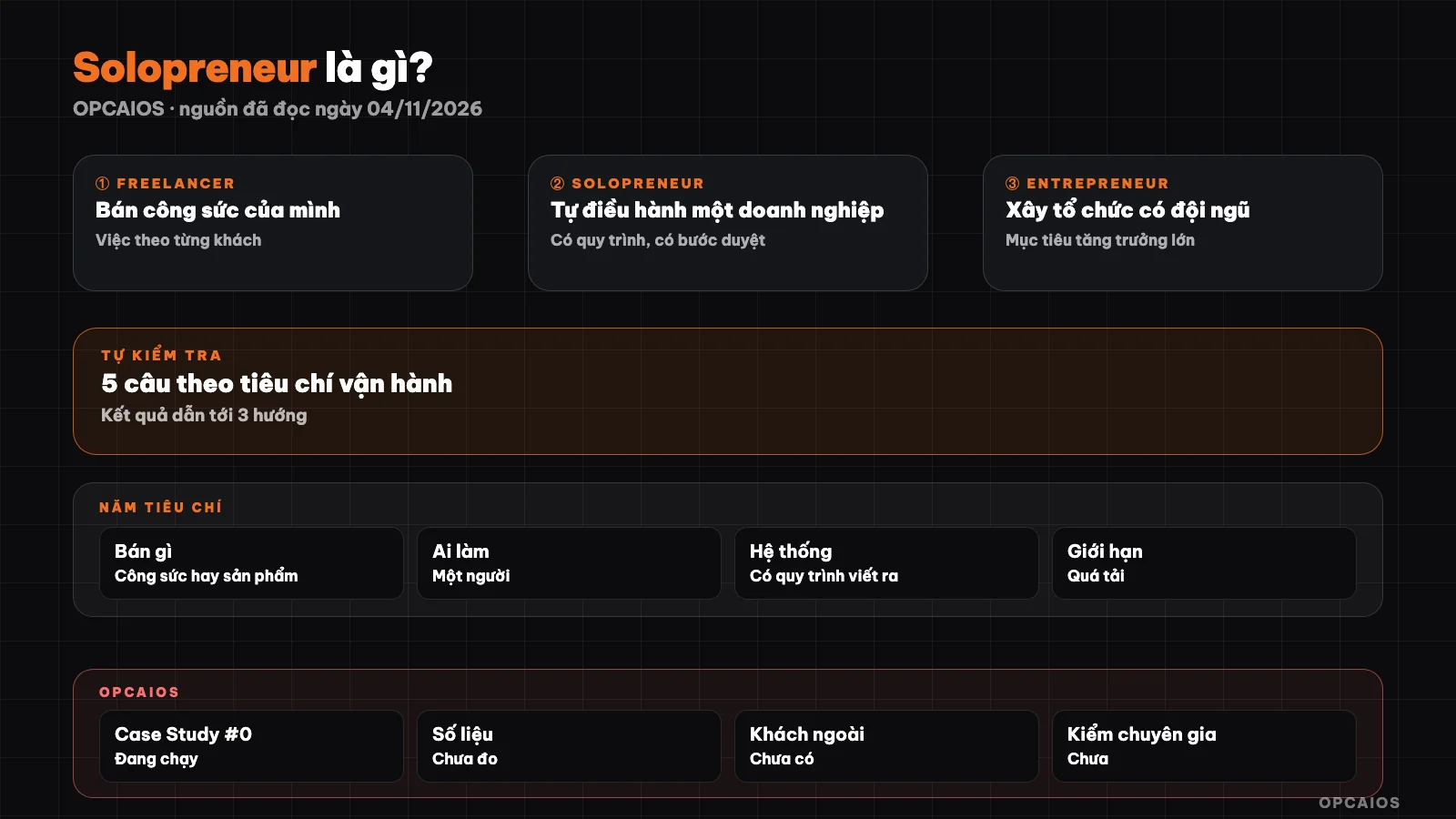
Three directions and a five-question self-check. Diagram: OPCAIOS.
Self-Check Quiz: 5 Questions to Locate Where You Are
This quiz has five questions about how you work today. For each question, choose A, B, or C, then count which letter appears most. This is a framework we created to locate how you operate—not a scientific assessment, not a measure of income, and not a predictor of success. Answer based on your current state, not what you wish for. You can copy the whole block below into your notes.
SOLOPRENEUR SELF-CHECK QUIZ (5 QUESTIONS)

Question 1. What do customers pay for?
A. Hours or projects I do directly myself
B. A packaged product or service I sell repeatedly
C. Results my team creates

Question 2. If I take two weeks off, what happens?
A. Work stops, customers have to wait
B. Some keeps running thanks to processes, documents, or automation
C. The team keeps operating, I just review big decisions

Question 3. In the next two years, do I plan to hire a full-time person?
A. No, and I rarely hire anyone anyway
B. No, but I'll outsource individual tasks as needed
C. Yes, I want to build a team

Question 4. How big do I want this work to grow?
A. Enough to live well, with flexible hours
B. What one person can handle but with clear systems
C. Bigger than one person, willing to manage and raise capital if needed

Question 5. For repeated work, am I ready to do what?
A. Just remember it in my head, do it when the work comes
B. Write it as a process and use tools and AI to repeat it
C. Write the process so someone else can do it for me

HOW TO SCORE
Count your A's, B's, and C's. Whichever letter appears most is your main result.
If two letters tie, read both corresponding rows in the decision table.
Which direction should I go based on the result?
The result is just a hint for your next step, not a judgment of your ability. If A is highest, you operate like a freelancer: income tied to your hours. If B is highest, you are close to a true solopreneur operation. If C is highest, you are thinking like an entrepreneur. If two letters tie, you are shifting between two modes—very common.
| Result | Means | Try this first | Read more |
|---|---|---|---|
| Mostly A | Pure freelancer | Pick one service you repeat the most, write down the steps | What is a productized service? |
| Mostly B | Solopreneur | Pick just-enough tools, keep yourself in the review role | Free AI tech stack for OPC |
| Mostly C | Entrepreneur direction | Try handing one task to someone else using a written process | AI system running on its own |
| A and B tied | Freelancer shifting to solopreneur | Package exactly one service, measure real hours | What is a productized service? |
| B and C tied | Solopreneur considering growth | Try outsourcing one task before you hire | AI system running on its own |
Tools are the last layer. The first thing is to know what you sell, to whom, and whether you can repeat it; only then pick your tools. If you are thinking about registering a business, read legal checklist for solopreneur and ask an accountant or lawyer; this post does not cover law and tax.
What are the limits of the solopreneur model?
The biggest limit is everything depends on one person. According to the US Chamber, growth potential hits a ceiling at some point because of one person's working capacity, and solopreneurs struggle to rest and may feel alone. According to Shopify, it's easy to get stressed, work long hours, and burn out when the line between work and life blurs; you also have to do tedious tasks like accounting and admin yourself. We would add: if you get sick or overwhelmed, no one covers for you; AI can work faster but can also make mistakes, and you still take the hit; and a self-check quiz like this only shows your perception, not hard data on time and money. We have no figures on what share of solopreneurs sustain their model or average income, and we don't cite any numbers.
OPCAIOS's Experience
OPCAIOS is an AI operating system that I, Lê Quốc Nghĩa, built for solopreneurs; the website opcaios.org was built by one person together with AI agents, and includes a blog, a document and template shop, courses, an internal CRM, and SEO posts that AI drafts and I review by hand. I'm running Case Study #0 on myself to test this approach. We use operating criteria (do you have written processes, do you have a review step, can you redo it) to examine ourselves, rather than self-labeling. We don't have verified published figures about revenue, time saved, or outside customers, so we don't measure and don't give numbers. One real limitation: filming and speaking on camera remains the slowest part; AI can't do it yet.
Frequently Asked Questions
Is a solopreneur the same as a freelancer?
Not entirely. According to Shopify, a freelancer can be a solopreneur, but a solopreneur doesn't have to be a freelancer. Freelancers usually take on individual jobs or projects and get paid when they're done; a solopreneur can run a product or service continuously. In practice the two overlap, and many people gradually shift from freelancer to solopreneur once they package their service. The self-check quiz in this post helps you see which way your work currently leans.
Can a solopreneur hire people?
According to the US Chamber, a solopreneur can occasionally hire outside freelancers but doesn't have regular employees or a formal team; Shopify says the same—you can run lean and hire outside work as needed. If you hire full-time staff and build a team, your path is usually called entrepreneurship. This boundary is a matter of naming, not law. Hiring people also brings legal and tax obligations, so ask an expert before you hire.
Does a solopreneur need to register a business?
This post can't answer that for you. Solopreneur is a name for how you work, not a legal category, so you could be an individual, a household business, or a company owner. Whether you need to register, what form to use, and what tax duties apply depends on your activity and current rules; we haven't checked the original text in this post. Read the legal checklist above and ask an accountant or lawyer.
Can AI help a solopreneur?
It can, but there are limits. AI helps draft, summarize, arrange, and repeat steps you've written down, so one person does less manual work. AI can't replace decisions, responsibility to customers, or the checking step. We haven't measured time savings so we don't promise a number. The safe way is to give AI a small task, review it yourself, and note the real minutes before and after. See an AI operating system for solo work to learn how to link the steps.
Is solopreneur work stable and does it pay well?
We don't have verified figures to answer that. The sources I've read mention both advantages (low costs, autonomy, flexibility) and disadvantages (pressure, hard to take time off, loneliness, growth limits, slow seasons). Income and stability depend on your field, customers, prices, and how you manage, so I can't promise anything broad. Start by writing down your real income, spending, and hours.
Next Steps
Copy the self-check quiz from this post, answer it for where you are now, and adjust the choices to match your work. Do it again after 30 days to see if your answers shift; that's your real measure.
Sources: Shopify, "What Is a Solopreneur? Solopreneur vs. Entrepreneur" (Chloe West, 19/09/2026); US Chamber of Commerce, "Solopreneurship: How to Build and Run a Successful Solo Business" (08/08/2025); terrilonier.com (Solopreneurs section); all read 04/11/2026. Not verified: the first publication year of Working Solo, other Vietnamese sources, and any figures on income or success rates (not used in the post). The table of five criteria and self-check quiz were written by OPCAIOS. The experience is OPCAIOS's.
Translated from Vietnamese with AI. Read the original.
Want to apply this in your business?
Book a free 30-minute call (Vietnam time, in English or Vietnamese).