
Free AI Tech Stack
A free AI tech stack is a set of AI, automation, data, and distribution tools that you can start using without paying a subscription fee, based on free plans or self-hosted software. One honest note right from the start: "0 đồng" only applies to software fees. You still spend on domain names, time, taxes, and possibly servers if self-hosting, while free plans come with usage limits or terms, for example Vercel Hobby is only for non-commercial projects.
This post synthesizes a set of tools by function, along with free tier limits read from official pages on 24/10/2026, terms to watch when using commercially, places where free is no longer free as you grow, and OPCAIOS's experience.
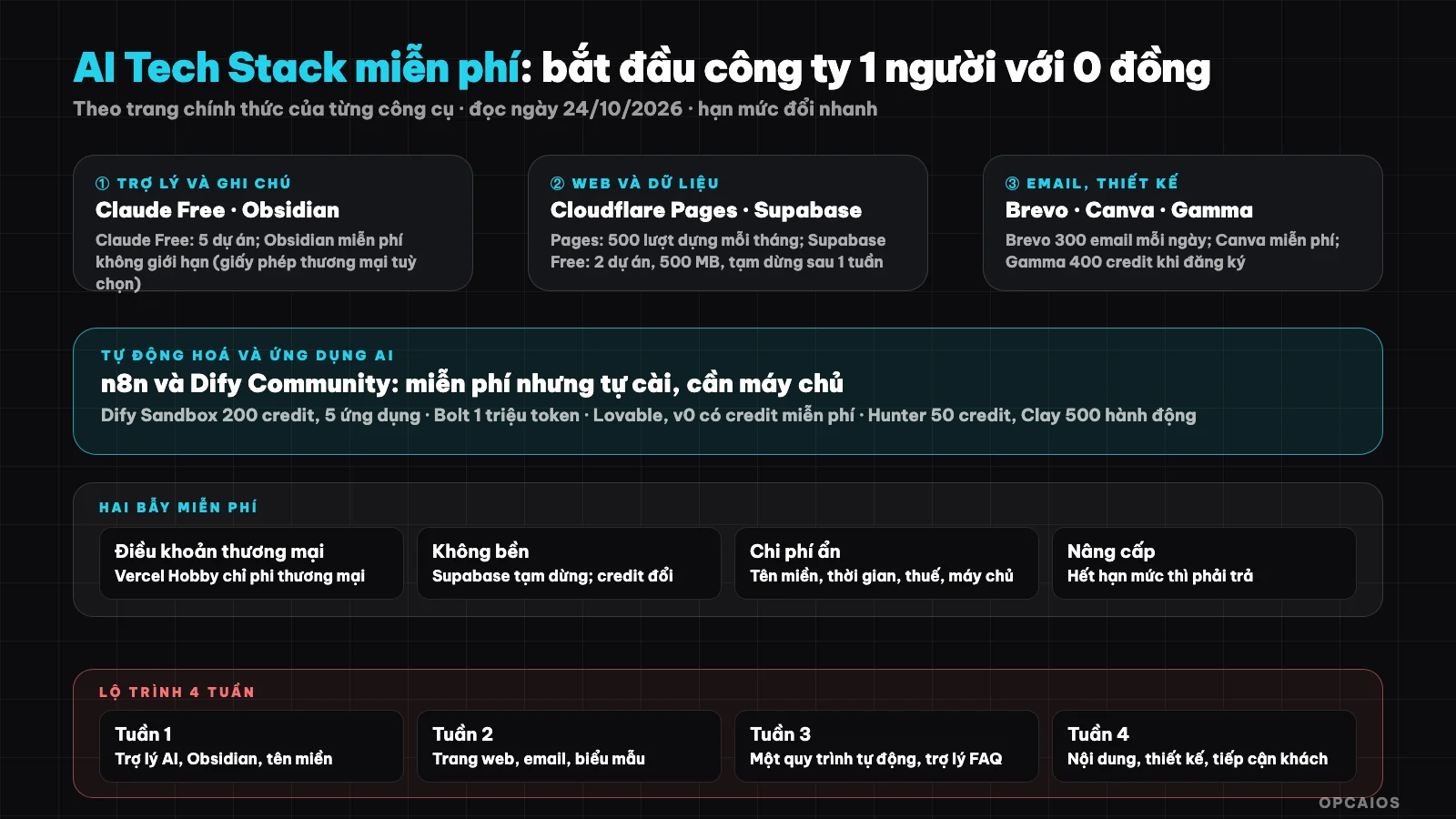
Free on software, not free on time, domain names, and terms. Diagram: OPCAIOS.
What's included in the free toolkit by function?
The limits below are read from the official page on October 24, 2026 and may change at any time.
AI assistant, programming and app building
The AI assistant, programming and app building group is the group that helps one person work like a small team, and the free limits, according to Anthropic, Bolt, v0 and Dify (read on October 24, 2026), are as follows.
- Claude by Anthropic: Free plan at $0, maximum 5 projects; no Claude Code and deep research.
- Antigravity: free limit refreshes weekly for individuals, according to Wikipedia; see What is Antigravity 2.0?.
- Bolt: 1 million tokens per month, maximum 300 thousand per day.
- Lovable: daily gift credits.
- v0: 7 messages per day and $5 credit once.
- Dify: Free Sandbox with 200 message credits and 5 apps, or self-hosted Community version; see What is Dify?.
For example, first a new user uses Claude to write content, next uses Bolt to build a homepage prototype, finally uses Dify to make a FAQ answering assistant. See also Top 5 Vibe Coding tools.
Notes, automation, data and web storage
The notes, automation, data and web storage group is the foundation of a one-person company, and the free limits, according to Supabase, Cloudflare and Obsidian (read on October 24, 2026), include the following items.
- Obsidian: unlimited free, no mandatory commercial license but organizations are encouraged to purchase ($50 per person per year); see What is Obsidian?.
- n8n Community version: free, self-hosted and requires a server; cloud plan paid; see What is n8n?.
- Supabase Free plan: 2 active projects, 500 MB database per project, 50,000 active users per month, 1 GB file storage and 5 GB outbound bandwidth; projects pause after 1 week of inactivity; see What is Supabase?.
- Cloudflare Pages Free plan: 500 builds per month, unlimited static files and 20,000 files per site; see What is Cloudflare Pages?.
For example, first place a static introduction page on Cloudflare Pages, next save forms to Supabase; both can run at no subscription cost, as long as limits are not exceeded and the Supabase project is not paused.
Email, design, voice and customer finding
The email, design, voice and customer finding group helps one person produce content and reach customers, and the free limits, according to Brevo, Canva and Gamma (read on October 24, 2026), include the following items.
- Brevo: 300 emails per day; see What is Brevo?.
- Canva: free Personal plan. Gamma: 400 credits on sign-up, 10 slides per command, export PDF, PPTX, PNG.
- ElevenLabs: about 10 minutes of voice per month. CapCut: has free templates and basic tools; see TikTok/Reels channel without showing face.
- Hunter: 50 credits per month. Clay: 500 actions and 100 data credits per month. Apollo: has Free plan; see Top 5 B2B customer finding tools.
For example, first a business owner designs images using Canva, next composes a newsletter using Brevo, finally sends up to 300 emails per day to a small list. This approach is enough to test the market in the first month without spending money on software, as long as the limits mentioned above are not exceeded.
What are the two big "free" traps?
"Free" traps are terms or limits that make a tool no longer free or unusable when you do business, and there are two big ones.
- Trap 1, commercial terms: Vercel Hobby is only for personal, non-commercial purposes according to Vercel's package documentation (see What is Vercel?); for e-commerce sites, use an appropriate paid plan or Cloudflare Pages. Ideogram and some AI image tools have different commercial use terms by plan: read them before use.
- Trap 2, unstable free: Supabase Free plan projects pause after 1 week of inactivity; token limits and credits of AI tools can decrease; free credits usually don't carry over to the next month.
For example, a small store putting an e-commerce website on Vercel Hobby could violate the terms, since the plan is only for non-commercial projects, according to Vercel. Supabase Free plan projects also pause after 1 week of inactivity, so customers could hit an error page. Finally, read each tool's terms before taking paying customers, since we haven't read the detailed commercial terms of every tool.
What other costs does "free" still have?
"Free" here means only free of software subscription fees, and the toolset still has five cost items below.
- Domain name: usually billed yearly; needed for email, website, branding.
- Server when self-hosting n8n or Dify: see What is VPS?; plus security, backups.
- Setup and learning time: first few weeks usually slower.
- Tax, accounting, legal: need experts when starting sales.
- Upgrades as you grow: hit limits and must pay; see the cost article.
We haven't totaled costs for a specific model, so you need to add these items yourself based on your needs.
What is the 4-week roadmap for using this free toolset?
The 4-week roadmap, equivalent to 30 days per detailed framework, is how to build the free toolset in order from platform to customer.
- Step 1, week 1: AI assistant, Obsidian (notes and context), one domain name.
- Step 2, week 2: one-page site on Cloudflare Pages, Brevo email, contact form.
- Step 3, week 3: one automation workflow (self-hosted n8n or simpler approach) and FAQ assistant.
- Step 4, week 4: content, design with Canva or Gamma, start reaching customers.
When you hit a free limit for the first time, pay for one tool that's truly the bottleneck, not all of them. For example, if Brevo's 300 emails per day per their official 2026 page isn't enough, only upgrade Brevo and keep the rest the same. See detailed framework 30-day roadmap to build OPC.
OPCAIOS experience
Our toolset includes both free and paid parts: notes in Obsidian, a self-hosted model routing gateway, self-hosted Dify and n8n, Supabase database self-hosted on a private server, email sent via Brevo; meaning we trade subscription fees for server costs, maintenance, and time. We haven't run a company using only free plans so we don't claim this free set is enough for all cases; the table above is a summary of published limits, not test results.
Frequently Asked Questions
Can I build a one-person company completely for free?
Software can start free, but you still need a domain name, time, taxes, and possibly a server; and free tiers have limits.
What's the minimum free toolkit?
The minimum free toolkit is a set of tools just enough to have an assistant, a website, email, and a way to collect customers. According to official pages (read on 24/10/2026), it includes:
- An AI assistant like Claude from Anthropic, Free plan at $0.
- Note-taking with Obsidian, unlimited and free.
- A static website on Cloudflare Pages, 500 builds per month.
- Email via Brevo, 300 emails per day.
- Design with Canva Personal free plan and one way to collect contact, like a form.
For example, these five tools are enough for someone to build an introduction page, collect email addresses, and send the first newsletter in week 2 of the roadmap. Limits can change, and you still spend on domain name and setup time.
Can I use free plans for business?
It depends on the tool: Vercel Hobby prohibits commercial use; Obsidian doesn't require a commercial license; read the terms of each tool.
When should I pay?
When a free tool is truly a bottleneck (hitting limits, lacking features needed for customers) and you've measured the benefit.
Is self-hosting n8n or Dify really free?
The software is free but you need a server and maintenance. To get guidance building a safe toolkit, see OPCAIOS's AI application training course.
Source: official pricing pages of Claude, Gamma, Canva (Vietnamese), Brevo, Supabase, Cloudflare (Pages documentation limited), Obsidian, Bolt, Lovable, v0, ElevenLabs, Hunter, Clay, Apollo, Dify; Wikipedia on Antigravity; read on 24/10/2026. Limits and terms change quickly; haven't read detailed commercial terms of each tool. Experience is from OPCAIOS.
Translated from Vietnamese with AI. Read the original.
Want to apply this in your business?
Book a free 30-minute call (Vietnam time, in English or Vietnamese).