


What is a One-Person Startup?
A one-person startup is a business founded and operated almost entirely by one person, using software and AI to replace much of the work that previously required a whole team. This wave is real but inflated: according to Fortune (4/2/2024), Sam Altman says he and other tech CEOs have a "bet" on the first year a billion-dollar company appears with just one person, and he believes AI will make this happen; however, according to sources we've read, no one has yet reached a billion-dollar valuation with only one employee. What's actually happening is that extremely small companies are generating large revenue per person. This post explains why this happens thanks to AI, provides examples with caveats, points out the limits that course sellers usually skip, and draws lessons applicable to a one-person company (OPC) in Vietnam.
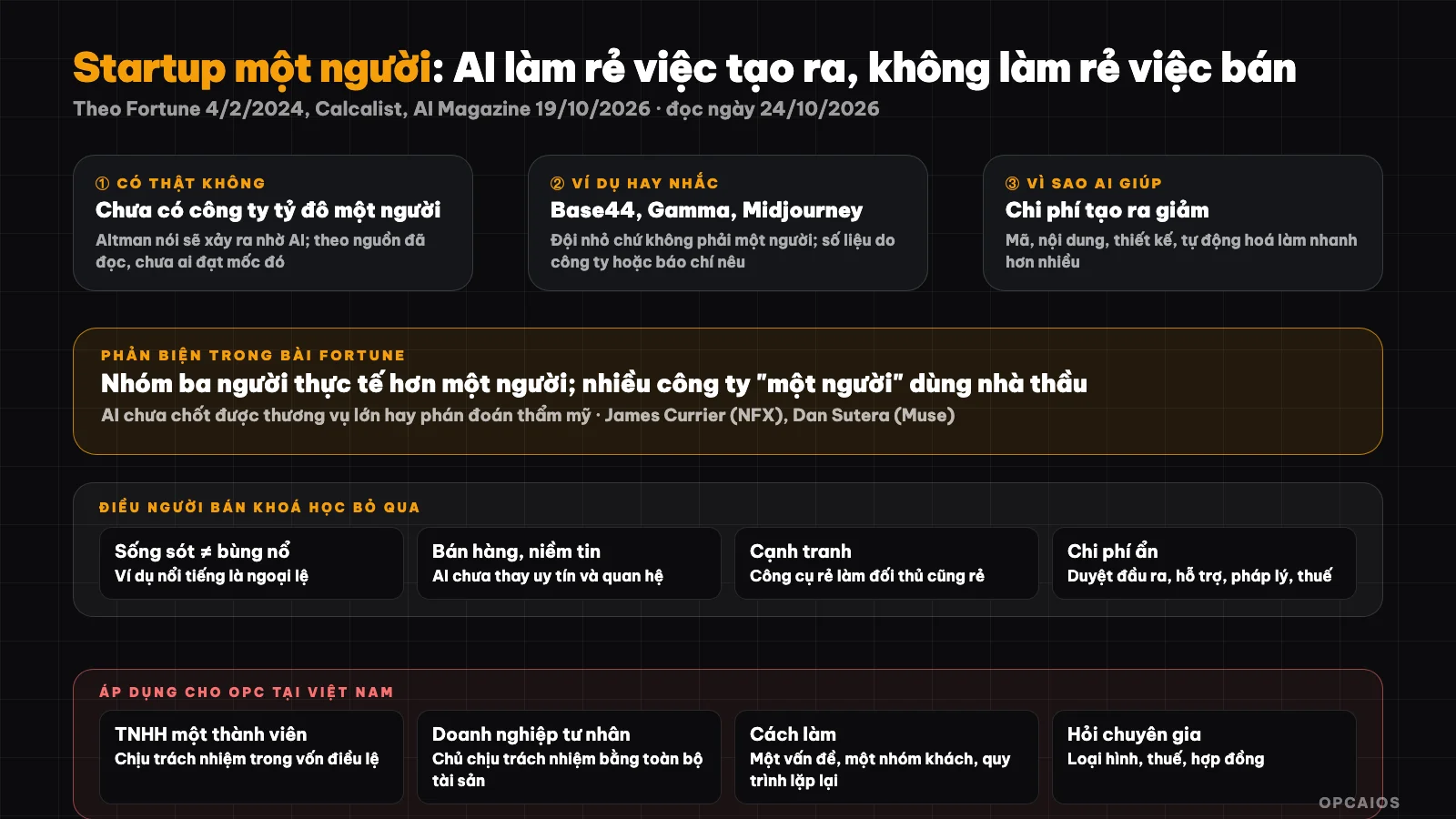
AI reduces the cost of creating products and content, but sales and trust still need humans. Diagram: OPCAIOS.
Is a "One-Person Startup" Real?
There's no evidence of a billion-dollar company with exactly one employee. Fortune records Altman's words (in an interview with Alexis Ohanian, recorded at a conference in September) that this milestone is "unimaginable without AI but will now happen"; in the same article, experts offer counterarguments: James Currier (NFX) argues that a team of three is more realistic than one because of loneliness and poor decisions; Dan Sutera (Muse) says many "one-person" companies actually rely on contractors; and AI hasn't closed large deals or made aesthetic judgments. In other words, "one person" usually means "one person plus a lot of tools and outsourcing."
Examples Often Mentioned and Points of Contention
| Example | What Was Reported | Notes |
|---|---|---|
| Base44 | Maor Shlomo built a "vibe coding" platform (see What is Vibe Code?); Wix bought it in 6/2025 for an estimated $80 million, potentially higher if revenue targets are met by 2029 | Sources differ on headcount: one says under 10 people, another says 6 to 8; "solo" is press terminology |
| Gamma | According to AI Magazine (19/10/2026), exceeded $100 million ARR with around 50 employees, and is profitable (see What is Gamma?) | Numbers disclosed by the company; 50 people is not one person |
| Midjourney | One report mentioned revenue above $200 million ARR with fewer than 40 employees | Secondary source, we haven't verified it |
Common thread: these are very small companies, not one person, and mostly software products that can be replicated at almost no cost. Bloomberg (4/2026), citing PitchBook data, suggests that unicorn companies' headcount is shrinking; we haven't read the full article because it's behind a paywall.
Why Does AI Make This More Feasible?
- Cost of producing products drops: writing code, design, and content creation are much faster with AI agents (see What is LLM? and What is Antigravity 2.0?).
- Tools that do repetitive work: automating workflows, customer care, reporting (see What is n8n?).
- Cheap infrastructure and pay-as-you-go pricing: cloud platforms, payments, email, all have free tiers or pay-per-use (see What is Vercel?, What is Cloudflare Pages?).
- Direct distribution: social media and content allow reaching customers without a large sales team.
- Task-based outsourcing: work that requires humans (accounting, legal, custom design) is bought per project.
What Course Sellers Usually Skip
- Survival is different from explosive growth: famous examples are outliers; there's no reliable data on the failure rate of one-person companies.
- Sales and trust: AI can write pitch emails but hasn't replaced reputation, relationships, and closing big deals.
- The product must address real demand: cheap tools make competitors cheaper too; advantage comes from expertise, data, and distribution channels.
- Hidden costs: time to check AI output, customer support, troubleshooting, legal, taxes.
- Concentrated risk: one person getting sick or burned out means the whole system stops.
What applies to a one-person company in Vietnam
Legally, an individual can choose between a single-member limited liability company (Article 74 of the 2020 Enterprise Law, where the owner is only liable within the scope of charter capital and has legal status) or a private enterprise (where the owner is liable with all assets and has no legal status). This is general information from legal analysis articles, not advice; ask an accountant or lawyer about taxes and the right business form. In terms of approach, the more practical direction is: pick a problem affecting a specific customer group, build a repeatable process, use AI to reduce the time for each delivery, and keep a reviewer at points with risk. See the specific roadmap at 30-day roadmap to building an OPC with AI; common mistakes at 5 mistakes that break the OPC model.
OPCAIOS's experience
OPCAIOS is built and run by one person, with a lot of work supported by AI agents: drafting articles, translations, reports, system checks. But we don't use ourselves as proof for the "million-dollar" claim: we haven't published revenue figures, and don't want to use our numbers to prove a trend. What we got from the building process is that AI helps one person work much faster at the part of creating products, but the part of picking the right customers, selling and maintaining trust is still the hardest and most time-consuming part.
Read more: The secret of one person creating millions of dollars a year without hiring any employees; Journey from Freelancer on monthly salary to OPC owner with automation.
Frequently Asked Questions
What is a one-person startup?
A one-person startup is a business founded and operated by one person who handles nearly everything, using software and AI to replace most of the work that previously required a whole team. According to Fortune (4/2/2024), Sam Altman talked about a "bet" among tech CEOs about the first year a billion-dollar company with just one person appears. However, according to sources OPCAIOS read on 10/24/2026, no company has reached this level yet. For example, Gamma was mentioned by AI Magazine (10/19/2026) as exceeding $100 million ARR with around 50 employees, meaning very small but not one person. So the phrase "one person" usually means one person plus many AI tools and task-based outsourcing. For one-person companies (OPC) in Vietnam, a more realistic goal is learning how to use AI to reduce task delegation time, not chasing billion-dollar milestones.
Does a billion-dollar company with just one person exist yet?
According to sources OPCAIOS read on 10/24/2026, no billion-dollar company with just one employee exists. The examples often mentioned are small teams, not one person. Base44, built by Maor Shlomo and acquired by Wix in June 2025 for an estimated $80 million, had varying numbers of employees reported by different sources: under 10 people or 6 to 8 people. Gamma, according to AI Magazine, exceeded $100 million ARR with around 50 employees. Midjourney was mentioned in one report as over $200 million ARR with under 40 employees, but this is unverified secondary source. Keep in mind that revenue and employee numbers disclosed by companies or the press have not been independently verified.
What work can AI replace at a company?
AI can mainly replace repetitive and drafting work: writing, basic design, summarization, answering frequently asked questions, and reporting. There are five reasons this is now more feasible: lower cost of producing a product, tools that automate repetitive work, cheap and pay-as-you-go infrastructure, direct distribution through social media, and task-based outsourcing. For example, an agent might write a draft report, while the business owner checks the data before sending it. However, according to critics quoted in Fortune's article, AI has not yet closed large deals or made aesthetic judgments. Work that requires reputation, relationships, and risk judgment still needs people.
What business type should a one-person company register as?
There are two common options for an individual, and this is general information, not legal advice. First, a single-member limited liability company (Article 74 of the 2020 Enterprise Law): the owner is only liable up to the registered capital and the company has legal personhood. Second, a private business: the owner is liable with all their assets and the business does not have legal personhood. For example, someone who wants to separate personal assets from business risk often considers the first type. These two types also differ in taxes and procedures, so ask an accountant or lawyer before registering. To learn how to apply AI to small businesses, see OPCAIOS's AI application training course.
Source: Fortune 4/2/2024 (Altman's remarks and critiques), Calcalist and Globes (Base44), AI Magazine 10/19/2026 (Gamma), search results on business law (2020 Enterprise Law), read on 10/24/2026. Revenue and employee numbers disclosed by companies or the press have not been independently verified; legal information is for reference only. Experience is OPCAIOS's.
Translated from Vietnamese with AI. Read the original.
Want to apply this in your business?
Book a free 30-minute call (Vietnam time, in English or Vietnamese).