


What is Tailscale?
Tailscale is a virtual private network platform based on the open source WireGuard protocol, connecting your devices into a private network called a tailnet, even if they're behind different routers or firewalls. According to Tailscale's documentation (read on 25/10/2026), connections within a tailnet don't require opening inbound ports or port forwarding. The pricing page on the same date lists a free Personal plan for up to 6 users. This post explains what Tailscale is, how it works, pricing, how to get started, risks, and OPCAIOS's experience.
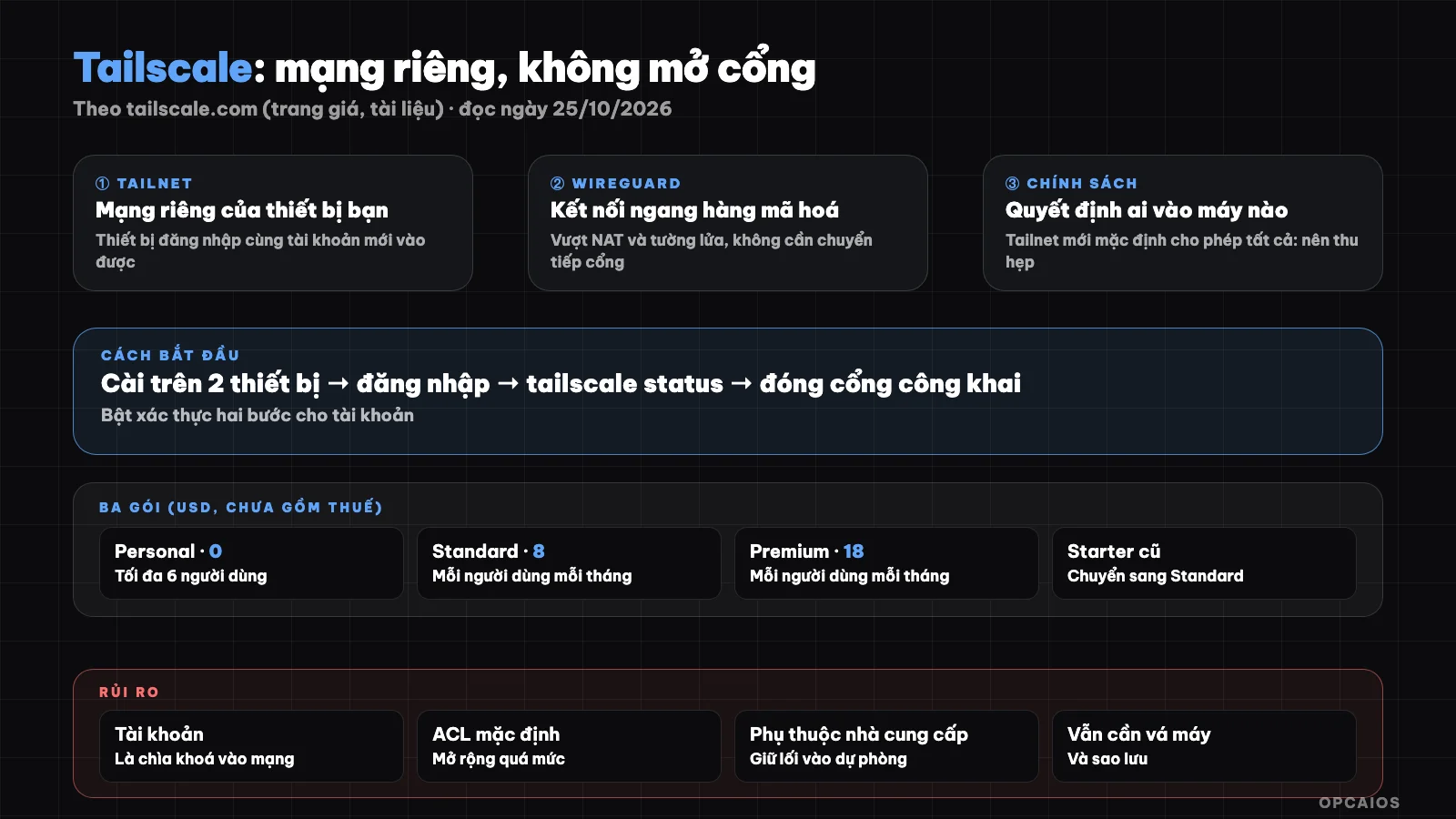
Laptops, home computers and servers connected to each other like a single LAN. Diagram: OPCAIOS.
What is Tailscale and what problem does it solve?
Tailscale helps you access remote machines (office computers, servers, NAS, AI machines) as if they're on the same internal network, without having to open ports to the Internet. The problem it solves: opening public ports for remote access increases your attack surface.
Tailscale describes itself as an identity-based connection platform ("zero trust"): devices must log in with your account to enter the tailnet. This network is peer-to-peer; when two devices authenticate with each other, they communicate using encrypted WireGuard connections.
How does Tailscale work?
Each device installs the Tailscale app, logs in with the same account, and receives a private address within the tailnet. The documentation states that Tailscale automatically traverses NAT and firewalls, so no port forwarding is needed; the detailed mechanism, including when it has to go through relay servers, isn't explained deeply in the documentation I read.
Key concepts you need to know:
- Tailnet: a private network consisting of authenticated devices.
- Exit node: a device that acts as an exit point, routing all your traffic like a traditional VPN.
- Access policy (ACL): defines who can access which machines. The documentation notes that new tailnets start with a default policy allowing everyone, so you should restrict it when you have multiple users.
- MagicDNS and subnet router: included in the product but not described on the page I read, so this post doesn't confirm details.
Tailscale pricing
According to Tailscale's pricing page read on 25/10/2026 (USD, before tax, subject to change): Personal plan free for up to 6 users; Standard plan 8 USD per user per month; Premium 18 USD per user per month. The page doesn't list the old Starter plan.
| Plan | Price | Users | Notes from pricing page |
|---|---|---|---|
| Personal | 0 | Up to 6 | Unlimited personal devices; 50 tagged resources; 1,000 ephemeral minutes/month |
| Standard | 8 USD/user/month | Unlimited | 1,000 ephemeral minutes/month |
| Premium | 18 USD/user/month | Unlimited | 10,000 ephemeral minutes/month |
The page states that old Starter plan customers will transition to Standard after the first year. I haven't read the commercial use terms of the free plan, so check the current terms before using it for business.
Getting started with Tailscale
The minimum process has four steps: create an account, install the app on at least two devices, log in with the same account, and check with the tailscale status command. Then use the address or name within the tailnet to SSH, access internal dashboards, or call APIs.
- Create an account through your chosen login provider.
- Install the app on each device (macOS, Windows, Linux, phones).
- Log in; each device appears in your machine list.
- Check:
tailscale status
- Access internal services via tailnet addresses instead of public addresses, then close the corresponding public ports on your firewall.
For servers, see also What is a VPS and security review of a one-person website.
Limitations and risks
Tailscale reduces the attack surface but isn't a silver bullet: you depend on their coordination service, your login account becomes the key, and the default policy allowing everyone may be too broad.
- Account is the weak point: enable two-factor authentication on your login account.
- Default ACL is broad: limit which devices can access which machines.
- Vendor dependency: if the coordination service goes down, new devices may not be able to connect; keep a backup access plan.
- No replacement for updates and backups: machines in your tailnet still need patching, see 3-2-1 backups.
- Version skew: I once saw the
tailscalecommand report version skew between client and daemon on OPCAIOS machines; you should update both.
Compared to other remote access methods
| Method | Advantages | Disadvantages |
|---|---|---|
| Open port + SSH/HTTP public | Simple, no third-party dependency | Constantly scanned and attacked |
| Self-hosted VPN (WireGuard/OpenVPN) | Full control | Self-configure, self-patch, self-manage keys |
| Cloudflare Tunnel | Safely expose web service without opening ports | Oriented to web services, (what is Cloudflare) |
| Tailscale | Quick setup, no open ports, centralized device management | Depends on coordination service, paid beyond free tier |
The table is a general description, not a benchmark.
OPCAIOS experience
We use Tailscale to connect a controlling Mac machine with a Windows machine running background work; on 25/10/2026 the tailscale status command on Mac showed both devices, the Windows machine in active state via relay. This way we didn't have to open the Windows machine's ports to the Internet.
Real limitation: relay means the connection isn't always direct, so latency is higher than peer-to-peer; we haven't measured it. This post also doesn't describe our ACL configuration because we haven't reviewed it before writing; if you use many devices or many people, you should review it yourself. Specific addresses and ports are not disclosed in this post.
Frequently asked questions
Is Tailscale free?
There is a free Personal plan for up to 6 users according to the pricing page read on 25/10/2026. Paid plans charge per user. Pricing may change.
Is Tailscale safer than opening ports?
Usually reduces the attack surface because ports aren't exposed to the Internet and connections are encrypted with WireGuard. Safety still depends on your account, ACL, and machine patching.
Can Tailscale replace a corporate VPN?
You can use it as a VPN via exit node, but compliance requirements of large companies need separate assessment; this post does not provide compliance advice.
Does Tailscale run on phones and Windows?
There are apps for many operating systems; on OPCAIOS machines we have used macOS and Windows. See the official documentation for the complete list.
I'm new, where should I start?
Connect two of your own devices and try accessing an internal service. If you need someone to guide you in building secure infrastructure, see AI application training service.
Source: tailscale.com/pricing and tailscale.com/kb/1151/what-is-tailscale, read on 25/10/2026; have not read commercial terms, ACL documentation, MagicDNS and subnet router. USD pricing does not include tax. Device status checked by OPCAIOS on 25/10/2026. Experience is OPCAIOS's.
Translated from Vietnamese with AI. Read the original.
Want to apply this in your business?
Book a free 30-minute call (Vietnam time, in English or Vietnamese).