


What is Tracardi?
Tracardi is an open-source Customer Data Platform (CDP) designed with an API-first and composable approach: it collects events from web, applications, webhooks and databases, combines them into a unified customer profile, then runs drag-and-drop automation workflows to segment and personalize. According to GitHub API (accessed 04/11/2026), the Tracardi/tracardi repository was created on 02/04/2021, has 658 stars, is written in Python, had its most recent code push on 22/09/2026, and the latest release is 1.1.25 (10/03/2026). The license is MIT with Commons Clause, meaning you cannot resell the software as a service. This post answers: what Tracardi can do, what infrastructure it needs to run, how the free version differs from the commercial version, and when a small company should or shouldn't use it.
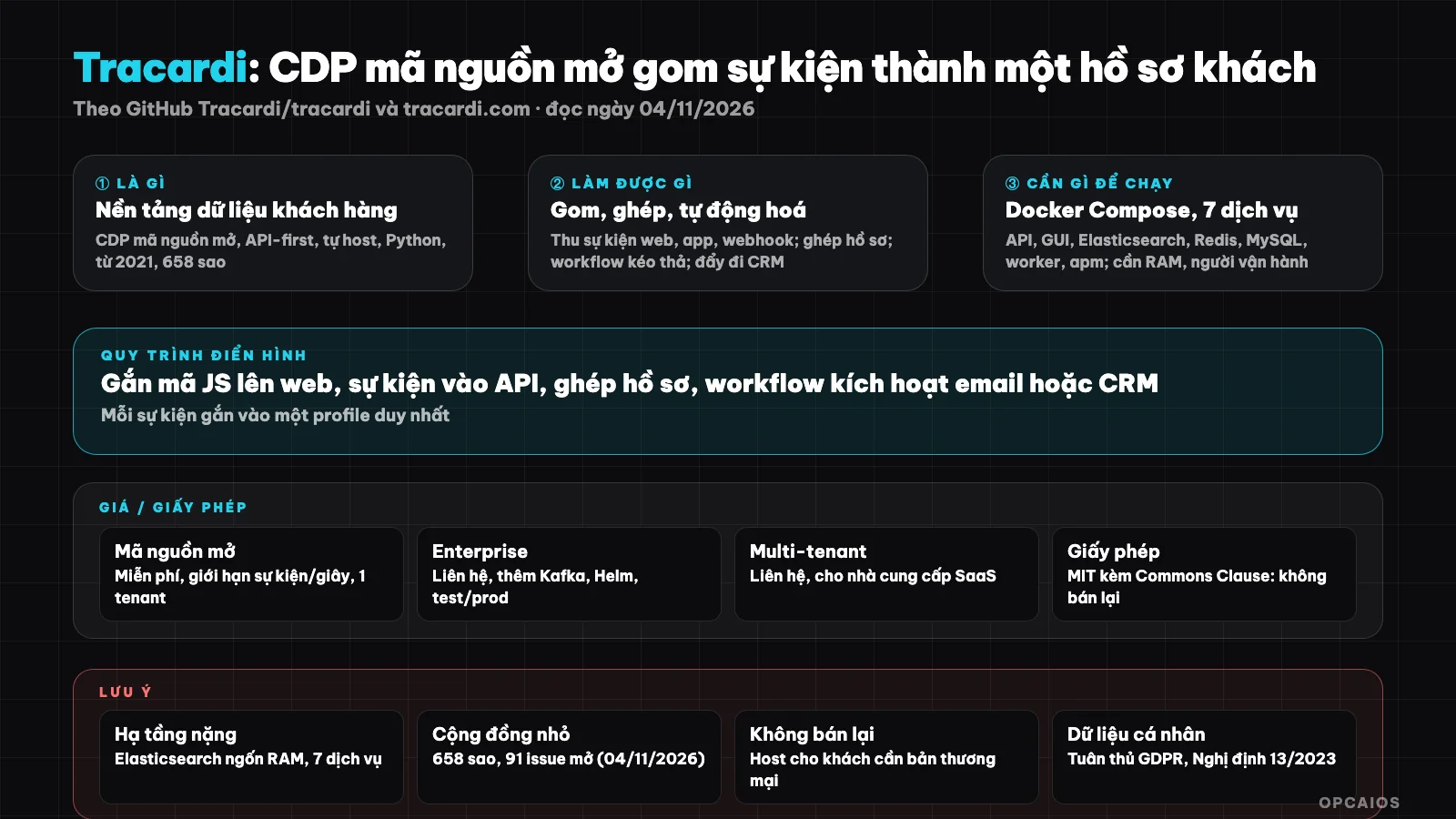
Tracardi receives events from multiple sources, merges them into profiles and pushes them to other systems. Diagram: OPCAIOS.
What is Tracardi and who created it?
Tracardi is an open-source CDP developed by the Tracardi team since 2021, positioned as a cheaper alternative to Segment or RudderStack. The tracardi.com homepage (accessed 04/11/2026) describes the product as a customer data platform that "won't drain your budget", with two versions: a free open-source and a paid commercial one.
A CDP is a system that collects every trace of a customer (which pages they view, what they click, what they buy, which channel they come from) in one place, then merges disparate records into a single profile. With Tracardi, each event sent in is attached to a profile, and that profile can be enriched, segmented, or triggered to run automation workflows. The GitHub README (accessed 04/11/2026) emphasizes three points: first, Tracardi runs on infrastructure you already have, including managed cloud services; second, data is collected and processed in real time; third, the system is headless, meaning it doesn't force you to use its interface but opens APIs for any other tools. The homepage doesn't mention the legal entity name or country behind the company, so we won't add that. If you're unclear how CDP differs from CRM, see What is CRM?.
What can Tracardi do?
Tracardi collects data, merges profiles, segments, automates and integrates. These five groups of features are described on the README and homepage (accessed 04/11/2026) as follows, rephrased in our own words:
| Feature group | What Tracardi does |
|---|---|
| Data collection | Receives events from JavaScript code embedded on web, webhooks, queues like Kafka, databases, CSV files, mobile apps and APIs |
| Profile unification | Merges records of the same person from multiple channels into one profile, automatically deduplicates |
| Data modeling | Rules to convert page data into profile attributes; segmentation by behavior |
| Automation | Drag-and-drop workflows that react to events: send messages, call APIs, update profiles |
| Personalization and integration | Micro front-end displays personalized content to customers on existing pages; acts as a central coordinator sending data to CRM, email, analytics |
The README also mentions "Tracardi bridge" to connect e-commerce stores with social networks, with reward mechanisms when customers share or comment; this is a description published by the project, we have not verified the completeness level. For extensions, developers can write their own plugins following the guide at manual.tracardi.com.
Is Tracardi free? Licensing and commercial versions
Tracardi has a free open-source version and two unlisted commercial versions. The pricing page on tracardi.com (as of 04/11/2026) shows only "Free" for the open-source version; the other two versions show "Contact Us". Prices do not include tax and may change.
| Version | Price | For | Key features |
|---|---|---|---|
| Open source | Free | Small companies, few customers | Behavior collection, profile merging, simple automation; limited events per second, single tenant, no event validation |
| Enterprise commercial | Contact Us | Large companies, lots of data | Event validation, custom profile merging, parallel processing, queue-based collection (Kafka, RabbitMQ), separate test/production environments, Helm installation on Kubernetes |
| Multi-tenant commercial | Contact Us | SaaS providers | Multiple tenants, installation and integration support |
Licensing is something to read carefully. The LICENSE.md file in the repository (as of 04/11/2026) says "MIT with Common Clause": you can use, modify, and distribute, but you cannot "sell" the software, and the definition of selling includes charging for hosting, consulting, or support where the main value comes from Tracardi itself. GitHub's API reads this license as NOASSERTION, meaning it is not a standard open license by OSI definition. For companies using it internally for their customers, there is no issue; for agencies wanting to sell "CDP as a service" built on Tracardi, a commercial license is needed. This is how we understand the text, not legal advice.
Hidden costs of the free version lie in infrastructure. The docker-compose file in the tracardi-api repository (as of 04/11/2026) pulls seven services: tracardi-api, tracardi-gui, Elasticsearch 7.13.2, Redis, MySQL 8.0, update-worker, and apm. The documentation also mentions Apache Pulsar for some configurations. Elasticsearch is known for consuming RAM, so a small VPS with 1 to 2 GB is usually not enough; the documentation has a FAQ section about minimum RAM but we have not been able to read the answer, so we cannot give a specific number.
How do I install Tracardi using Docker?
Tracardi installs via Docker Compose, requiring Docker and docker-compose on your machine. The README (as of 04/11/2026) outlines the following steps; we have not run it ourselves, so we are quoting the documentation exactly:
- First, install Docker and docker-compose. If you are new to this, read What is Docker?.
- Next, clone the API repository to your machine:
git clone https://github.com/Tracardi/tracardi-api.git:1.1.x
Note: the :1.1.x suffix is not standard git clone syntax; if the command throws an error, clone the repository and then switch to the 1.1.x branch the usual way. We are quoting the exact command so you can compare it with the README.
3. Enter the directory and start:
cd tracardi-api
docker-compose up
- Finally, open the interface on port 8787 on your local machine to complete setup; the API documentation is at port 8686 at the
/docspath (the README specifies these ports).
After installation, you create an "event source", attach a JavaScript snippet to your website, then build your first workflow. Other installation methods (Kubernetes with Helm for commercial versions, installing each service separately—Elasticsearch, MySQL, Redis) are documented in manual.tracardi.com.
Limits, risks, and legal notes
The biggest risk for small companies is operating seven services just to do the work of a small CRM that could be simpler. Specifically, four areas to consider, based on what we read on 04/11/2026:
- Infrastructure complexity. Elasticsearch, MySQL, Redis, and possibly Pulsar need backups, upgrades, and monitoring. The repository has 91 open issues (GitHub API) and the documentation still shows copyright dates from 2020 to 2021, so prepare for self-troubleshooting.
- Small community. 658 stars after more than five years is modest compared to other open-source CDPs; questions on Slack or GitHub may wait a long time for answers.
- Commons Clause license. You cannot resell services built on Tracardi; any business model like "I host it for my customer" needs a commercial license.
- Personal data. A CDP is fundamentally a place where individual behavior is collected. Even running on your own server, you control the data and must comply with GDPR (if you have EU customers) and Vietnam's Decree 13/2023 on personal data protection: you need a legal basis to collect, you must give customers deletion rights, and you cannot send data to undeclared third parties. We have not cross-checked each clause against the original documents; this is not legal advice.
On security, the admin interface and API should sit behind a firewall or authenticated proxy; do not expose Elasticsearch to the Internet.
Tracardi versus other options
Tracardi is suitable when you need a CDP with automated workflows and are comfortable with heavy self-hosting; other tools excel in different areas. The table below is a general overview, not a measurement:
| Tool | Strengths | Differences from Tracardi |
|---|---|---|
| Tracardi | CDP with drag-and-drop workflows, unified profiles, on-premise personalization | Heavy infrastructure, Commons Clause license |
| RudderStack (open source) | Segment-compatible event pipeline, pushes to data warehouse | Leans toward data transport rather than profiles and automation; see What is RudderStack? |
| Segment (paid service) | Many pre-built integrations, no self-operation needed | Pricing by volume, data held by third party |
| PostHog | Product analytics, session replay, feature flags | Not a multi-source profile-merging CDP; see What is PostHog? |
| CRM + GA4 | Enough for most small companies, low cost | No unified behavior profiles in real time; see What is GA4? |
When should you use Tracardi?
Use Tracardi when you have multiple separate customer data sources and need to own your data on your own servers. Scenario table:
| Scenario | Recommendation |
|---|---|
| Solo person, few hundred customers, selling through Zalo and website | Not yet needed; simple CRM and GA4 are enough |
| Online store with app, web, email, needs one unified profile and automated flows | Try the open source version on your own server, start with one source |
| Agency wanting to sell CDP to clients | Need commercial version because of Commons Clause |
| Enterprise with requirement that data never leaves private infrastructure | Reasonable candidate, weigh the cost of running Elasticsearch |
Example (hypothetical): a cosmetics shop has a website and app, wants to automatically send an email reminder with a discount code when a customer views a product three times without buying. With Tracardi, the shop puts tracking code on web, app sends events via API, workflow counts "view product" events on the profile and calls the email service when conditions are met; see also What is email marketing?.
OPCAIOS's experience
We added Tracardi to our Repo list in the Tools section of opcaios.org after reading the README and checking that the repository is still maintained; we have not yet run a trial, so this section states the criteria we use to weigh it, not an evaluation after use. Four criteria: first, the repository is active (last code push September 2026, version 1.1.25 March 2026); next, the Commons Clause license does not prevent internal use but does prevent resale; third, hidden costs are RAM and labor for running Elasticsearch, MySQL, Redis; finally, can Tracardi replace our custom in-house CRM. The current answer is no: our CRM on our website already brings together leads, orders, and email sequences in one place, and at one-person scale, a separate CDP is more work than less. We will revisit when we have more than two data sources needing profile merging.
Read more: What is CRM?, What is Docker?, What is VPS?, Tools section.
Frequently Asked Questions
Is Tracardi free?
There is a free open-source version according to tracardi.com pricing page as of 04/11/2026. This version limits the number of events per second, has one tenant, and does not include event validation. The two commercial versions (Enterprise and Multi-tenant) do not list prices and require contact. The real cost of the free version is the servers: Elasticsearch, MySQL, Redis running simultaneously need RAM and an operator.
What infrastructure does Tracardi need?
According to the docker-compose file in the tracardi-api repository (read on 04/11/2026), a standard installation includes tracardi-api, tracardi-gui, Elasticsearch 7.13.2, Redis, MySQL 8.0, update-worker and apm. The documentation also mentions Apache Pulsar. You need Docker and docker-compose; the commercial version adds installation via Helm on Kubernetes. The documentation does not specify minimum RAM on the pages we read.
How is Tracardi different from a CRM?
A CRM stores customer information and transaction history for sales teams to work with; a CDP like Tracardi stores streams of behavioral events in real time from multiple sources, combines them into profiles and triggers automations. Typically a CDP comes first and pushes data into a CRM. Small businesses with few data sources often find a CRM sufficient.
Can I use Tracardi to sell services to my customers?
According to LICENSE.md (read on 04/11/2026), the MIT license with Commons Clause does not permit "selling" the software, and selling includes charging for hosting, support or consulting where the primary value comes from Tracardi. Using it for your own customers is normal; selling Tracardi as a service to third parties requires a commercial license. This is not legal advice.
Can someone without coding knowledge use Tracardi?
The workflow building part is drag-and-drop, segmentation and profile viewing happen on a web interface, so marketing people can use it once the system is set up. However, installation, connecting data sources, writing plugins and operating Elasticsearch require technical people or a supervised AI agent. If you want to do these things yourself with an AI assistant, see OPCAIOS's AI application training program.
Source: GitHub Tracardi/tracardi and Tracardi/tracardi-api (README, LICENSE.md, docker-compose, API, read on 04/11/2026), tracardi.com and pricing page, manual.tracardi.com (introduction and installation pages); not read/not verified: minimum RAM requirements, other details about commercial versions in FAQ documentation (page returns 404), customer testimonials on the homepage; star count and pricing may change. Experience is from OPCAIOS.
Translated from Vietnamese with AI. Read the original.
Want to apply this in your business?
Book a free 30-minute call (Vietnam time, in English or Vietnamese).